Volvo RWD Forum

INDEX FOR 1/2026(CURRENT) INDEX FOR 11/2005

[<<]  [>>]


THREADED THREADED EXPANDED FLAT PRINT ALL
MESSAGES IN THIS THREAD


  REPLY TO THIS MESSAGE Replies to this message will be emailed.    PRINT   SAVE 

Brake bleed sequence

I am bleeding the brakes and my car is 1990 240 DL SW without ABS.
If I see Haynes manual it has a diagram showing that but that is more difficult method if you do not have the facility of lift
As it says LR RF LF RR RF LF.
The 700/900 FAQ say that for such a car use LR RR RF LF .
Moreover the front calipers have three bleed screws. Two on inner side and one on outer side. I have already bled the LR.
What is correct procedure.I have replaced the LR caliper and rear compartment in the fluid reservoir had gone empty as I did not secure the brake pedal.
Regards
Gopesh


  REPLY TO THIS MESSAGE Replies to this message will be emailed.    PRINT   SAVE 

Brake bleed sequence

IMO, a complete system bleeding without a lift requires the car to be on 4 jackstands with all 4 wheels removed.

I think you have over-simplified the Haynes sequence (more below). The 700/900 FAQ does not apply to 200 series brakes.

The MC must be filled and kept full throughout the bleeding process. If either reservoir is let go empty, you have to start over on that circuit (explained below).

Before you start bleeding, go around and make sure you can open each bleeder. A frozen or broken bleeder half-way thru the job takes a lot of the fun out of it. While doing this bleeder check, you can also expel much of the old fluid in the caliper by pushing the pads back with bleeder open and piped to your drain container.

Because the 200's have two separate hydraulic systems, the recommended sequence (below) bleeds each system separately.

On the front calipers, the upper two cylinders form an inverted "U", with a single bleeder at the highest point. The lower two cylinders form an upright "U", with bleeders at the two high points. The upper and lower cylinders are each in a separate hydraulic system.
(See illustrations in Bentley, p 500-1 and Haynes, p 9-13)

Either system can be done first:

System A:
1) Left rear
2) Left front - Upper piston chambers (single bleeder, top)
3) Right front - Upper piston chambers (single bleeder, top)

System B:
4) Right rear
5) Right front - Lower piston chambers (inner and outer bleeders, either first)
6) Left front - Lower piston chambers (inner and outer bleeders, either first)


--
Bruce Young
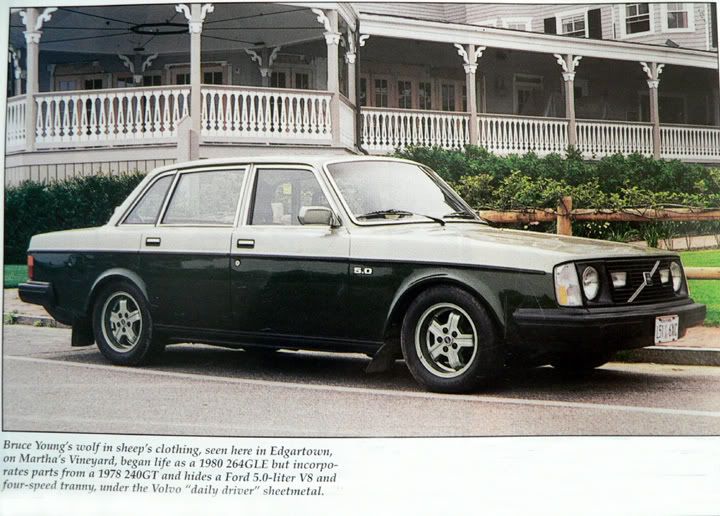
'93 940-NA (current), 240s (one V8), 140s, 122s, since '63.


  REPLY TO THIS MESSAGE Replies to this message will be emailed.    PRINT   SAVE 

Brake bleed sequence

Thanks for this clarification and good interpretation.Haynes manual does not write about what is lower or upper bleeders but with your text haynes diagram becomes clear. I got confused with the 700 FAQ as may be I wanted it to be that because of the ease and simplicity.
Regards
Gopesh


  REPLY TO THIS MESSAGE Replies to this message will be emailed.    PRINT   SAVE 

Brake bleed sequence

I forgot to mention quantity of fluid. Much is often wasted due to not knowing when to stop bleeding at a given wheel. This waste can be avoided by using Ate Super Blue Racing Fluid, if available in your area. Blue fluid at the bleeder is new fluid.

It costs about $10 per liter but exceeds Volvo requirements, and one liter will be more than enough — unless you are using a pressure bleeder with a 2 liter, opaque reservoir, where there is danger of running low and introducing air, when only 1 liter of fluid gets low.

That means you'd need 2 liters to be safe, which would negate the potential saving to be gained by the color change at the bleeder. However, I get by on less than 1 liter because I simply pressurize the MC with a small hand air pump. I do have to keep watch on the MC fluid level, and replenish 2 or 3 times on a complete sequence, but I consider that a small inconvenience to pay for the efficient use of fluid and having no clean up afterward.
--
Bruce Young
'93 940-NA (current), 240s (one V8), 140s, 122s, since '63.


  REPLY TO THIS MESSAGE Replies to this message will be emailed.    PRINT   SAVE 

Brake bleed sequence

That is true as you will not imagine that so far for caliper replacement and finally bleeding of one wheel I am already down by 2 liters.
Some fluid was also wasted as while replacing caliper I had opened the brake line and let it hang loose.Then that brake line was loose for some time.
I bought Volvoline (label says exceeds dot 3 and 4) . I have got two more bottles (liter each). I have formed a simple system where I have installed a tire pressure value in the spare fluid reservoir cap. I attach cycle pump to that.Overall it will cost more that costlier fluids.
Rookie mistakes.
Thanks a lot for guiding.
regards
Gopesh


<< < > >>


©Jarrod Stenberg 1997-2022. All material except where indicated.


All participants agree to these terms.

Brickboard.com is not affiliated with nor sponsored by AB Volvo, Volvo Car Corporation, Volvo Cars of North America, Inc. or Ford Motor Company. Brickboard.com is a Volvo owner/enthusiast site, similar to a club, and does not intend to pose as an official Volvo site. The official Volvo site can be found here.