|
|
|
'89 245 EZK ign LH 2.4FI 252,000 mi. Failed emissions w too high HC (1.77gpm) and NOx (5.44 gpm). CO is 1.44 gpm -low and good/pass.
So I put a can of FI cleaner into gas tank, new NGK plugs, new air filter, new oil filter & oil, new timing belt, new O2 sensor, switched FPR valve, swapped in a good compatible AMM, flushed cooling system & put in new 50/50 mix. Retested at 254,000 miles - HC now low enough (0.58 gpm) but NOx slightly higher (6.42 gpm) and still failing. OBD says problems w injectors...
So I drive the car w expired inspection and at 255,000 mi I work on injectors (first time for me for removing/servicing injectors). Couldn't locate a shop that services or rebuilds gas fuel injectors, only diesel...
I have battery voltage at injector hot leads. I removed and cleaned/flushed injectors w aerosol cleaner. All 4 have approx 16 Ohms at elec contacts. All 4 had flow through when I pushed the FI down to depress the tip/needle. I flushed and now they are cleaner. I put new sealrings and endcaps on them w a light coating of vasoline. I've been using 93 octane gas. I re-installed and started engine. It seems smoother. I go for another emissions inspection on a diff machine Feb 25, 2009:
HC 0.39 pass, CO 5.45 pass, NOx 5.02 fail (2.00 gpm is Test Limit for NOx).
I run OBD at home and get Fault Codes 2-2-1, 2-3-1, & 1-1-3. "Check Engine" light is on, so is "Service" light.
NOW will I see the light and the consequences of my Cheapness? There is a big hole in exhaust pipe/header where bracket attaches it to transmission. I've patched it with furnace cement and fiberglass cloth, but it steadily blows that away, leaking more and more exhaust out before it reaches the O2 sensor just beyond, and then comes the Cat. Is the "thinness" of the exhaust effecting the O2 sensor reading, which is then signalling for more fuel to be injected, thus giving me "extremely rich or extremely lean air/fuel mixture at cruise" 2-2-1 ? If so, I'll buy a new exh pipe for c. $140. If not, then I may need 4 new injectors at $120 each. Yikes!
Another Inspector told me to drive down to the Bronx and buy a sticker for $200, but I don't want to do that.
I figure I'm close to the correct fix. Hoping BB experts will guide me to the finish. Thanks in advance.
Steve
|
|
|
|
|
My 245 has 270000 miles on it running good,failed the Pa emissions.CO LIMIT 01.10-TEST 4.07 FAIL,HC LIMIT 0275 TEST 494 FAIL,NO LIMIT 03600 TEST 1009 PASS.Humm after this I cleaned all the junk of the throttle body,it was nasty.Replaced spark plugs,air filter,change oil,replace distributor cap and rotor.Pulled out air valve and cleaned it also,allso cleaned the AMM with amm cleaner from CFC,good stuff.2th test CO LIMIT 1.10-TEST 0.32 PASS,HC LIMIT 275 TEST 175 PASS,NO LIMIT 3600 TEST 3505 PASS. Hummm I pass this time ,the NO came up some?Allso replaced back brakes cost in parts about 45.00 bucks,also I pull the small hose off the manifold,that came from the flame trap .Got an can of Berryman's B-12 Chemtool ,Cost about 4 bucks,.I put the hose in the can and ran up the RPMs,this will clean off the top valves,and pistons and inside of the intank manifold.
|
|
|
|
|
High NOx is a product of high combustion temps in the cylinders. NOx forms under high pressure and heat, of which one component, pressure, is missing in the exhaust system. Nice to have a quiet exhaust but IMOP, do not spend money on it at this time.
With the 2xx, codes, the FI system is running lean, which would increase combustion temps in the cylinders. The other 113 code for faulty injectors was proven wrong when you verified the 16 ohms reading.
So why did the system set a faulty code when outside verification indicated nothing wrong? The diagnostic unit has internal values against which it compares real time measurements. If it "measures" the total resistance of the injectors lower than 16 ohms by some threshold value, it sets the code. The process is similar for all other codes.
It compares the internal values via system grounds. Those things on the intake manifold which all the Volvo Service manuals in BOLD letters say to clean and retighten before further diagnostics is undertaken.
Taking the grounds one step further. If the grounds are corroded and not conducting well, resistance increases, which effectively changes the value of the injector and causes the injector to not react to the grounding pulses of the ECU firing the injectors, in this case leaning out the mixture?, setting the other codes since the O2 sensor eventually would be unable to compensate for the lack of fuel.
Since the siganl eventually needs to get to the battery, clean all negative battery to engine block connections as well.
Other causes of lean conditions include air leaks in the intake after the AMM. A thorough check of all hoses and removal and flexure of the AMM to intake hose is in order. The AMM to intake hose forms cracks in the bottom of the bellows or wears through when it rubs on the fender so close exam is needed.
Another not so obvious air leak is the vacuum chamber of the power brake unit. A quick test is while the engine is running, clamp the hose off for about ten seconds then release. Engine should not stumble or react. Or if brake peddle is hard to push after ten minutes of sitting with engine off, the diaphram is leaking.
Also look at the charcoal cannister air connections from below up under the left front fender.
And last but not least, the ECU itself which may be at fault. I have heard but not experienced a 561 ECU that fails. Since an initial HC reading was high, (a possible condition of actually not having an engine at full operating temp prior to testing*) a bad ECU increase with that condition present.
*When waiting for emmisions testing, that is the only time I recommend leaving the engine running when waiting for a long time. Time the engine to have been running for at least ten minutes before testing.
Another cause of lean is faulty intake pump either not running or not having the hose between, but this is present only when the tank is below a certain level. Best to have a full tank for the test. A cheap "fix" of this possibility since you will use the gas anyway.
Good luck,
Duane
|
|

|
|
Hi Duane,
It is a widely propagated myth the LH2.4 ECU "measures injector resistance". The ECU has no circuitry whatever to know the injectors are even electrically present and accounted for, but gets all its info from the lambda sensor. The 113 code, and its "fault in injectors" tag, is derived from the computer's inability to vary the injector duration into a range that results in the expected mixture reported by the oxygen sensor.
Any exhaust leak prior to the sensor will most definitely affect this.
I hate doing this, but I take some comfort in having seen you set the record straight on our Laycock OD mythology.
--
Art Benstein near Baltimore
My father said there are two kinds of people in the world: givers and takers.
The takers may eat better, but the givers sleep better.
|
|
|
|
|
Not to cause problems: But..
Since (quoted from Bosch)
--
The engine-management ECU is required to use OBD on-board diagnostic functions to monitor all of the systems and components within the vehicle whose failure could lead to substantial increases in pollutant emissions. An error is present once defined diagnostic thresholds (limits) are exceeded.
---
And also from Bosch
---
One of the OBD requirements stipulates monitoring for all electrical wiring leading to the control unit....This means that “comprehensive components” are monitored for signal plausibility ...as well as signs of electrical failure...Simple operational checks (black and white tests) only assess the basic operational status of the system or component... etc.
----
Is it not simpler to check resistance of the injectors rather than derive how they are functioning later since OBD requirements mandate verifying the wires are monitored?
Granted in OBDII systems, more complex monitoring was required but OBDII does not apply to the LH2.4 system.
I do not have the full book from Bosch explaining how their systems function, but from what I have read and dervied talking with a local Bosch service technician, it would seem rather easy to compare resistance to a known value ( black and white) rather than derive a component failure from other data.
Granted in the OBDII requirements, the ability to compensate for component degredation was mandated which required more complex circuitry and logic derivation, the derivation of a specific fault would be more readily available through the system.
Duane
|
|
|
|
|
Hi Duane,
No problems caused, however it probably has Steve's eyes glazing over. This is a discussion board after all.
I have no doubt Bosch could have measured injector current as a feedback item in later designs, especially those using series resistors and fancy pulse modulation for peak hold. My point is they did not do it in LH2.4, or any injection scheme used in a 240. Steve's working on a 240 and his question is posted on the 200 forum.
Someday I'll own something modern enough to have OBD2. Then I suppose I'll pursue that knowledge. It will be fun, just as tearing apart these older ones has been.
--
Art Benstein near Baltimore
By the time a man is wise enough to watch his step, he's too old to go anywhere.
|
|
|
|
|
Art,
Now you'e got me more curious than I have been in a long time.:>)
There's an 89 with right front damage into the ECU area that probably killed the ECU in the salvage yard.
Actually got my left mirror to upgrade the 85's to something that is not knocked out of kilter when someone walks by them.
I don't know if I'll learn anything but will have some fun looking at how the circuits are put together since the Bosch books do not tell how they do it.
The next thing someone will smell burning is my brain as it gets fried trying to back engineer the circuits.
I've got to know how they do it.
Duane
|
|
|
|
|
There's a bright fellow, name of Fred perhaps, maybe in Gothenburg, who must know LH2.4 well enough to write his own fuel maps for the turbo version used in 7/9 cars, or anyone who's dropped a b230ft into a 240. You can find him over on TB. All I have done with the various 240 LH ecus is trace their input and output circuits so I know more about how they can interact with what they are connected to. The output driving the injectors on the 561, 563, 933, 951 models is a simple NPN bipolar transistor open collector with an RC snubber and back-emf diode.
The brains are on the eprom of course. I'll leave disassembling that to the performance chippers. I just want to know how to fix them, and how to tell when they're broke.
--
Art Benstein near Baltimore
Youth would be an ideal state if it came a little later in life. - Herbert Henry Asquith
|
|
|
|
|
Art,
Thanks for your concern, and for keeping me and others on track here to the simplest and most direct diagnosis and fix.
I'm posting next to my emission test today.
Steve
|
|
|
|
|
Hi Steve,
The cat won't fix the 113, and I don't think you can ignore that one - it sets the Check Engine light, and that alone ought to get your car failed. A new cat might bring the NOx reading down some, but I think you still have an issue to solve at the motor.
Reassembled all, reset OBD codes, ran engine for 30 mins.
Can you walk me through how you reset the OBD codes?
--
Art Benstein near Baltimore
|
|
|
|
|
Art,
Sorry for dropping the conversation. My eyes and brain glazed over with TMI.
Re your Q to me - More accurately, I didn't reset the OBD codes, I erased the held faults by holding down the button for 5+ seconds two times. It seemed the blinking was not as Bentley described it should be to erase, so I did it again. Later I pulled out the 25 amp fuse on the fender wall, then reinstalled it.
Plus you are correct about the Cat not fixing the 113 nor the high NOx. The inspector insisted that my existing Cat was bad, so I bought and installed a new one & new gasket. Now, both exhaust header pipe and Cat are new with new gaskets. O2 sensor threads in to the front end of Cat. Retested, CO was down to 0, but NOx was slightly higher than prev test.
So now I will more diligently test for vacuum leaks, incl hoses, intake manifold gasket, throttle sw & body for clean & proper action. I'll look at Duane's list again- I had already checked and cleaned the accordian hose from the AMM. Duane, your explanation of the lean mix causing running hot was good for me to understand the creation (source) of the NOx. (Now I understand better why my Stihl chainsaw manuals caution not to adjust the carbs too lean under load.) A different mechanic had told me high NOx was caused by antifreeze leaking into combustion thru a bad head gasket.
I'm worried about busting nuts or studs if I find a leak and have to change the intake manifold gasket.
I'll have more to report by midweek. Any more advice will be appreciated by me and maybe some others reading this thread.
Steve
|
|
|
|
|
Hi Steve,
I admit my (our) methods for resolving high NOx are nothing but educated guesswork. The education part is knowing what contributes to NOx (high combustion temps for one thing) and the guesswork is going down through the list of likely suspects, sometimes one at a time from most to least likely. The coolant being added to combustion (as a cause) is a new one on me.
Even with a gas analyzer and a shop full of diagnostic equipment, emissions are not always put right on the first try.
My experience would have had it fixed with the exhaust leaks. Pulling the fuse resets the OBD codes and the adaptive memory in the computer, while executing the button code reset only clears the OBD codes. And driving for 20 minutes, at all speeds, helps it to re-adapt if it needs to, not idling in the driveway.
You won't likely discover something that will blame the intake gasket. The only test I know that would is forcing smoke in - none of this propane, carb cleaner, or even my stethoscope is effective for me except in the grossest of leaks.
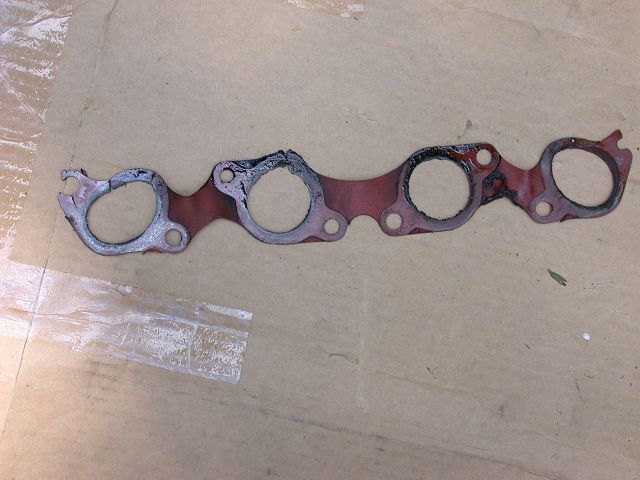
Just change it if it hasn't been done lately. No studs or nuts are going to break on that side of the motor - they are really easy. The worst you'll do is drop one of the nuts and spend time looking for it. No need to disconnect fuel. No coolant need be drained. Just 8 nuts and the one bolt at the support bracket. No gasket sealer to deal with (unless someone was there before you). In my opinion, this is as easy as changing the injector seals, which you've already done.
After pulling the fuse, are you still setting 113 codes? At least you may be able to gauge the effectiveness of your fixes by the OBD indications, instead of the expensive re-tests each time.
--
Art Benstein near Baltimore
What's the use of happiness? It can't buy you money. - Henny Youngman
|
|
|
|
|
cut a can length wise&then wrap that around the hole&using muffler patch tighten it w/2 -3" steel clamps to secure it..that should work
|
|
|
|
|
kb somerdale ,nj cleans the fuel injectors really good.$15 ea.runs reall smoooth&accelerates like a vette.
|
|
|
|
|
Check your plugs carefully to see if any look like they are very lean, or others are very rich. Also get a reading of the O2 sensor. You should get a lean indication.
Good chance it is the intake gasket, especially if you can see variation among the plugs. Gasket it cheap, $5.
--
84 242Ti IPD bars&springs, 89 745 16v M46 IPD bars, 89 744 16v M46 IPD bars, 90 745 AW70, 91 245SE AW70 IPD bars, 93 245 CLassic M47
|
|
|
|
|
Thanks for this advice. This afternoon I bought an exhaust header pipe and gaskets for both ends of it. Very difficult to separate old pipe from the Cat, but it's done. I'll finish installing it tomorrow and then recheck plugs, intake gasket, vac hoses and OBD etc.
Steve
|
|
|
|
|
I installed the new header pipe w new gaskets at both ends. I gently vacuum cleaned front open end of Cat. There were some crumbles of furnace cement pipepatch. Mesh grid of Cat was intact, unclogged, fairly clean. Reassembled all, reset OBD codes, ran engine for 30 mins. "Service" and "Check Engine" lights stay off. OBD reads 1-1-1.
I take car to same E inspection station for retest. Inspector tells me he told the other guy that car needs a Cat to pass and if it fails I have to pay $27 again.. I told him I replaced holey, leaking exh hdr w a new one - shouldn't be running lean any more - yes, retest.
New results:
HC 0.22 gpm passes; CO 0.64 gpm passes; NOx 4.52 gpm (down from 5.02) but still failing - NOx test limit is 2.00 gpm
Inspector says get a Cat. I drive 3 miles home, shut off engine, then run OBD test. Results: 2-3-1, 1-1-3, 2-3-1. "compensating for over rich or over lean fuel mixture at cruise speed". Thanks to advice rcvd here I'm disregardig the
1-1-3 code.
Counter man at Mt Kisco Truck & Auto Parts says he had similar problems, only too high NOx and only fixed when he finally sprang for and installed a new Cat.
I ordered CAT from FCP and a sew other things for $150+ to get free UPS shipping. Should have here Wed or Th. I ordered intake manifold gasket but they don't have nuts for the studs. Volvo parts? Get studs too? I want to be prepared.
Any opinions and advice for me to persue in the meantime? Thanks.
Steve
|
|
|
|
|
Hi Steve,
The reason you can't find anyone to clean gas injectors is they wouldn't have any business.* The 113 "injector" diagnosis has misled many of us. The code is really saying the computer ran out of ability to compensate for what could be a leaking or inoperative injector - or any other reason the oxygen sensor can't be made to see the correct mixture regardless of how long the pulse is to the injectors.
Don't buy injectors!!
Do fix any exhaust leaks. Get a solid head pipe. Do make sure your fuel pressure is OK and the regulator diaphragm is not leaking. Do suspect intake leaks, especially if you've not had your intake manifold gasket replaced in the last 1 or 2 hundred thousand miles. It is good that you've go new injector o-rings.
And as Bubba says, if you've still got the airbox functioning with a heated air duct from the exhaust manifold, fix it so the air is not heated all the time, and the NOx reading will be reduced.
Reset your computer (remove the 25A blade fuse for a moment) and run 10 miles or so, confirming a 111, before taking it for the test.
* I didn't mean to say no one does this - you can certainly mail them to race-oriented shops, but as a routine maintenance/repair, there's no demand.
--
Art Benstein near Baltimore
Some mistakes are too much fun to only make once.
|
|
|
|
|
Your logic makes sense, the O2 sensor might be giving a bogus reading. I don't think you are running rich though, you could expect significantly higher HC and CO readings if you were. I once had the very same symptoms on my '87 240; I spent a small fortune replacing all kinds of parts, not to mention more than $150 on all those failed inspections. Finally, after much stress, the culprit turned out to be a $5 airbox thermostat.
|
|
|
|
|
Steve,
I don't really have a good understanding of these systems, but I have been led to believe that an exhaust leak before the O2 sensor will screw things up.
Also, if your exhaust pipe is sound and just has a hole torn in it from the bracket, it may be worth having it welded. Maybe it could be done in place, or maybe you would have to take it off and take it to a welder. For that matter, $140 doesn't miss much of buying the welding equipment and doing it yourself.
Charley
|
|

|
|
Good morning Steve,
As Kentucky said, high NOx indicates an overly lean mixture leaving the tailpipe. An exhaust leak will pull air into the pipe. You must find and repair all exhaust leaks before you can move forward. There is no reason to retest until you do.
The title of your original post says ...ODB indicates injectors.... OBD cannot indicate problems with the injectors. The only thing the ECU knows is that it has responded to the O2 sensor according to the embedded mapping and the O2 sensor is still indicating a problem with the mixture. We do not know whether the mix is lean or rich; only that the O2 sensor is still not satisfied. However, the tailpipe sniffer can tell the difference; you have NOx in the exhaust -- a lean mix.
Get the exhaust leak(s) fixed, clear the code and drive the car for a day or two to see if the codes return before you take it to be tested again.
--
Mr. Shannon DeWolfe -- I've taken to using mister because my name misleads folks on the WWW. I am a 53 year old fat man. ;-)
|
|
|
|
|


