|
|
|
I've spent a good half day messing with my 68 145, dual SU carbs. After a 30 minute freeway drive, I got off, and noticed that the car was idling about 1600 RPM, and it would not go down no matter how long I gave it. I pulled off and began messing with everything. Blocking off either the PCV or the brake booster vacuum hoses does not alter the high idle. I messed with the mixture, idle, and plugging the vacuum hoses one at a time. Nothing seemed to fix it. At one point, with the mixture back to where I balanced it before (11 flats down), I totally unscrewed the idle screws, without changing the high idle at all. FYI, the SU's are totally rebuilt, and are totally functional.
I've tried to cover all bases. I've made sure the choke set screws are correct, and that the jets are all the way up when the choke cables are retracted. I've triple checked that the throttle linkage is not sticking and keeping the throttle plates slightly open. They definitely aren't. I've been up and down the mixture scale, and while I can kill it on the rich and lean ends, I've got it dialed in at a reasonable place, 11 flats down. High idle still persists.
So I began messing with the timing. At 1600 RPM idle it was about 21 deg, which seemed just about right. However, when I tried to adjust it, I couldn't get it to stick. What I mean is, when I would reduce the advance a few degrees, it would drift by itself all the way down to 0 deg and almost kill the engine. Then, when I tried to compensate and bring it back up a little bit, it would drift all the way back to 21 deg or so. It was like it was impossible to keep the car at any timing advance between 0 and 21 deg. I'm not sure if this is normal at 1600 RPM or not.
I'm pretty convinced I've eliminated everything else. I've pulled apart the distributor and everything looked ok. The points were clean, the spring on the points arm seemed to operate the arm just fine. All the contacts on the rotor and distributor head were good as well.
I have a hairline crack in my intake, but I'm pretty sure it's been there a while, and it seems pretty benign. I don't feel like it could be introducing enough air to make the idle this high. Also considering I know its been there in the past, without the high idle problem.
Anyone have any ideas?
|
|
|
|
|
i dealt with a similar issue due to sticking butterflys, even with fresh throttle shaft bushings if the shaft can slide end to end the buterflys can catch in the throat, i would check the butterfly screws as well, perhaps loosen and retighten after letting the butterfly reseat in the throat. i found that when at a stop light i could tap the gas pedal very slightly and sometimes the carbs would idle down a little to a near desirable rpm.
|
|
|
|
|
Below, you can see the the crack I have in the intake. I've checked over the rest of the manifold and don't see any other issues. The mating surfaces look square, and the gasket appears to have a complete seal around all the ports.
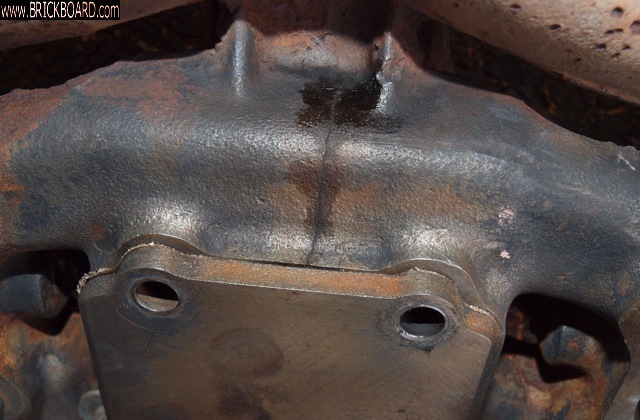
Despite the picture, I'm more convinced now than ever that it's actually a timing issue. After reassembly, I started cold with choke. Everything seemed normal. Warmed up the engine and it seemed to idle at 1000 RPM, but was a little rough. Checked the timing, it was at 0 degrees. Loosened the distributor and attempted an adjustment. As soon as I advanced at all, it jumped up to 20 deg and about 1600 RPM. I turned it back a little, and it jumped down to 0 deg and 1000 RPM. I fiddled for a long while, and there was simply no way to get it to stay between 0 and 20. So I picked a spot as close to center of those two as possible and retightened the distributor.
Now with the engine warm, when I first start it up, it idles at 1000 RPM. If I rev it at all and let it fall down, it falls to 1600 RPM and stays. If I stop and start the engine, it again idles at 1000 RPM.
Am I facing multiple issues here? The car seems to act differently every time I start it up, or tear down and reassemble the carbs and manifold.
|
|
|
|
|
Did you look at my post? I had very similar behavior, even on the timing setup. My fix, after doing a triple check of all possible vacuum leaks, was a different distributor and keeping the vacuum retard hooked up.
RE: That crack - Have you given it the carb cleaner test? To see if that effects idle, therefore giving a (very rough) indication of how much air that crack is actually letting in?
|
|
|
|
|
Yes, I did read through the post, and started looking around for another distributor in my desperation. I'm like you in that I've absolutely ruled out all vacuum leaks. Tried a new manifold, totally disconnected the brake booster and PCV valve, and sprayed starter fluid everywhere, without ever affecting the high idle.
A total rebuild of my distributor didn't fix the problem either, although I don't have one that has a vacuum advance anyway. At this point, I just have to start blindly replacing parts, starting with the distributor.
|
|
|
|
|
I may have a spare distributor, but it's in unknown condition. Picked it up in an auction of a box of parts. Yours for the shipping cost, if you get that far.
|
|

|
|
My guess is intake manifold leak at the gasket.
|
|

|
|
That would be my guess as well...
I'd also be suspect of an issue with the advance mechanism in the distributor, and the possibility that the screws that hold the butterfly plates to the throttle shafts perhaps came loose, and those plates (or just one of them) is slightly off.
I'd also be suspect of that intake crack.. it doesn't take a very big leak to increase the idle by 700 rpm.
You say this happens after driving for a half hour or so.. is that to say it's normal when the car is cold?
--
-Matt I ♥ my ♂
|
|
|
|
|
Although the gasket could be bad, I also should have mentioned a warped mainfold. I can't count how many I've seen that the intake portion of a combination manifold will not mate to the head in the same plane as the exhaust portion.
It is something I always check whenever I notice a leak or poor running. It is very easy for a machine shop to reface the combination manifold.
|
|
|
|
|
I've had a chance to address several of the suggestions made, without success.
First, I totally rebuilt the distributor, thinking the timing advance weights may have been gummed up. They were dirty, but after reinstallation, the problem remained. I have new plugs, wires, rotor, cap, points, and coil installed as well.
Second, I got ahold of another manifold, one without secondary butterfly valves, or a crack. I made sure the port section was totally flat before installation, and I used a new manifold gasket. Still, no affect on the problem.
At this point, once warm, the car idles just below 2000 RPM. The carbs were just recently professionally rebuilt. I have them tuned to 12 flats down, and the idle screws at 180 degrees past engagement. I can artificially lower the idle by leaning the mixture, or messing with the timing, but nothing to bring it even close to normal idle levels.
At the current idle speed, it seems like it would have to be something obvious but I've literally replaced everything between the carbs and the head, and I can't think of what else to do!!
I'm dying! Help!
|
|
|
|
|
?
High Idle is often caused by a vacuum leak...this can be anywhere in intake including PVC system or throttle overun valves of carbs (if present). Check your timing also.
Good Hunting
|
|
|
|
|
Ron, this story is quite a bit longer and more complicated that you may realize. In other words, I've already gone through the easy stuff. All these results come from totally disconnecting the vacuum system. I also have no overrun valves. I've been constantly checking my timing, and can adjust it from 10-30 deg. It will affect the idle speed, but will never bring it anywhere close to low enough.
|
|
|
|
|
By any chance, have you tried a different set of carbs? I don't think I remember reading that you have.
OR, while she's idling high, block off some of the intake area on the front of each carb and see what happens...it should lower. I've seen the same thing when the housing and/or slides are worn and air's getting through.
I know they were rebuilt, but the carbs seem to be the last variable.
Good luck with that, also, what weight/type oil do you have in the carbs? Not that it should make a difference that noticeable at idle.
Jay
9 or so 140's (different states of disassebly), and parts to make another 3 more.
'72 142s daily driver.
|
|
|
|
|
I haven't tried a new set of carbs, mostly because they're hard to come by. I have tried forcibly blocking the air flow into the inlet, and it does drop very fast very quickly. I use ATF in the carbs. Is it possible to overfill?
My kick right now is the timing advance weights in the distributor getting stuck in some state of out. I'm thinking this because of the nature of the high idle. After sitting for a short while, occasionally it will idle normally until I go above 1500 RPM, then it will always idle high. Also, very occasionally, the idle will wander slowly down to 800 then wander back up to 1500. That doesn't sound like an air leak to me. I also know my distributor has too much axial play in its shaft.
I note in your signature that you have a ton of 140's. You wouldn't possibly have a B18 or B20 distributor you'd loan or sell me would you?
|
|
|
|
|
Yeah, I've got a few kicking around. What's the number on the distributor, I might have the same one, but I've certainly got one that will work.
And, you're right, it sounds like the distributor now that you mention it. It makes sense once you rev it up the weights don't properly move back, and you're stuck advanced.
email me: usedvolvoboy @ yahoo.com
I'm in Norwich, CT. where are you located?
|
|
|
|
|
Wondered if you ever found the cause of the high idle? I, too, have idle problems. It will be ok for a few days and then it will go up. Also wonder about timing gears?
|
|
|
|
|
Yes and no. At this moment, it appears there were several contributions to that high idle. First, I had a hairline crack in my intake manifold. Fixing that lowered idle a bit. Second problem was a loose set of timing advance weights in my distributor. This caused my timing to be over advanced at low speeds, artificially raising the idle. A new distributor fixed that. Finally, the biggest contributor was a slightly off centered butterfly valve on my rear carb. This allowed a higher fuel/air flow even at full closed. Re-centering that valve so that fully closed was totally sealed finally fixed that issue. I can now get the car to idle around 800 RPM, although it still wanders around a bit.
My remaining problem is that after extended periods at highway speeds, taking my foot off the gas and out of gear causes the engine to die or stutter badly at 200 RPM for 25 seconds. It eventually rights itself, but is mysterious. Around town driving causes no such issues. One potential, I've learned, is a loose jet. If it can move up and down without your foot input, it could cause dying issues, or high idle issues, or a wandering idle, by my figuring.
|
|
|
|
|
Thanks for the info. My '73 is fuel injected and I think the distributer is the problem. There are some contact points in it that have something to do with the D-jet system and I'm going to check into that. Thought I would also convert it to electronic.
|
|
|
|
|


