|
|
|
So after getting my seat webbing replaced and having my head in the general area, I started poking about in what I had my fingers crossed would be relatively clean floor pans.
It was not to be (sigh).
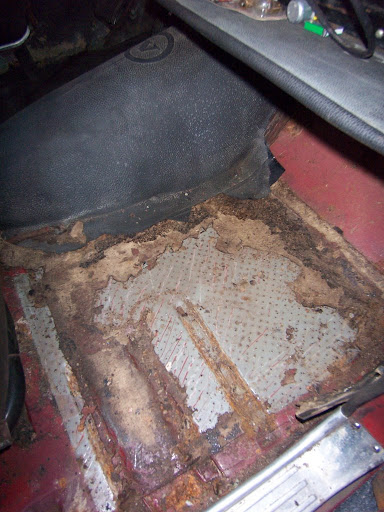
First off, the good. The passenger side front looks fine-ish for a new england car. Little surface rust here and there, but it's mostly just the factory gray primer under the sound deadening mat. From what I've seen of the front drivers side, it's in much the same shape. In these pictures there is still some sound deadening needing to be removed.

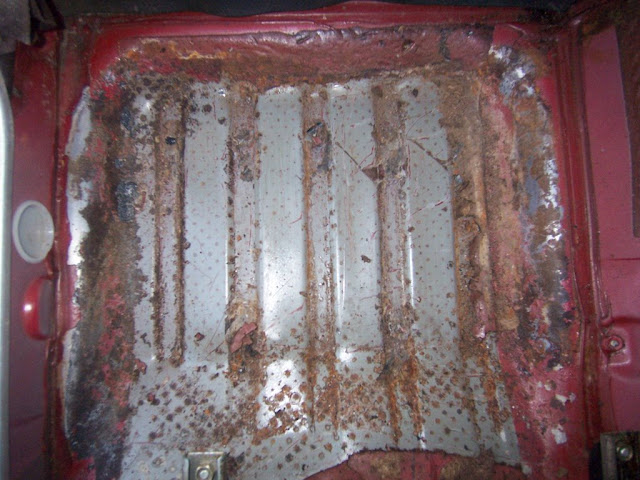
Next up, the slightly less confidence inspiring. The passenger rear has some holes in the rear outside corner, but the rest is solid.
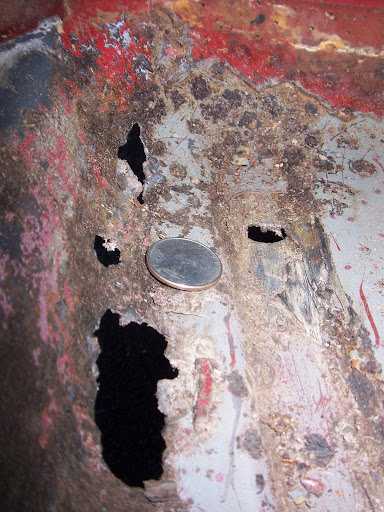
Finally . . .the heart-sinker. The drivers side rear floors have some significant rust-through in the rear out corner as well. It seems like the frame rail and structural members adjacent have been spared. Again, the problem seem largley confined to the rear corer of the rear footwell.
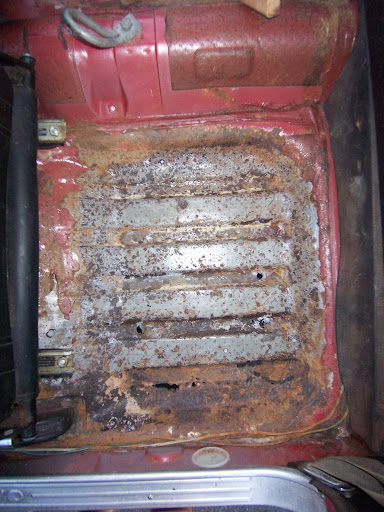
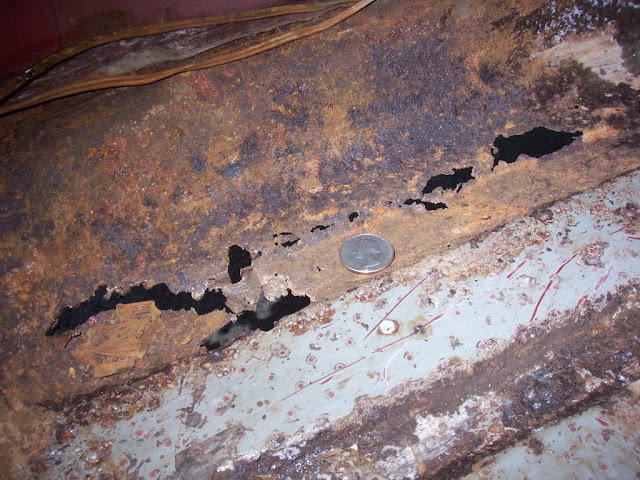
So . . . should I even be considering options beyond just having new rear floor panels put in? I've seen several vendors offer a "flat" and "pressed steel" versions of these panels, with the pressed steel variety being several times more expensive. Would the pressed panels be required for these repairs since they affect the concave corner areas and not just the flat section? What should I expect, ballpark, to have patch panels installed?
Mucho thanks in advance, as always.
|
|
|
|
|
Looks like a cream puff to me!
I would charge in the $1000 range to do floors on that, and that still isn't enough money. Rust work is the bane of the body industry.
Welding in new floors is the right way to go, however, for that car, I would clean and por-15 then panel bond some new patches in, no question about it. You can see exactly what it looks like under the metal in my albums. There are a million welds on that floor and structure.
|
|
|
|
|
So, how on earth does water accumulate in the rear floor sections like that? The trunk is essentially rust free, under the rear seat is essentially rust free (although I think there is a critter nest), and the front floors seem to be much better off than the rears.
The firewall has no shortage of holes for water to get through, but I'd tend to think that the front floors would be worse off than the rears if that is where it was coming from. I suppose the rear foot wells are about the lowest point in the car, so that any water that gets in through the firewall eventually makes it's way back there to pool up (?)
I think for now, I may just go with one of the more temporary, band-aid type solutions, but at least do what I can to prevent any further spread of the problem. I'd rather spend the time and money getting the car mechanically tip-top so I can enjoy it the rest of the summer and fall. Then when winter rolls around and it gets taken off the road do things the proper way. It bugs me to "fix" things incorrectly, but I suppose at some point I need to admit this is a driver, not a show car, and not everything needs to be factory fresh.
|
|
|
|
|
Maybe a plugged drain towards the rear of the car? Heck, it seems to be one of those mysteries of life. As cruel as it is, most of us don't have the financial horsepower to hire a full restoration on our beloved Amazons. Which is a darn shame, of course. Maybe for now, some "duxseal" or equivalent fairly harmless sealant and some sheet metal and some stainless steel screws will get you through the driving season without having to buy a bilge pump! By the way, not to rub salt into the wound, but to make sure it gets covered here, "I told you so!"
|
|
|
|
|
I could have told you so too.
But....., rear floors rusting out is hardly unique to old volvos. The problem is always water getting in from somewhere, on 122's it's unusually the windshield gasket leaking. On mustangs on up to rangers, it's the cowl rusting and letting water in through the firewall.
That water never really get's a chance to dry out, the carpet wicks it up like a sponge and gravity takes it to low points. Here on the east coast, add salt to that brew and you have the basis for the 2nd law of thermodynamics.
In fact, my 91 marquis has a hole below the windshield you can stick your hand in, it was a car from the beach down here. They turn to dust if not cared for.
|
|
|
|
|
Those are "relatively clean" floor panels. I'd patch them. Clean right back to bare metal, cut out the thin bits, panel beat a patch and seam weld it into place.
Don't be tempted to put in lots of little patches a couple of bigger one will make a neater job.
|
|
|
|
|
What are your plans for the car? Is it a keeper, or a 3 year car? Do you have the welding skills, equipment, and time and facility to work on this? Judging by your inquiry, it sounds like you'd like to get new panels installed. This is time-comsuming work, if done correctly, but fortunately doesn't take the same degree of finesse that body panels do. I'd ask around some body shops for pricing, letting them know that you can supply the panels if needed. Their answer will probably drive if you go the fiberglass repair at home, or the sheet metal and mastic with stainless steel sheet metal screws, or have them work on your vehicle. Good luck, it is a shame indeed that "Rust Never Sleeps".
|
|
|
|
|
Dunno what the pros will charge but I can GARE-WON-TEE you that it will be a LOT cheaper if you do it yourself!!
--
George Downs, Bartlesville, Heart of the USA!
|
|
|
|
|
By "Amazon rusty floors" standards, those don't look too bad, especially if the rust doesn't extend into the rockers. After showing us what looks to be a nice, and now very shiney car, it would be a shame not to do a good quality repair. Shaped and ribbed panels are more expensive but once the floor is cut out you should get good metal to weld them to. Welding time is then less and makes it easier for a welder who may not have the skills to make a good job of multiple patch panels. Cutting out small sections and making up patches that fit properly is very time consuming and time = money. It might be that putting in the moulded panels will cost less overall due to less shop time. It'll be a much nicer job when finished.
Unless you're running a car as a "beater" there's no place for the bodge repairs mentioned in another post, although the comments might have been tongue in cheek. Your car is too good for that sort of treatment.
I'm in the UK and that sort of repair wouldn't pass MOT inspection so perhaps my views are coloured.
Do it once, do it right and add future value to your car.
|
|
|
|
|
I wholeheartedly agree that the best way to do this is panel removal and replacement..I just didn't know if there was the talent(s) or money available. And, your Ministry of Transport point is well taken. We don't have a Federal inspection program here, but some states do have annual safety inspections.
|
|
|
|
|
Sorry to see what you found, but after I found similar stuff and freaked out I've gotten my head around it.
There are panels available for all of that, and if the rockers/sills are OK you "simply" cut out the rot, leave a bit if a lip for the new floor section to sit on, and then weld them in (butt welding everything is a better way to go but is harder from a fit and welding perspective).
So now - do you have a welder and good cutting disk? If not, are you game for learning?
If not, try Craigslist for welders that will travel to you.
How are you feeling about all of this after reading these posts?
|
|
|
|
|


