|
|
|
OK, I am clearly paying for my $200 Craigslist car with sweat equity... and possibly parts.
So, 1978 Volvo, B21F, K-Jet FI. Car ran but not well, tried to adjust timing (was at 0 degrees vice 12.5), ended up breaking the distributor, and I just replaced it yesterday with a known good one from Dave AKA Volvo from heck.
Now, car will start, but only if floored. It will not go above 800 rpms for anything, and really wants to die if you take your foot off the gas. Absolutely gutless also, even floored will not move the car. I added about 5 gallons of gas yesterday, seemed to make it run a tad smoother.
I jumped the left side of fuse 4 and 6, and heard the relay hum, and clicking from the main fuel pump, but it did not appear to be buzzing and pumping.
Previous owner supposedly replaced both fuel pumps and the filter (they do look new and there's evidence the in-tank one was done as well). Filter weeps just a tad on the inlet side. They also screwed up installing the timing belt, so it sat for a few months at minimum before I bought it.
So, is this a case where the pump crapped out, or could the filter be clogged? I may replace the filter anyway, need to stop the leak and its only $25. $100 plus fuel pump has me pausing though.
|
|
|
|
|
I haven't seen anyone throw it out there, but since it ran when the timing was "wrong" and now does not run unless floored (timing advanced to max bdc?), perhaps the timing marks are off, and/or the harmonic balancer has come un-laminated from its rubber mount. It's a huge complaint on later cars.
Also, what the heck is a frequency valve?
Good Luck
William
--
1990 740 Turbo, on its way to stock specs, maybe beyond
|
|
|
|
It's a nonexistent complaint on early cars.
B21/B23 engines had a different crankshaft pulley than the B230.
The frequency valve is a component of the Lambda-Sond system and is used in cars with continuous injection.
--
'80 DL 2 door, '89 DL Wagon
|
|
|
|
|
I'm beginning to lean in this direction some- at least as something to rule out. I checked the timing tonight, and it showed something like 30 degrees before tdc at about 800 rpm. Moving the distributor to bring the timing closer to 12.5 after TDC kills the engine. It seems to want to be timed even farther before tdc.
So I'm thinking perhaps, like William suggested, something was misaligned when I did the timing belt, or I put that on wrong somehow, etc. Anyway, that's next up to check. Nothing like doing thing twice to make sure you really know how to fix it!
|
|
|
|
|
Line up the timing marks on the cam, idler and crank shafts. Then check the distributor to see if the rotor is pointed at the notch on the distributor rim. If not, pull distributor and re-orient.
--
1980 245 Canadian B21A with SU carb but electronic ignition and M46 trans in Brampton, Ont.
|
|
|
|
|
If you are getting those kinds of readings it must appear confusing to you, let alone trying to write it up.
One or two things must be out of whack. There should not be that much movement within the slot of the distributor. When you can move things that much, well, it should die.
I mean, there really could be but in most cases the distributor should be very close to the advanced mark of 12.5 Before Top Center (BTC) degrees. All is good when the lock down bolt is located near the center of the slot. Not at one end or the other.
The distributor’s intermediate sprocket is moderately hard to line up properly with out a mirror in my opinion. The formed creased/bump line in the sheet metal on the right can be deceptive to the punched dot on the sprocket.
Another thing I watch for or noticed during my endeavors is that the belt’s third mark. It ends up down at the crankshaft and has to be counted or imagined to go over the required three slots to engage in the sprocket notch/mark.
There can not be any slack on the right side from the valve cam and around and down when you pull the pin from the hole in the shaft that is holding the tension roller back. Marks are nice but not mandatory to do the job. Checking the alignment of the three components to their casting and formed marks become paramount after all is set with the tension roller. Do a final check with a mirror and the good old finger tester of the belt.
Refrain from using the middle one though! Vehicle only understand certain words, spoken softly, especially if its a SHE!
Thanks for the posting back.
Phil
|
|
|
|
Hello.
You never checked compression.
Goatman
|
|
|
|
|
OK, so I still haven't checked compression, but I'm getting there. Today was pretty much an incomplete-- two steps forward, at least one back.
This afternoon, I pulled the timing chain cover and checked all the marks. Distributor was in the right spot at TDC, but...
Take a look at the picture of the camshaft pulley-- two different marks! I had forgotten about this from the first time I reinstalled the timing belt. I lined it up with the inner mark, because that's what the pictures I could find showed. I'm thinking perhaps this one is incorrect, so I re-aligned the camshaft pulley with the outer notch (the one with the arrow in the pic). I also appeared off a tooth or two on the distributor pulley line up, so I fixed that.
Other stuff-- found a wire that had come off the alternator, hopefully explaining why the battery wasn't really charging.
Finally, the idler pulley that tensions the power steering pump (or could be the AC, I'm honestly not sure)-- how are you supposed to adjust this? I'm not sure my way is working, and I seem to have added too much tension to it. I may have over-tightened the bolt that holds the pulley on-- Even with jumper cables, the battery/starter (with jumper cables attached, voltage w
And by this time it was dark, so I'll tackle the battery and idler/tensioner pulley tomorrow.

|
|
|
|
|
OK, so I charged my battery and tried to start her up-- sounded very peculiar, definitely not right. After pulling the AC/Power steering belt and hand turning the idler/tensioner pulley, I decided that was definitely not the source of the strange noise (I feared I might have reassembled it too tight or incorrectly).
So, I decided the original, inside cam pulley mark must have been correct. Pulled the timing cover, realigned the belt, (and made sure the distributor pulley mark was lined up still), reassembled, and VROOOM!
She started up easy as pie. I adjusted timing, adjusted idle, readjusted timing, and took her for a drive. All good to go so far. Idle is a little rough, but I'll start messing with that later. (And I'll be checking compression as I mess with the rougher than desired idle, clean up, put in a new valve cover gasket, etc.)
So, lesson learned-- it was timing. I must have originally installed the timing belt with the distributor pulley off three or four notches. Reinstalled correctly she's a brand new car. I found it much easier to see that mark with a flashlight pointed upwards at it-- otherwise its almost invisible on my car.
Next up is a smog check, wish me luck...
|
|
|
|
|
I'm glad you got it looked at with a straight on eyeball!
As I said, it is hard to see the mark down there.
Phil
|
|
|
|
On the 16th I edited in a tip you might want for future reference.
And I also asked about your '79 CA car's fuse strip so I could learn more about it:
12 or 16 fuses?
NO PROFILE SIGNATURE COMING OUT????????
|
|
|
|
|
Sorry about that-- it has 12 fuses. Thanks again for all the assistance, you and everyone around here!
|
|
|
|
|
"I jumped the left side of fuse 4 and 6, and heard the relay hum, and clicking from the main fuel pump, but it did not appear to be buzzing and pumping."
Those fuses have nothing to do with the pumps on a '78. I don't know what you heard but it wasn't the pumps.
For your '78 K-jet, fuse #7 powers everything but the Tank pump, which has a separate (unnumbered) 5A fuse in an inline holder back near the pump, but before the wires go down thru the square access plate (I think).
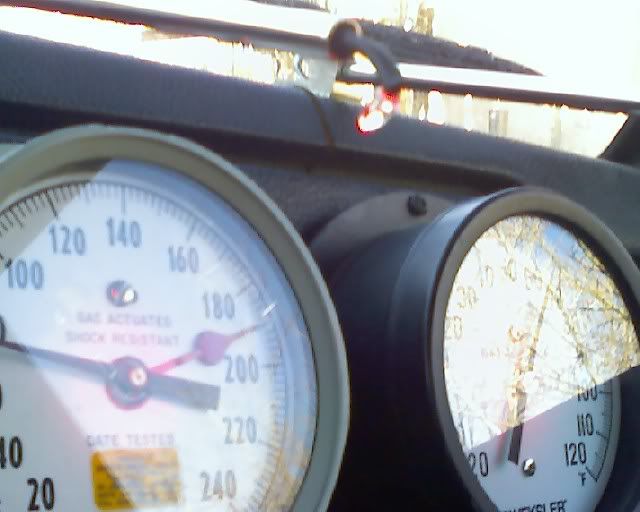
You probably aren't hot to spend any more than necessary, but if you plan to work on K-jet problems, the best starting point is a fuel pressure test. And with K-jet FI, that requires a special gauge setup that can measure not only the Main pump pressure, but "Control" pressure, which is critical to starting and normal running. Without knowing those pressures, it's apt to be just frustrated guesswork and parts swapping.
The best K-jet gauge price and availability that I know of is at JC WHITNEY.
[For comparison, mine cost $97.00 "back in the day".]
Also, your learning curve will benefit greatly from owning and reading the K-jet section in "Bosch Fuel Injection & Engine Management" published by Bentley (stock Number GFIB). The list is $29.95 but I see Amazon has it for under $20.
EDIT: There is no fuse jumpering that will run the pumps on your '78. And you don't have The Frequency Valve that Jesse mentions (unless it's a California car) with the "Lambdasond" Oxygen sensor (in which case jumpering fuses 5 and 7 will run both pumps).
--
Bruce Young, '93 940-NA (current), 240s (one V8), 140s, 122s, since '63.
|
|
|
|
|
Fuel filter replaced, fuel just dribbled out. Used starting fluid to get it going, after which it would run (floored). Looks like something in this system, as I see it either check valve, accumulator, or in tank or main fuel pump. Crawling under the car to check the main next.
|
|
|
|
|
I have a 78 GT Coupe and had to give Lucid a thumb up on his post. I have never tried to jump the pumps on that car. I would have never known that there was a difference either.
The car I have is a California car and it has the frequency valve.
I thought you might want to check for this since my car had a badly corroded one, on its underside and inside the cover. I have had this car almost since new and I was surprised how it sneaked up on me.
There is a relay on the driver’s side front fender. It is about one inch square and next to the headlight dipper relay.
When it turns on it connects the valve and 0-2 sensor up after starting. It will crank excessively and run like crap unless it closes.
Since you have too open the throttle wide open, you may want to check the fuel distributor air flow plate that is inside the rubber bellows. It might be fuel gummed or stuck down and dirty. Look for holes in the rubber bellows. Bad clamp up can happen too.
I have always been mindful of keeping good fresh fuel in my car just because it is a mechanical moving flow mixture control system. It has been reliable but then so has the whole car for its almost 300k life. I had the seat redone with the stripe and that is the most I have ever spent on the car, next to the tires.
The paint sucked right off because of the then new two stage paint used. I got rid of the stripes and had “Imron” single stage urethane put on it. Now it’s gone. The total paint job back then was 500 bucks. Those days are gone! That stuff is over $300 a gallon the last I checked.
Any who, good luck and keep us posted on things you find!
Phil
|
|
|
|
|
Yup, Lucid was right-- jumpered 5 and 7 and the pumps appeared to run. Mine's a California 1978 with the O2 sensor also.
Curious what it was doing with 4 and 6... oh well.
So, I crawled under the car, and I saw that the ground wire for the main fuel pump was mostly torn off the terminal. I was excited-- haha, easy! I cleaned up the wire, crimped a new connection on there, and tightened everything up. Woohoo!
Except when I reconnected the battery, and started the car... same old problem. By that time, I was frustrated, so I cleaned the fuses and fuse panel with my dremel tool and called it day.
Anyway, next step, after talking to Dave/Volvo from Heck and confirmed by Machine Man Phil above, is to pull apart the fuel distributor, check the air flow plate and needle. I also plan to clean the throttle body, since that's on my list also
and I haven't done it yet.
I also checked my O2 sensor, and the bakelite plug pretty much disintegrated, but underneath it all, it had a good looking, clean connection. I did not check its function though.
Thanks to everyone for all the help! Brickboard and all of you have been great!
|
|
|
|
|
"Anyway, next step, ... is to pull apart the fuel distributor,"
If "pull apart" means separate the 2 halves of the FD, then the next step after that will be to toss it in the scrap metal bin. They can't be resealed once separated. But you could remove it to see if the control plunger is free to move up and down to follow the airflow plate movement.
But that's where 15-20 minutes with the gauge would tell you if you need to spend that 2+ hours of time and effort on the FD or not. What is your time worth?
Phil and Dave's tip on the Frequency Valve is a good one, now that we know you have one. You can check it for "buzzing" with the engine off by unclipping the Lambda relay on the fender rail to turn it upside down. Then use a jumper to "back-probe" +12V from the battery onto the Blue wire terminal at the (still connected) relay harness plug. The relay should "pick" immediately and make the Frequency Valve buzz noticeably.
EDITed in at 9:49 EDT:
"...jumpered 5 and 7 and the pumps appeared to run."
You can also test each pump separately by removing fuse 5, then jumper the +12V to the LEFT fuse 5 contact to run the Main pump or to the RIGHT contact to run the Tank pump.
BTW, does the car have 12 fuses or 16 (like the '79 and later 240's?
If it has 16 fuses, it may be that the wiring is basically like the '79.
If 12, I'll have to refer to an old Clymer manual for any more tips.
--
Bruce Young, '93 940-NA (current), 240s (one V8), 140s, 122s, since '63.
|
|
|
|
|
As McCain said about "That Guy" and President Regan said "There you go again."
Putting out those juicy morsels of experience and knowledge of the "K-Jet" system. I printed this one out to put in my manual! Thanks, a BIG tank full!
I would try to answer the question on anout the frequency valve, from William but I may have only a partial knowledge about it. I think it varies the mixture volume by pulsating the pressure according to the 0-2 sensor and computer.
The K Jet is a Hybird LH system. The LH changes pulse width "on" time of the injectors instead!
Use a good strong rope and fish me out. Just in case I'm caught in the lip or some were else!
Oh, by the way, I thumbed you again! Your'e one of the best. Since that is all I have on my hands appear to be thumbs, you win!
Phil
|
|
|
|
|
Does it have lamda sond? If it does, is your frequency valve buzzing? Did you maybe bump the connector when you were working on the distributer? Those symptoms sound a lot like when the frequency valve is unplugged.
|
|
|
|
|
Hello,
You really should check that the engine is intact and has compression, before you try to diagnose a control problem.
It sounds like you have a dead cylinder or two.
Raw fuel is poison and dangerous, do not hesitate to correct any leaks. Make sure to use nylon or injection rated fuel hose as a substitute. Crimp clamps are recommended.
Goatman
|
|
|
|
|


