|
|
|
Hey guys,
I just swapped in a new engine & trans into my old 245. What a blast! I seriously had a lot of fun doing the whole thing - these cars are truly a joy to work on.
So now that everything is all settled and I'm back to driving my car, I had an idea: Remove the radiator fan to save on gas over the winter months. My "other car" has an electric fan that only kicks on in the summer, so that got me thinking that this was worth a try.
I only did this a few days ago, so I haven't had a chance to come up with any real data. Since then, I was in line at the local DQ drive-up window and had to idle for about 6-8 minutes total. The temp was about 45 deg outside and there was no oncoming wind. Normally, I'd shut it off when waiting this long, but I decided to see if it would get hot. I had the heater off too. As I was ready to pull out, I noticed that the temp climbed above its usual 1/2 way mark - it didn't quite get 2/3 of the way up, but it dropped down when I kicked on the heater fan and began rolling.
So, anyone out there that's tried this? What kind of improvement did you see?
Steve
|
|
|
|
|
I put an electric fan setup in my '90 240. The fan and shroud are from a 940 (had to modify the shroud extensively). The thermostatic switch comes from a Saab 9000, and screws right into the port in the 740 radiator that was already there. The two-way fan relay came from an 850, with power drawn directly from the battery through a fusible link. The high speed circuit is on the thermostatic switch, while the low speed circuit is hooked up the brake light switch, so whenever the car is stopped, the fan is on low. I also included a capacitor from the dome light circuit on another 240, which keeps the fan on for ten seconds after the brake is released, even if the car is shut off (credit where credit is due: the idea for these last two features came from Sven's Maintainer: http://www.brickboard.com/RWD/user_data.htm?uid=25912, a great source of info on 240 electric fan conversion).
So it's a cool setup (no pun intended!), but I can't say as I've seen any fuel economy improvement or reduced noise levels. Definitely worth it, though, if only for the fact that I can now work on the front of the engine, swapping out belts including the timing belt, without having to remove a fan and shroud. It's a real luxury.
As far as cooling is concerned, with the temp gauge compensator board removed and bypassed, my temp needle sticks like glue just above the middle, and hardly ever goes any hotter than that. Knock wood, I have never once overheated, nor even come close.
Hope this helps!
Cheers,
--EdM.
--
'90 240DL Wagon 'Lola' -- '72 1800ES 'Galadriel'
|
|
|
|
|
I did this on my 745 several years ago. I realize many who say this will be a disaster have logic on their side, but on the other hand, the fan is only there to move air when the car is not. As I seldom drive in traffic the car is never stopped for more than a minute.
I had it off for a whole winter, and never a problem, and you say, much quieter.
Someone noted a 9xx radiator will fit a 240.... not sure about that, they seem much wider. I will be taking one out of the 940 turbo soon and will check that. I was only hoping it would fit my 745.
--
84 242Ti IPD bars&springs, 89 745 16v M46 IPD bars, 89 744 16v M46 IPD bars, 91 245SE AW70 IPD bars, 93 245 CLassic M47
|
|
|
|
|
Can't imagine a 900-series radiator would fit a 240. I had to seriously mod the fan shroud from the 940 donor I used, since the radiator is so much wider. I think I took about 4" out of it.
--EdM.
--
'90 240DL Wagon 'Lola' -- '72 1800ES 'Galadriel'
|
|
|
|
|
Hey Ed,
I just noticed in your signature that you have a 1972 1800ES. I happen to have a dealer brochure for the 1972 1800E & 1800ES (it's mostly the ES though). I can't part with the original brochure since it's my dad's, but I have the whole thing scanned. It's about 90megs and it's in TIF file format. I can mail that to you on disk if you want or I can color print each page and mail them to you if you're interested.
Sorry everybody else, I tried to send this message via the email link and it bounced.
Steve
|
|
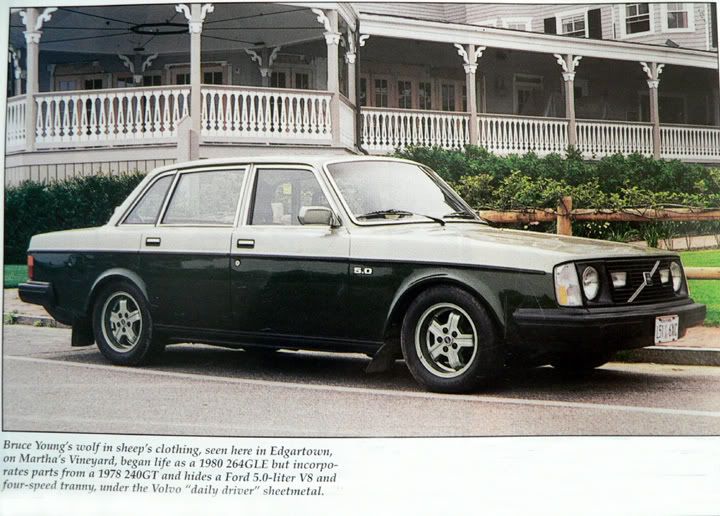
|
|
...which I used in my old '80 gle V8.
To my eye it was the same width as in my current '93 040.
--
Bruce Young, '93 940-NA (current), 240s (one V8), 140s, 122s, since '63.
|
|

|
|
This is not a good idea. I can appreciate wanting to save some fuel, but without an engine fan you will overheat the engine if you are stuck in traffic. You can't always shut the engine off as you have to progress at a few miles an hour. If you get a tailwind under those conditions, you've had it.
--
john
|
|
|
|
|
I have removed my fan now for two winters,i like the results,quieter,quicker warmup(my clutch fans have always moved some air even when cold) .I live in northern ontario its cold here.That being said i wont let anyone else drive it
and would recomend installing a temperature sensor for a warning light or
pusher fan(I have bought a 10" hayden fan kit,with sensor &relay for this purpose,have not installed it yet)Gas mileage is terrible at low temperatures, i can not see any advantage being measurable on this aspect.
--
Rene
|
|
|
|
|
Hi Rene,
I sympathize with you - I lived in the upper peninsula of Michigan for a year so I know what cold and snow is like! I ruined the transmission on my Mitsubishi driving 2 miles each way to work when it was 20 below zero and I was working night shifts. Extreme cold is very hard on the machinery. You know it's cold when your fresh 60% antifreeze gets frozen in 30 minutes!
When I began the experiment I thought that I could keep the fan off for 4 months over the winter. I've since reconsidered that. I think what I'll do next year is remove the fan in mid December and leave it off until close to Feb. 1st and see what kind of improvements I can get in fuel mileage. It certainly isn't ever going to be enough to offset all the enrichment that goes into warming up that cold engine, but maybe I'll see some kind of benefit. Honestly, the way I feel is that it MIGHT give about 1mpg. Before removing the fan I was clipping a piece of cardboard onto the front of my radiator to block half of the rad.
You're definitely right about how nice and quiet it is without the fan! And it did help speed up the warmup process. I won't go the measure of installing an electric fan, but I'll limit the time I keep the fan off and I'll keep the fan in the trunk just incase.
|
|
|
|
|
Don't do it.
A friend of your daughters will die while your daughter is overseas.
You will have to drive to Chicago, which is no big deal, for the funeral.
But you will then get stuck in a very long line at some &^%& toll booth, where something has gone terribly wrong.
You can't turn back, you can't exit, you have no choices.
Except to watch your temperature gauge.
And then start running the heater at full bore to try to cool the engine. etc.
You will feel like a moron.
And there is worse yet to come.
And I don't want to talk about it.
Standard at this point: don't ask me how I know.
|
|
|
|
|
Ha! You must know my friends Murphy and Finnegan! Murphy is the guy that crashes his car and causes the highway backup 10 miles up ahead. Finnegan is the gremlin that lives in the dash and makes the heater fan quit at just the right moment.
Yeah, and I thought I'd never see a twitch of that needle above the half-way mark in this cold weather but it did happen on some warmer days. As you saw in my other posts, it happened once while waiting for 5min or so at the drive thru and a second time on a warm day with a tailwind getting caught at stoplights.
Fortunately, I do have 2 other cars which I deem as being more reliable than this one. I use those cars only for driving over the road. I am going to try pushing longer distances with the Volvo soon though!
|
|
|
|
|
Well guys. I've done 2 tankfuls on this experiment and I'm done with it! On both tanks I SQUEEKED maybe 1/2mpg. On the first tank, I got 1mpg. On the second, nothing from the usual. You guys were pretty much right... I'm going to call this one a negligible improvement. I can't say that I was driving more or less carefully, but perhaps on my first tank I was babying it.
I drove about 15mi into town with a pretty stiff tailwind (about 20mph) yesterday, and I had to clear about 5 traffic lites to get to my destination. With the 70deg temps I was a bit worried. When I turned in to park, the temp ga started to go up about 2 needle widths past the 1/2 way mark. That was the 2nd close call, so experiment over!!!!
Maybe I'll try again next January! Or maybe not!
Steve
|
|
|
|
|
re: "...the temp ga started to go up about 2 needle widths past the 1/2 way mark...."
A couple of things. Frist, I believe you asked about the higher performance fan clutch, officially a "Tropical Cooling Fan Clutch", that we've been calling a "swamp cooler". It's Volvo p/n is 1357433, and its list price is $248. Years ago, I got two for 1/3 that price, but I don't think the vender has any more (he told me then that these were the last of his supply).
Second, you never said what model year car you have, but while that gauge reading (in the quote on top) is okay for a pre-'85 car, if you've got a '85-on car with the temperature compensation board still working (which would be rare), you could have been quite a lot hotter. The TCB limits the movement of gauge's needle until it's really very hot (at which time it starts to indicate overheating), so you might have actually been at the equivalent (on a non-TCB car) of very close to the red. That's why on my two '93's, I removed the TCB (and jumpered its contacts) so that the gauge works like it should.
In any case, I agree with the others who suggested keeping the fan on. But, realize that with the "swamp cooler", your fan will actually have a higher duty cycle, running slightly more often because the fan clutch engages more readily -- good in hot climates to forestall over heating, but bad if you want to save gas.
|
|
|
|
|
Mine is a 1990 245. Yeah, when that needle starts moving, it goes really fast!!!
I have no need for the swamp cooler fan clutch. I have two fans and clutches now that I installed a new engine. The new engine is from a southern car (a 1992 245) and the fan clutch feels a lot tighter. This might be the swamp cooler clutch you guys were referring to... is there any way to definitely tell? Any kind of markings or physical attributes to look for to identify it?
I'm currently using the "yankee cooler" from my old engine since it never caused me any overheating problems in the hottest of Illinois weather.
Actually, what really initiated this whole experiment is a problem I had with my Ford Focus. That car keeps burning up fan relays and I ran it for well over a year without it overheating because I never run the A/C and I hardly ever get caught in traffic. I've since replaced the relay in that car, but it almost never kicks on unless I turn on the A/C. I don't know what makes that car so much more resistant to overheating - it could be a larger capacity radiator or the fact that there is very good ducting with baffles in front of the rad to direct air into it. Nothing as nice as that on my Volvo. My front splitter is long gone, but at least I still have the big plastic belly pan.
|
|
|
|
|
re: "...is there any way to definitely tell? Any kind of markings or physical attributes to look for to identify it?..."
Only by the part number that I gave you in the earlier message. I don't remember anything else that's visually distinctive, but it's been a few years since I've looked at them because they're installed on my cars, covered mostly by the plastic fan's hub, with only their face showing. Sorry.
|
|
|
|
|
The fan, especially in winter, will probably extract only a negligible amount of power.
First, assuming you've got a fan clutch (standard in our 240's) that's in good condition, the fan is almost always freewheeling -- even though the fan looks like it's being driven by the engine, it's really mostly coasting.
Thus, it only engages if the radiator (and thus the air flowing through it) gets hot for some reason, but if you're driving along, the car's movement is enough to drive air through the radiator and keep it cool (again, assuming winter weather).
When stopped, the radiator may get hot enough so that the clutch engages, but that's about the only time. So how many times, and for how long, do you sit idling? So in summary, its wintertime impact on your gas mileage is probably negligible.
Finally, there are so many variables in trying to measure your gas mileage, those sources of error will probably overwhelm the slight improvement possible from removing your fan.
Likewise, another possible but negligible advantage would be to lessen the load on your water pump's bearing -- it may last a few thousand miles longer :-). Is it worth the trouble?
|
|

|
|
Inflate your tires to just below the hardest pressure on the tire.
Turn off the AC and roll down the windows until you break a sweat.
Smooth take offs and feathered break stops.
Make sure the air filter is clean, the vacuum lines are tight, and the throttle body is clean.
If your O2 sensor is the only one your car has had, think about changing it.
YES to all those.
Take a chance on overheating a AL head to find out if maybe you get better mileage, I'll pass on trying that one.
Regards,
Paul
|
|
|
|
|
I'll put my support behind Paul on this one. You just went through the pain of replacing a drive train, but you enjoyed it... go figure. If you continue this experiment, sooner or later you will destroy the new engine.
If you want to rid yourself of the parasitic drag of the mechanical cooling fan, remove the fan, go to the bone yard, and find a 940 or 960 with an electric fan assembly and thermostat on the engine side of the radiator. Note that the 9xx and 240 had the same radiator so it is a bolt-up job. You will have to add the thermostat, relay, and wiring to make it all work though it is only ever so slightly more efficient.
Keep in mind though that the energy to run the fan is still coming from the engine via the alternator and battery. Surprisingly though, the electric fan is slightly more efficient than the mechanical meat chopper on the front of the engine that came from the factory. Will you notice the difference in your gas mileage? I seriously doubt it unless your measurements are meticulous.
jorrell
--
92 245 307K miles, IPD'd to the hilt, 06 XC70, 00 Eclipse custom Turbo setup...currently taking names and kicking reputations!
|
|
|
|
|
Well, I do agree with you guys Paul & Jorrell. I won't be pushing it again like I did in the drive-thru line. I guess curiousity got the best of me right there and i wanted to see how long. It is certainly too easy to be inattentive and it doesn't take very long at all after the time that needle starts moving past its parked position - hot coolant just gets hotter, eh? Where I live, I never deal with traffic jams. I'm pretty much on the open highway most of the time, so I feel pretty safe for the time being. I'm going to continue the experiment for at least two tanks to see what it proves out.
Actually, I was thinking about it while driving today and the fan pretty much unloads at speed when air is already flowing through the grille. The amount of loss in that condition may be negligible, if not immeasurable. Because most of my driving is on the highway, I'm starting to think I won't notice a savings. We'll see how it plays out.
The fan clutch is designed to load and unload as you guys have noted, but it is known that electric fans are more fuel effecient. I guess this will be my experiment on "how much" more effecient.
I'll keep ya guys posted! Don't worry, I'll be careful not to cook my new engine. :)
Steve
|
|
|
|
|
I have the, "Swamp Cooler," fan clutch on mine, and its coupled with an auxiliary pusher fan in front of the condenser. I doubt if any single electric fan is close to being as efficient as this set up. I use mine in Central Florida in the summer, and I'll promise you that if you don't hear the whoosh on take off, you will be on the side of the road with the hood up waiting for it to cool off.
|
|
|
|
|
I have been looking for one of those fan clutch setups, where might I find one?
--
-Chaos Manager-
|
|
|
|
|
EEuroparts.com has one for about $70. Lookup part number 1357433 for the "tropical" fan clutch.
Just checked FCP Groton as well. They want $65 for the same thing, but you'll pay for shipping unless you order more.
|
|
|
|
|


