|
|
|
Remember me? "No start under 5 degrees C unless plugged all night"...
I had tested everything electrical component and my mechanic replaced a faulty check valve last week, but I still can't start when it's cold (not even freezing yet...). Most people in the group tended too agree that it was likely the cold start injector was at cause... only problem is LH-Jetronic 2.2 doesn't have a cold start injector! Yesterday my mechanic suggested a vaccum leak through the head gasket. I thought it wasn't making much sense but my Haynes clearly mention this as a possible cause of my problem. Vacuum leak could also be elsewhere though: oil fill cap, dipstick, hoses, conduct...
My questions are :
-Is this diagnostic realistic?
-Could I have caused this leak by driving on compression a little too often (I love to use the engine brake to slow down ;))?
-Although the cost of having the head gasket is reasonable, is it something I could easily do? At this time of the year, I would have to rent a garage and be on my own if I happened to goof: no car to go to the auto part store, etc... ?(it happened before: I took the driving shaft of to replace the central support bearing. The bearing they had sold me turned out to be the wrong size! It's late, I need the car in the morning and I don't have transportation to go back to the god**m part store).
Thanks again for your help!
Richard Bouchard.
|
|
|
|
Richard,
First off I suggest you post the year of your car. That might eliminate some good (but unfortunately irrelevant) hints, such as the K-Jet info from Mike.
You'r LH ECU may not know how cold it is, due to a faulty ECT Engine Coolant Temp.) sensor, it's connector, or the corresponding contacts at the ECU itself. Having no CS Injector, your ECU lengthens the injector pulse duration in proportion to the temperature drop.
This sensor's resistance Increases as the temperature drops. If you could unplug it, the infinite resistance would look like - 100° to the ECU, and get the engine started. (Note: on an '89 or later, this would probably set an "Engine Check Light". Not a big deal in this case.)
The ECT not easy to get at, way up inder the Intake Manifold, and has that miserable Bosch lock spring on the connecter. Bentley and Haynes show it in the head, just below the #3 Intake Runner. I have no LH car here to verify this location.
(But Bentley has an arrow pointing to the block, below the 4th runner, where it is on a K-jet engine, raising my suspicions.)
The FAQ has details on measuring the ECT resistance. If you have a meter, the easiest & quickest way is from ECU pin #2 to ground.
PS - Vacuum leaks" Possible. Head gasket? Not likely. Cold starting is the ECT's job, making it the prime suspect.
--
Bruce Young,
'93 940-NA (current)
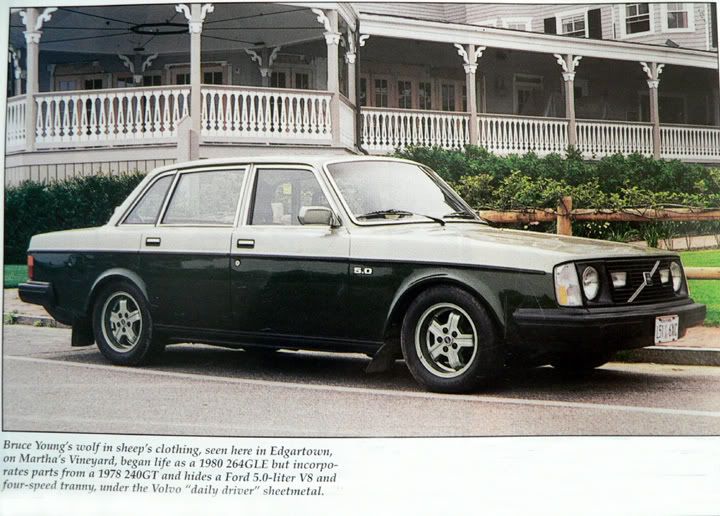
'80 GLE V8 (Sold 5/03)
'83 Turbo 245
'76 244 (lasted only 255,000 miles)
73 142 (98K)
'71 144 (track modified--crusher bound)
New 144 from '67 to '78
Used '62 122 from '63 to '67
|
|
posted by
someone claiming to be Mike
on
Fri Nov 21 03:15 CST 2003 [ RELATED]
|
|
I'm new to your specific posting, but have had a similar problem for two years (fixed it about a month ago). Let's start with a no-start algorithm that works in any situation, so that we don't miss anything common (my mantra is "common things occur commonly")
Do you hear a brief "hummmmmm" when you turn the ignition key? If not, your external fuel pump and/or fuel pump relay is faulty. A quick check of fuel pressure is removing a fuel injector (10 mm socket), crank the engine, and check for a fuel spray; fuel spray = ok pump and relay.
When you turn the igntion, you should hear a "click, click, click" of the starter. No click = dead battery and/or defective starter.
Next, pull a spark plug and ground it against the frame or engine. Have someone crank the engine. A spark means your ignition system is ok.
I assume that your car won't start or starts with difficulty ONLY when the engine is cold and/or it's cold outside, right? Here's what was wrong with my car, a 1980 B21F with LH Jetronic (1979-1982). To the best of my knowledge, your car has the same equipment. Immediately behind your distributor and attached to the engine block is the control pressure regulator (CPR), a silver piece of metal with two black hoses coming out of it and a wire assembly. This CPR was defective in my car. I went to a junkyard and got a replacement part for $20 ($70 at fcpgroton). The plug removes without tools. You'll need a 5 mm Allen/hex wrench to remove the two mounting bolts (that's the hardest part of the job, try using a 5 mm hex socket instead of those damn "L" shaped keys which I'm always dropping and are hard to get adequate torque). Remove the banjo fuel line fitting with a ratchet and 14 and 12 mm sockets. Replace it and see if the engine starts. Over the past month, my car had only one episode of difficulty starting and that worked out on the second attempt.
Other areas to check are the air auxiliary valve. That's the pointy, almost metal, silver structure mounted to the engine block on the same side as the intake manifold. Remove the two 5 mm bolts and clean it out.
To me, it does NOT sound like a head gasket problem. Check for coolant in the oil (milky/honey appearance) and oil in the coolant. Run a compression test (normal is >128 psi per cylinder and no more than 10% variation between cylinders) and a leak down test.
|
|
|
|
|
Thanks for your replies.
Forgot to mention it : 1988 240 Wagon, 340,000 kms, LH Jetronic 2.2. I did check the ECT, the O2 sensor, the air mass meter as well as coil, rotor, plugs and wire last winter and everythign was fine then (this will be the fourth winter I've had this problem). My mechanic checked fuel pressure two weeks ago and it seemed OK. I will go through another check of the electrical components though, and go by elimination as suggested. I'll also check all the ground connectors. Last year I was experimenting funny symptoms : Every now and then, the tailgate wiper would stop running, the center stop light would stay on and turn off when I put on the brakes and the engine would keep firing after shut off, but only if I held the brake pedal. I realized all this was happening when I had the tailgate shut thight, but not if I just let it lean against its stoppers. I discovered all this was caused by a loose ground wire in the tailgate's hinge. So I know now these bad ground connections can lead to puzzling diagnostics!
Next step would be a compression test, which I cannot do myself...
Thanks again!
Richard.
|
|
|
|
|
Cold starting means engine needs a richer than normal mixture. The ECT tells the ECU to shoot in more gas. BUT - if there is an air leak, that makes the mixture leaner, and makes cold start harder if at all.
Vacuum leaks can occur in the intake manifold gasket. One test is to use carb cleaner. With the engine running, spray around each manifold rail. Where there is a vacuum leak the cleaner will be sucked in and the engine speed will change.
Replacing the intake manifold gasket is not a big DIY job. The things attached to the manifold don't have to be removed, mostly.
Another spot to check is in the corrugations on the bottom of the main air inlet hose. I replaced that air hose on my 1988 at a cost of about $20 last year, aftermarket. Only when I got the old hose off could I see the hole in it. Couldn't even feel it with fingertips! Odds are your car is ready for a new hose, just based on age.
Good Luck,
Bob
:>)
|
|
|
|
|


