Volvo RWD 200 Forum

INDEX FOR 1/2026(CURRENT) INDEX FOR 7/2016 200 INDEX

[<<]  [>>]


THREADED THREADED EXPANDED FLAT PRINT ALL
MESSAGES IN THIS THREAD


  REPLY TO THIS MESSAGE    PRINT   SAVE 

Foster, Bruce Y., or any electrically minded contributors - Riddle me this. 200

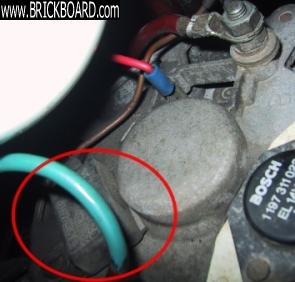
What is this doo-dad (circled in red) on the back of my alternator? There is a brown wire from it to the B+ terminal. There is not a device like this on the spare alternator I took from my old '79.
Does the device in question have anything to do with energizing the field so that charging can occur?
I inquire because something has been puzzling me for a while. I bought the car in Oregon in 2001 and the previous owner informed me that the alternator warning light didn't work. All it meant to me at the time was that I should replace the bulb. I have since learned, in this very forum, that the warning lamp must be functioning in order for the alternator to start charging the battery. I drove from Oregon to Kansas City over the course of four days with the warning light not functioning. I drove mainly during daylight hours but I used the headlights a few times the longest being for about three hours on the last night of the trip. I continued to drive the car occasionally for a couple of weeks before I looked for the cause of the problem. It turned out that the thinner red wire from the warning light to the alternator was broken. I spliced it and the light worked. I have not had any battery/alternator problems before or since.
It seems to me that, even without using the headlights, if the alternator was not charging the battery, the car should have shut down somewhere in Idaho or before. Do I just have the worlds most powerful car battery? I can't see any other sign of creative wiring to the alternator. Being an electrical dumbshit, I am at a loss for an explanation. Unless the warning light 'on' condition is not true of all 240 alternators. Enlighten me, please.
--
'80 DL 2 dr


  REPLY TO THIS MESSAGE    PRINT   SAVE 

Foster, Bruce Y., or any electrically minded contributors - Riddle me this. 200

So does anyone know if the capacitor is internal on rebuilt and later units? Like I said, the 55w alternator off of my '79 doesn't have this item. I had it rebuilt locally. The alternator from my '84 doesn't have one either.
--
'80 DL 2 dr


  REPLY TO THIS MESSAGE    PRINT   SAVE 

Engineering discussion on Alternators, Capacitors, and Battery Light question. 200

If you should ever look at the un-loaded output of an Automotive alternator, you would be astonished at what shows up on the scope. Huge spikes upwards of 1,000 volts, RF noise, Inductive kicks, etc. The alternator is (electrically speaking) a very noisy device that will destroy just about every electrical device on your car if it's output is not regulated, filtered, and damped.

The capacitor on the alternator helps to suppress some of the electrical kicks that your alternator produces. While it doesn't stop them, it helps to soften them and weed-out the larger ones and some that start passing into the RF spectrum and generate radio interference. Your car battery does the rest... The battery functions as a HUGE capacitor and absorbs the rest of the spikes that the alternator produces and helps to 'float' the voltage at a nice constant value. If it were not for the capacitor on the Alternator, your battery cable (between the alternator and the battery) would be radiating all sorts of RF noise at large amplitudes in a very broad-banded way.

During the late '90s while I was in college and interning at Donnelly Corporation, I had to perform several "Full-Field" tests on the electronic parts we developed before we shipped them for production. In the lab, we had test equipment that would simulate the Full-Field output of an alternator without a car battery hooked to it. All of the automotive manufacturers (Ford, GM, Mitsubishi, -all of them) did not expect the parts to survive this test, they simply wanted to make sure that they would not catch fire if these circumstances should arise. Let me say that again: If you should disconnect the battery of your car while it is running, none of the automakers expect the electronics within the car to survive. While in the design stages, much of the EMC/EMI issues can be simulated and addressed (before actually building a prototype) with advanced automotive electrical modeling. Software packages are developed for these applications and Saber Modeling is one of the "top-dog" computer electrical modeling simulators in the industry. While the benefits are great, the price will set you back about $1 Million US Dollars (said without putting my pinky finger to the corner of my mouth).

Lastly, regarding the battery light in your instrument cluster. When you initially turn your key to the ON position (but not to START), this sends power through the Battery Light to the alternator and energizes the electromagnetic field. As the alternator starts turning, the magnets are spinning with an pre-established field and thus it produces power right away. If the coils are not energized before starting the car, they can develop the fields on their own, but you have to get the RPMs up there a bit before they'll "kick-in." It's takes a moment since you're working with a ramp-up voltage (usually comes up pretty fast) rather than starting at full potential. You can watch this with a multi-meter hooked to the posts of your battery if you've disconnected the Battery Light.

Sorry for the extra info. -Fond memories of college and the cool toys (err, lab equipment) I got to play with. When we got bored, sometimes we'd blow holes through our co-workers styrofoam coffee cups with the ESD guns. Those were BIG electric shockers that could punch holes through objects the size of a few water molecules using only a few PicoFarads (thus generating a very slow and visually undetectable leak). Hmmm.....now lets go play with the sonic welder.
God bless,
Fitz Fitzgerald.
--
'87 Blue 245, NA 236K


  REPLY TO THIS MESSAGE    PRINT   SAVE 

Engineering discussion on Alternators, Capacitors, and Battery Light question. 200

More than I wanted to know. But very educational. Thanks.
--
'80 DL 2 dr


  REPLY TO THIS MESSAGE    PRINT   SAVE 

Foster, Bruce Y., or any electrically minded contributors - Riddle me this. 200

I've heard that an alternator will self exite over 2500-3000 rpm, as the alternator pully is smaller than the crank pully you probably were charging most of the time you were on the highway. Hopefully someone with a bit more experience with these things will give a definitive answer instead of hearsay. Bottom line is you made it, that's a good thing.

--
Dave Shannon
Spring Valley, California (San Diego area)
'84-245T 190K+
'88-240 190K+
'92 745Ti 150K
'01 Jeep Wrangler Sahara 10K
www.volvo2.homestead.com


  REPLY TO THIS MESSAGE Replies to this message will be emailed.    PRINT   SAVE 

Foster, Bruce Y., or any electrically minded contributors - Riddle me this. 200

Yes, some makes/models of alternators will self excite, it probably depends on there being some residual magnetism left in the rotor.

Years ago I fitted a Lucas ACR series alternator to a `65 Mustang which had no warning light, but did have an ammeter.

The charging kicked in only when the engine was revved to about 2000 rpm but once it got going it would then keep charging right down to idling speed.

Colin.

1990 740SE B200E/M47, remote C/Locking.


  REPLY TO THIS MESSAGE    PRINT   SAVE 

Foster, Bruce Y., or any electrically minded contributors - Riddle me this. 200

Self excite, huh? Sounds like your average junior high school age male. But it's the best explanation so far.
--
'80 DL 2 dr


  REPLY TO THIS MESSAGE    PRINT   SAVE 

Foster, Bruce Y., or any electrically minded contributors - Riddle me this. 200

Awww shucks, do you know how badly I wanted to go there, but I fought the temptation.
--
Dave Shannon
Spring Valley, California (San Diego area)
'84-245T 190K+
'88-240 190K+
'92 745Ti 150K
'01 Jeep Wrangler Sahara 10K
www.volvo2.homestead.com


  REPLY TO THIS MESSAGE    PRINT   SAVE 

Foster, Bruce Y., or any electrically minded contributors - Riddle me this. 200

I admire your restraint.
--
'80 DL 2 dr


  REPLY TO THIS MESSAGE Replies to this message will be emailed.    PRINT   SAVE 

Foster, Bruce Y., or any electrically minded contributors - Riddle me this. 200

It's a capacitor. Filters out noise, aka alternator whine, or reduces it.
--
Don Foster (near Cape Cod, MA)


  REPLY TO THIS MESSAGE    PRINT   SAVE 

Foster, Bruce Y., or any electrically minded contributors - Riddle me this. 200

So no opinion on the warning lamp anomaly?
--
'80 DL 2 dr


  REPLY TO THIS MESSAGE Replies to this message will be emailed.    PRINT   SAVE 

Foster, Bruce Y., or any electrically minded contributors - Riddle me this. 200

Sorry, didn't read beyond doo-dad.

To my knowledge, the alternator idiot light must have continuity in order for the alternator to charge. But I've never verified that rumor nor have I faced the problem myself, so I can't share firsthand experience with you.

It's possible that you sinply started out with a very well charged battery.

I had bad alternator brushes in my '90 when I bought it last year and drove it almost a month (about 350 miles) before it quit on the road. I got a lot from that battery before it died.

Someday when you're looking for a good experiment, measure your battery voltage at idle. Then unplug that red wire and re-measure the voltage at idle. See if it drops from 14 volts to 12.5 volts without the red wire.
Write up the results and report back here...


--
Don Foster (near Cape Cod, MA)


  REPLY TO THIS MESSAGE    PRINT   SAVE 

Foster, Bruce Y., or any electrically minded contributors - Riddle me this. 200

I will do that. Thanks.
--
'80 DL 2 dr


  REPLY TO THIS MESSAGE Replies to this message will be emailed.    PRINT   SAVE 

Foster, Bruce Y., or any electrically minded contributors - Riddle me this. 200

that's the noise suppressor, keeps alt whine out of the radio and speakers. as far as your trip, just lucky, i guess. good luck, chuck.


  REPLY TO THIS MESSAGE    PRINT   SAVE 

Foster, Bruce Y., or any electrically minded contributors - Riddle me this. 200

Thanks, Chuck. Now that you mention it, I always have been pretty lucky.
Maybe I should do an endorsement for Interstate batteries.
--
'80 DL 2 dr


<< < > >>


©Jarrod Stenberg 1997-2022. All material except where indicated.


All participants agree to these terms.

Brickboard.com is not affiliated with nor sponsored by AB Volvo, Volvo Car Corporation, Volvo Cars of North America, Inc. or Ford Motor Company. Brickboard.com is a Volvo owner/enthusiast site, similar to a club, and does not intend to pose as an official Volvo site. The official Volvo site can be found here.