|
|
|
Hello,
I have an issue with the coolant on my 1990 760 GLE. Just bought the car. It runs great, but the coolant is disappearing. The previous owner did tell me that this was the case and that he regularly (once every couple months) had to refill the coolant. I did not run into any engine issue. However, just a few days ago I added almost a whole bottle of coolant and filled up the expansion tank just below the max mark. I checked it again tonight and the coolant was totally gone from the expansion tank. It is *not* leaking down to the floor of my garage at night and I just can't tell where the liquid is going. I tried to fill around that bigger hose that goes from the expansion tank to the radiator and the underside of it felt cold and wet. Since the whole engine is very dirty; I am not sure if what I see or feel in there is oil or just coolant that has been leaking over dirt. There is some liquid on the large metal bars at the bottom directly below the hose.
Sooo....my totally inexperienced guess is that the hose is messed up and when the pressure is high (the car is running) the coolant leaks through it...
I also have what appears to be an oil leak dripping from that large bolt under what I think is the oil pan (I can see it pretty clearly just kneeling down at the front of the car). At least I hope the leak comes from there, not from higher up.
Any way, I'd say the oil leak is less scary because at least I can see it, which is not the case for the coolant.
The thing is, my local Volvo mechanic doesn't want to touch the car because it does not have a Volvo engine, and I do not know of another trustworthy (and yet not too expensive) place to have this checked out right now.
Any hint of what to look for? The first thing I did is make sure I have coolant and oil in the trunk. Second thing is I wiped out the wet stuff under the hose and I plan to check it out again for wetness after coming back from work tomorrow...I think I'd be happy if only a hose needs to be changed :)
David.
|
|
|
|
|
Hello David
I have had coolant leaks with the B280F, and they can be a bit of a bear to track down. You've received some good advice to date, but some of it does not apply to your car.
Fundamental checks:
1) oil dipstick-- does the oil look normal on the stick? It should be somewhere between honey and black like ink, but definitely not like a chocolate milkshake. If there is milkshake oil, you are leaking your coolant into your oil.
2) Transmission fluid at the dipstick-- does it look clear and pink? If it looks like strawberry milkshake, your transmission fluid is being contaminated by coolant.
3) Exhaust pipe-- when the car is warmed up from driving for a while, is there any white smoke at the tailpipe? Particularly if it smells a little sweet, then you have coolant being burned by your engine (leaking into the combustion chamber). Another useful thing to do is remove one spark plug at a time and look for one that looks perfectly clean compared to the other-- this would suggest a head gasket leak.
4) Coolant recovery tank (where you put the coolant in)-- is this part full of oily scum? That would indicate an oil leak into the coolant.
If not, then you most likely have an external leak. Look in the valley between the banks of cylinders-- is there coolant (green) or a white crust in there? Carefully inspect all the hoses, the heater control valve, the base of the coolant recovery tank, the radiator tanks and hose inlets and outlets. Look at the water pump (behind the fan on the motor), particularly at the back where the gasket is. There are coolant bypass hoses that go into each head-- the gaskets leak where the steel hose bosses attach to the aluminum heads (dissimilar metal problem resulting in corrosion). There are to hoses exiting the back of the water pump, one big fat one and a smaller one. Check those carefully. Sometimes getting the car warm and then looking immediately after shutdown is the best way to find leaks-- the system is still pressurized to some degree but nothing is moving anymore.
Definitely shampoo the motor-- get some engine shampoo spray and take it to a pressure washer-- don't blast electrical components-- otherwise it is pretty safe.
Leave cardboard under the engine compartment after you shut it off and check an hour later for stains.
Practical concerns-- watch your coolant level very carefully-- keep it topped up. Watch your temperature gauge-- if is getting hot, stop driving it! You need to find a mechanic who is willing to work on this car and who has the know-how and access to special tools. Taking a head off of one of these cars is not trivial-- there are steel cylinder liners inside the aluminum bores-- if the head is removed incorrectly, the liners will move and you will have coolant leaks at the base of the cylinders and you will have a whopping repair bill. Any shop should be able to pressure test the system to locate the leak if you can't find it yourself-- you may get lucky and just need hoses or a radiator.
Good luck-- those 760GLEs are nice cars-- they tend to be bargains because of the undeserved bad reputation of the B280F, which is actually quite a robust motor.
--
Herb Goltz, London, Ontario, Canada '92 245 w/109K mi
|
|
|
|
|
Hey, thanks very much for taking the time to write this!
Tonight I went to buy a powerful flashlight and opened the hood right after coming back from work and pulling into the garage. And well...I think I found where the coolant is.
I didn't check the fluids yet but last time I looked at the oil, it had the right color.
Is the water pump that thing that is at the top, right behind the radiator's big fan?
There seems to be some green mold on the left side of it. There's a really big hose on the left and a very big one that goes to the radiator, but near the big one on the left there is also some kind of hole with no hose, looks like some kind of bolt in there and it looks like the green mold is coming from there. Right in the center of the engine block, under everything else (so I assume right between the cylinders and directly under the engine block) there is a metal beam and a lot of green liquid is resting on there. I guess it runs down from there when I am driving.
Sooo....does it look like it's the water pump that needs to be replaced?
However, that's not the only place where I've found some green. There is also a little bit on the left side; right at the foot of the battery and on a connector on a cable running from the battery. I am not sure how it got there. Maybe the coolant falls on a belt somewhere and gets thrown around, or maybe ahose is messed up in that area, hard to tell. One looks a bit weird but I cannot really explain where it's located. To the left, close to one of the pullies that carry one of the belts...
Also, right behind the water pump (if it really is the water pump), and a bit below, there is a very big pipe or hose connected, that goes right below the engine block, and the connector is very corroded and messed up.
Darn...
|
|
|
|
|
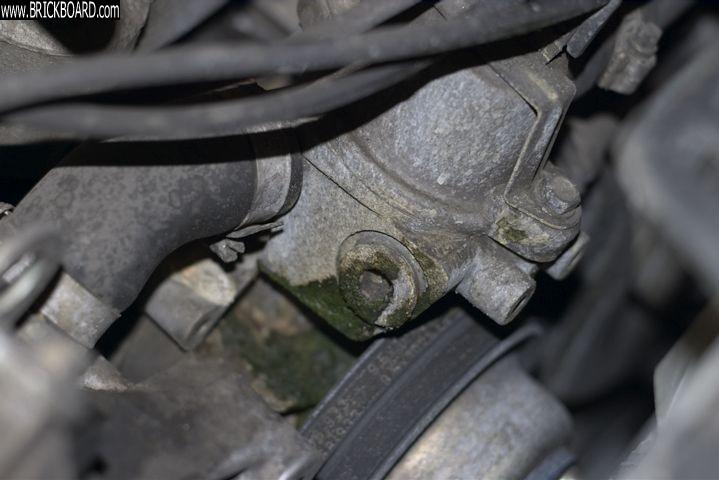
A picture is worth a thousand words, so here is the mug of the offender. Now tell me this is not going to cost a million bucks!

|
|
|
|
|
hmmm a threaded plug where my car has a temp sender. looks easy enough, remove it, clean the threads on both the plug and the housing, add some thread sealer and put it beck together. find/cure the leaks one at a time.
--
80 262C Coupe- (FSO black, M46, original) 82 244GLT- (auto)
|
|
|
|
|
Thread sealer? OK, I'll try that tonight. Thanks!
|
|
|
|
|
That "cap" on top, held on by two bolts, is your thermostat housing. Might also be a good time to do your thermostat as well, not a difficult task at all. Make sure the end of the top radiator hose is tight and not split either. As you cure one leak often another "weak" spot will reveal itself... one slice at a time, you'll slay the lil dragon.
--
80 262C Coupe- (FSO black, M46, original) 82 244GLT- (auto)
|
|
|
|
|
Thanks for the info. I have found a local shop that seems serious and they will look at the car in a couple days. We'll see what they come up with. I think I found where a hose is messed up (in addition to the pump area). I like to learn about how all that works from all the answers I got on this issue but I am not yet sure enough of myself to pay for spare parts that I might not need or might not be able to change, so it's time to let a professional take care of it, as long as it's a good one :)
Although, I'm writing down a lot of the things I learn here and will make sure I ask the right questions once there and nothing gets left out!
While I will let them take care of the engine repairs I will get busy working on the electric seats, which I feel more comfortable with :)
Thanks again!
|
|
|
|
|
Well this is a big disappointment.
The shop I took it to wants 734 bucks to fix the coolant problem. Apparently to change the waterpump that is leaking, and the six hoses that are attached to it.
I cannot believe this particular problem could be *that* expensive, sooo, I guess I will have to get the parts and do it myself. Can somebody point me to the correct water pump that I would need to buy for the 1990 760 GLE, and exactly what those 6 hoses are?
Also, they quote me a price of about 600 bucks to fix the oil leak (I am not sure where they said it came from but it involves the word "gasket").
Gee, this car is so nice though...
|
|
|
|
|
Sooo, here's the deal.
I have to replace the water pump, thermostat, 2 upper hoses, 2 rear hoses, upper radiator hose and lower radiator hose. I might be wrong (and hope I'm not) but it just doesn't seem like this should cost $700+
Aside from that, per what the garage is saying the oil leak comes from the timing chain cover gaskets. They are claiming that this last one is labor intensive and will cost over $600... (although at this point the coolant issue seems like a much bigger problem).
Aside from that the front strut rod bushings need replacing but that's another story. Need to read up on that...
|
|
|
|
|
Well, I have done the water pump job in question about a half dozen times over the years and it's no picnic. To be done right, you'll need to pull the intake manifold. The repair shops wanted to charge my friends a similar amount and that's how I wound up elected to perform the task. Overall it's not extremely difficult but there's a lot of things to remove and wires/hoses to label. Need a bunch of things like intake manifold and Y-pipe O-rings, copper washers for the fuel injection hoses, and a few other odds and ends in addition to the hoses and pump you're already looking at. Probably also wind up replacing the engine V belts at the same time.
With regard to the timing cover gasket, I've never done one but i can see its going to be a similar incovenience. To do both jobs, some of the stuff to remove for the water pump will be the same items needed to remove in order to pull the timing cover. The block is aluminum so you'll need to be real careful not to nick anything unless you want a leak worse than the one you have now. You have to set the motor to the overlap mark and remove the starter, jam the ring gear so the crank can't move. Volvo sells a special tool to hold it in place. I would have someone verify the leak location with a dye indicator before tearing into it.
--
80 262C Coupe- (FSO black, M46, original) 82 244GLT- (auto)
|
|
|
|
|
Would the procedure to change the water pump on the 280F (1990) differ greatly from the 280? I have the Chilton book that explains that procedure for the 280 (covers the cars only up to 1989) and it looks like it doesn't require going under the car but removing the radiator and fan. They specifically say the procedure is essentially the same as for B28F but doesn't involve removing any intake manifold part...
|
|
|
|
|
I stand corrected as the manual I have details the 280 as not needing the manifold removed. I have only worked on B27F's and B28F's and thought the B280F looked strikingly similar in it's construction. All i know is it sure makes the job a TON easier on the earlier V6's.
--
80 262C Coupe- (FSO black, M46, original) 82 244GLT- (auto)
|
|
|
|
|
I didn't intend to correct anyone as you undoubtedly know this stuff a zillion times better than I do. But I have this book that I'm trying to use for some guidance, and I guess it's just much less scary to me if I don't have to get under the car...(and cheaper, as I don't have anything to jack it up). So I'll see how it all works out and if I need to do that or not.
In any case, I've made the jump and ordered the pump.
I am preparing an online order for the hoses but I have an issue there. I have the upper radiator hose already. I am ordering the lower one. I am also ordering the 2 bypass (short and fat) hoses that go to each cylinder head from the pump. Also, I am getting the bypass hose (even shorter and fatter) that comes out from the lower back of the water pump. That one is bulging and the clamp has exploded. However, there is another hose right next to that one, but much thinner, about half thinner, that I think I need to change too (even though it looks alright), or probably should change. But I cannot find any reference to that one. Do you know how it's called? It doesn't seem to be on the FCPGroton site.
And I am getting the hose that brings coolant from the expansion tank into the radiator on the left. I suppose it's what they call the "Expansion tank hose".
Also getting a gasket/seal kit.
If I manage to do that myself, it will cost me $550 less than if the shop does it, which is enormous.
David.
|
|
|
|
|
I am fairly sure that other smaller hose you speak of coming directly off the back of the water pump is one of your heater hoses. I found those very tough to find other than at the dealer who wanted like 30 bucks each. While expensive, you do get a tough-cloth-tape-wrapped, bent-in-four-spots, two-different-diameters hose for the price.
I am glad you're taking the 'replace it all' approach to this task, i certainly don't want any reason to dig back into one of those.
With regard to the savings, where you are really saving the most money is in doing the job right yourself and doing a much better job than some guy who doesnt want to touch a V6 in the first place and then having to repair the repair later on.
--
80 262C Coupe- (FSO black, M46, original) 82 244GLT- (auto)
|
|
|
|
|
Yeah, I want to replace them all if I can. I am fairly sure that the previous owner never did that so it's just due for a change anyway, even if that one might no be leaking yet.
It looks like a fairly short hose though, about 10cm long. I can drop by the dealership that is just minutes from where I work.
My usual mechanic still hasn't seen the car. I just took it to another garage, but really, it doesn't look like a difficult enough job that they should charge so much.
Now I think I'm just goind to start taking this apart to gain some time, as soon as I figure out where that darn coolant drain cock is! Supposed to be on the side of the engine but I just can't find it.
|
|
|
|
|
You'll have a much easier time finding leaks once you get the engine compartment clean. You can do it yourself if you have a hose. Use some Simple Green spray; it works pretty well. Don't spray directly on any wires or directly where the wires seem to plug in, but you don't have to keep them perfectly dry.
If you check the engine when it's hot the first time after you've topped off the coolant you might be able to track down the coolant leak.
What kind of engine is it, by the way?
--
87 745T, 97 855
|
|
|
|
|
Cleaning the engine compartment seems really scary. The whole thing is filthy...
It's the V6 engine. 1990, the B230F I think?
|
|
|
|
|
>The thing is, my local Volvo mechanic doesn't want to touch the car because it >does not have a Volvo engine...
The B230 IS a Volvo engine. Anyway, I find cleaning the engine compartment makes it much less daunting to explore. Just spray the cleaner around in there, let it soak for a few minutes, then hose it off. You'll be much better able to find any leaks.
The Haynes manual includes some pretty good "orientation" pictures that will help you identify various components. If you don't want to spring for one, just take a look through it at the bookstore or library (the auto parts store near me seals them in plastic, probably so they don't get dirty fingerprints). I don't know the V6, but the water pump is almost certainly at the front of the engine. It has a pulley with a belt on the front, and you'll see a couple thick rubber hoses attached to it.
--
87 745T, 97 855
|
|
|
|
|
I will try to clean it and look for the spray at the auto store. Dumb question probably, but is it safe to use the water hose on the engine? Anything I should be very careful about when doing that? What do I do about the battery? It is just black and shiny with grim and its posts and cables too.
I have the Haynes manual for our 240 that I got for 10 bucks in a used book store so I want to try to find the one for the 760. I'm more of a driver than a mechanic but I've learned a few things with it. For example that the air filter on the 240 is a pain to replace :)
After seeing the photo of a water pump on the IPD site (since the mechanic is snobing my beautiful new car I want to try the oil change and fixing the drain plug leak myself), I think I know where it is...
|
|
|
|
|
It's safe to use a water hose to clean the engine. Just keep the full force of the spray away from any wires. It's okay if the wires get wet, just don't spray _directly_ on them or where they connect. Spray the big metal stuff and you'll be fine!
--
87 745T, 97 855
|
|
|
|
|
B280F, check your oil for any contamination by coolant!
--
80 262C Coupe- (FSO black, M46, original) 82 244GLT- (auto)
|
|
|
|
|
Yeah, B280F. How do you check that?
|
|
|
|
|
David;
Dig around the FAQ too. Don Foster has posted some info about how to detect coolant in the oil.
--
Norm Cook Vancouver BC; 1989 745T 202,000KM
|
|
|
|
|
If there is coolant in the engine oil pan typically you'll see a white/brown frothy substance on the underside of the oil filler cap. When this is the case it's usually due to a bad headgasket... Check the cap and change the oil as you were planning on doing.
Odd that your mechanic won't touch your car, it's a Volvo engine, he probably doesn't know much about it. It's a GOOD thing that he refused considering the V6 engines are more sensitive than the 4 cylinders (so I've heard), any mechanic working on the V6 should know what he/she is dealing with.
Good luck,
Bean
--
'80 242GT 93k, '94 945T 139k, '89 765T 68k (new '94 B230FT)
|
|
|
|
|
"Odd that your mechanic won't touch your car, it's a Volvo engine, he probably doesn't know much about it. It's a GOOD thing that he refused considering the V6 engines are more sensitive than the 4 cylinders (so I've heard), any mechanic working on the V6 should know what he/she is dealing with."
LOTS of 'Volvo' mechanics "won't touch the 6 banger". You couldnt be more right about needing to know what they're dealing with as it's an entirely different design than the tried and true 4 cylinder red-block Volvo design. I have watched "VOLVO master mechanics" flinch when I mention a 6 cylinder (IMO- lazy wuss!).
It's not ENTIRELY a 'Volvo' engine though, it was jointly developed with Renault and Peugeot (sp?)... hence PRV motor. Even got put into the Deloreans, and some Maseratis too! The earlier versions of it gained it a bad reputation but properly repaired and cared for they can last a long time. It's finicky, delicate, difficult to tune but FUN FUN FUN on the road when they run right.
--
80 262C Coupe- (FSO black, M46, original) 82 244GLT- (auto)
|
|
|
|
|
Thanks for the reminder, I had forgotten that this was the PRV. I guess it's only 1/3 Volvo (by name at least!). Recently there was a guy near me (RI) that needed a headgasket done on his 780 V6, I would have loved to help him fix it but didn't want to cut my teeth on someone elses car. Maybe someday I'll pick one up and take it apart, I can't get enough (okay sometimes) of these cars!
Take care,
Bean
--
'80 242GT 93k, '94 945T 139k, '89 765T 68k (new '94 B230FT)
|
|
|
|
|
The oil filler cap seemed alright...
You are probably right about the mechanic not knowing this particular engine. He told my wife to sell it right away and buy a 4 cylinder. That we will only have trouble with it. That seems a little bit extrem and considering how smoothly the car is running after 145k miles and 14 years we can hardly call it a bad one. I just have a little leak to repair and a coolant issue, no big deal. But with such an answer to a current customer (he's serviced the 240), he's lost my business!
|
|
|
|
|
The last time I had the 'coolant dissapearing with no puddle on the floor' problem, it turned out to be a leaking heater-core. After pulling up the carpets, I found all the missing coolant - in the cabin and soaked into the carpets.
Hope that's not your problem: turn off your heater-selection and your heater (so no coolant flows into your heater-core) and see if the coolant stops dissapearing.
If that's not the problem, visually inspect the engine while you raise the idle (to boost the pressure) to see if you can spot the leak.
Noel
|
|
|
|
|
I don't think it's under the carpet. We have just totally cleaned the inside of the car including the carpets and I'm sure we would have felt it if a whole gallon of coolant was somewhere in there...
Also, I barely use the heater, as it's not that cold around here (South-East Arizona), but I'll try that anyway. That's for the suggestion.
I didn't think of actually looking at it while running the engine. I'll try that as soon as possible!
|
|
posted by
someone claiming to be auser
on
Mon Dec 6 16:43 CST 2004 [ RELATED]
|
|
Check for leak from water pump gasket, seals may leak because of corrosion on the pump mating surface.
|
|
|
|
|
Thanks. I will have to figure out what the water pump is first (I'm really not a specialist of this, as you can tell) but I should be able to find out. Thanks for the tip. First off I will look in the morning to see if the expansion tank level is still the same after the car has just been sitting all night.
|
|
|
|
|
I dont know if this applys to your situation but I have a 1990 760T and coolant was disapearing into the (later found with much difficulty) transmission via the cooling lines running through the radiator. My transmission fluid was kind of pink and had some slipping issues as well.
This issue of course developed on my first long trip in the car.
Anyway all you have to do is check your transmission fluid to see if this is your problem.
Rege
|
|
|
|
|
Well, it sounds maybe like the Heater Core is NG. My Volvo has Terrible heat also but not that bad.
--
92 240 2.3 L with a Borla! 104,000 Miles !!
|
|
|
|
|
It sounds like you core is partially blocked. Find were the hoses go into the firewall. If one is significantly cooler then the coolant isn't flowing well through the core. the heat will be especially poor when idling.
I was able to vastly improve the heating in my 740 by reverse flushing the core with a garden hose. That made a world of difference!
--
Paul NW Indiana '89 740 Turbo 110,000
|
|
|
|
|
Thanks, I will do that.
The thing to keep in mind though, is that it's not a new or sudden thing. The previous owner told me about it and that had been going on for a while, months probably, and no other malfunction seems to come as a result of that, which makes me doubt that it is leaking into something else...I'll get to the bottom of this :) They were apparently very sloppy in their care. I had to spend hours trying to get rid of 14 years of dirt from the alloy wheels...
|
|
|
|
|


