|
|
|
hello, bricknuts!
can any of you walking volvo encyclopedias clear this up for me about coolant and atf mixing?
This was posted by rule 308 in the 900 forum, the original discussion is here: http://www.brickboard.com/RWD/index.htm?id=917496
Well, since the trans line pressure is much greater than the cooling system pressure, when the cooler fails it is usually a one-way valve and sends atf into the coolant. I have done a bunch of these on the old red engines and by the time it gets bad enough for your average chuckle-head driver to realize there is a problem it usually has eaten up a bunch of the rubber hoses…. As far as the transmissions every one I have seen has been on an old read engine so I have no idea how the aw3040 is going to take to that. But like I stated there should not be much coolant in the trans at all. If you have a good auxillary trans cooler I would not worry about by passing the factory one. If you ever cut the side tanks off of one and looked at the cooler you would realize that there is not a whole lot going on there in the first place. Flush the coolant, run it on simple green and water for a couple of hours (may even want to let it cool all the way down once before you drain it),flush the trans good and proper, and run it.
and here is a different viewpoint from fitzfitzgerald, the original discussion is here: http://www.brickboard.com/RWD/index.htm?id=926786&show_all=1
If the tranny fluid is pink (like a Pepto-Bismal milkshake) you probably have a leak between your cooling system and your tranny cooler. You should have two tranny coolers, an external one that's mounted between the AC Condenser and the Radiator, and a second tranny cooler that's mounted inside the radiator end-tank.
If engine coolant gets into the transmission, the Ethylene-Glycol in the coolant will disolve the clutch packs in your transmission (and start giving symptoms that you are experiencing). If this is the case, your transmission is not salvageable, unless you want to pay to have it rebuilt (which isn't cheap). I'd also change out the radiator, or your next tranny will suffer the same fate as the first.
(from a separate post)
http://www.brickboard.com/RWD/index.htm?id=929877
I would suspect that your transmission is still going to be in need of replacement in the near future, and I would strongly advise you to start shopping around the local salvage yards for a replacement one. The Aisin-Warner transmissions in our 200/700/900 Volvos are pretty bulletproof, but engine coolant will kill an automatic transmission. The Ethylene Glycol disolves the clutch packs and is not easily removed from the system. A typical American made transmission (Ford/GM/Chrysler) can fail in a quick as 2 weeks from the time of contamination with engine coolant. After reading almost a dozen or so accounts (in the last 2 years) of Brickboard members who have encountered this issue, it would seem that our Aisin-Warner transmission can go as long as 6 months to a year before failing (after contamination with engine coolant). Even though you've flushed the transmission ATF with fresh fluid, I would expect it to need replacement within a year from now (depending on contamination level, duration, and driving conditions).
the reason this is important to me is because my '89 240 with the red block engine and with original blackstone radiator had similar issues where there was reddish oil in the rad. expansion tank. (I think that's what killed my original tranny--car was driven for 15k-plus miles before the tranny went out.) at the time I didn’t think much of it until I did a coolant flush after I got a new tranny and still saw atf in the coolant resevoir, only then did I suspect some coolant/atf mixing issue. after reading about "catastrophic" cracking and the possibility of atf getting into the cooling system via the cooler lines, I got a new all-metal rad. installed. I got a new thermostat, uper and lower rad. hoses, and draining the cooling system (I don't think it was a flush in the sense that a garden hose was attached to it and water was ran through the system). my volvo indie said no need to flush atf (had it done about a month before by him). so, is he right and I shouldn't be concerned, as rule 308 says? I did an atf flush for a peace of mind though :o)
|
|
|
|
|
In one of the quoted passages (fourth paragraph, or the first large paragraph), it states, "...since the trans line pressure is much greater than the cooling system pressure, when the cooler fails it is usually a one-way valve and sends atf into the coolant...."
This is not so, at least most of the time. If you have ever done a transmission fluid "flush" using the hose technique (e.g., using IPD's kit hose), you would see that the ATF pressure is low. The pressure gradient (ATF versus coolant pressures) depends on the state of the engine:
When you first start up a cold engine, there is little coolant pressure, so the ATF pressure, although modest, is greater.
As the engine warms to normal operating temperature, the coolant pressure also rises, and soon far surpasses the ATF pressure. And this gradient, in this direction (i.e., higher for coolant and lower for ATF) increases further after shut-down, when there is zero ATF pressure and the coolant remains hot and pressurized. Only when the coolant has cooled to ambient temperature will the coolant pressure also drop to zero and equal the ATF pressure (also zero).
And then, when you start up the cold engine again...[back to the beginning].
So the majority of the time when there is some pressure gradient, it's the coolant that has the higher pressure -- ATF pressure is greater only for the short time the engine runs until its coolant warms up. And so one would expect a greater transfer of coolant into the transmission fluid than vice versa -- as well as doing the worse harm, as the cooling passages can tolerate some ATF far better than the transmission can tolerate some coolant.
|
|
|
|
|
I just past week had problem with ATF and coolant mixing. It most definitely can happen and did happen to me. Not sure how long it had been happening for but definitely had coolant in my ATF. Actually to be exact 6% of ATF was coolant. Know as I had it chemically analysed. Switched radiator to a known good one(tested and only 2X years old)(problem/bad radiator was original from 1988) and flushed tranny. Problem so far has gone away. Sure hope it did not do damage to transmission. Guess will see in time. Hope this helps.
|
|
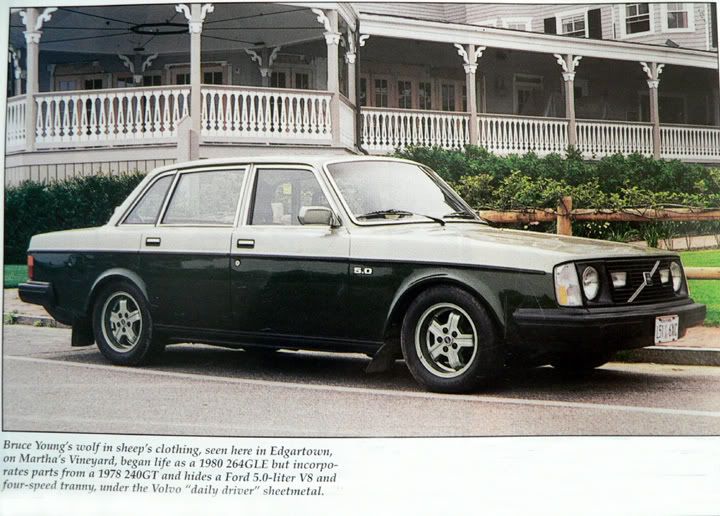
|
|
"Well, since the trans line pressure is much greater than the cooling system pressure, when the cooler fails it is usually a one-way valve and sends atf into the coolant."
Not sure what your question is, but I tend to think that coolant can get back into the coolant when the engine is shut off—contrary to the above.
The tranny pump stops and pressure drops, but the coolant system holds pressure for a long time. Seems like this residual pressure could force coolant into the (leaky) ATF cooler (immersed in pressurized coolant) and possibly into the ATF return line, which could even develop a slight negative pressure when it drains back to the tranny.
The ATF contamination might be small each time, but it would be circulated thru the tranny when running, and added-to with every shut down. This could explain the Coolant-to-ATF cross-contamination, IMO.
--
Bruce Young
'93 940-NA (current) — 240s (one V8) — 140s — 122s — since '63.
|
|
|
|
|
sounds like you know what info is out there
flushing the tranny is a requirement, just as flushing and cycling out any other fluid
some you do more often than others
engine oil - often
rear differential fluid - infrequent
every 60K is the good thumb rule for tranny, brake, and radiator fluids
every 30-40K for brake fluid
rear diff is like 120K
--
big rich in arkansas '62 544 132K, 85 244 220K, 95 855 115K
|
|
|
|
|


