|
|
|
Hi all,
I noticed a couple bulges on my drivers side front brake lines. I talked perviously to a volvo mechanic and he told me the hoses are double walled and a failure is not that likely. I don't want to change them if I don't have to on the other hand i want to be safe. Has anyone ever had one fail. Their original and I have 476,000 km on the car
Thanks
|
|
|
|
|
For heaven's sake, if they are bulging you are mad to consider driving until they are replaced.
|
|
|
|
|
I've got to agree with that. If you're worried about problems getting the old hoses off, try the following: use Bruce's trick to keep fluid in the master cylinder (depress & block the pedal) then cut the flex hose off at the fitting, at each end. Heat the fitting with a torch - being careful not to apply heat directly to the rigid line, it'll melt if you use acetylene on it - you want to heat the female fitting on the hose. WEAR SAFETY GOGGLES & GLOVES! Glasses aren't enough, the inner liner of the hose is going to melt shut, the brake fluid is going to boil, and then the fluid will burst out of the hose with great force. 9 times out of 10 that happens when you do this, so be prepared for it, keep your face out of the way! Once the hose fitting starts to glow, grab your wrenches & crack the fittings open, then stand back & wait for the steam to stop as the fluid makes its way around the threads. This'll also lubricate the threads, so you can wait until it cools before getting your hands back in there. I've used this method every time since a mechanic showed me it, and since then I have never rounded off a line fitting while changing a hose. Makes very short work of the job, as long as your bleeder screws open.
-Chris
|
|
posted by
someone claiming to be johnwr
on
Wed Mar 30 03:22 CST 2005 [ RELATED]
|
|
One at a time, we hope. If both on a front wheel bulged, wouldn't you suspect prior damage, like when some misguided DIY type squashes the hoses with a clamp while doing work on the wheel? Good way to test the dual-circuit redundancy.
|
|
|
|
|
My god, man, they're like $8 each!! Put some new ones on there already!
Though you might want to buy a power bleeder to complete the job without losing your sanity...
--
Rob Bareiss, New London CT ::: Roterande Fläkt Och Drivremmar!
|
|
|
|
|
Thanks I'll look into it, looks like a good spring project
|
|
|
|
When you get into it (opening brake lines), you can prevent draining the Master Cylinder by propping the brake pedal about 1.5" depressed. The MC piston seals will then block off the reservoir ports, so you can leave lines open with no mess.
Disclaimer: this may not work if MC seals are really bad. But it's never failed me in the 10 years or so since I learned the rick.
--
Bruce Young
'93 940-NA (current) — 240s (one V8) — 140s — 122s — since '63.
|
|
|
|
|
Sorry Bruce can you explain this further. What do you mean and how would I do this.
Would a full system bleed still be required or just partial (front only)
Thanks
|
|
|
|
|
Any time a brake line is opened (replacing caliper, usually), the fluid will drain from the Master cylinder by gravity. As I said, propping the pedal depressed (a piece of wood braced against the driver's seat cushion) will keep the fluid in the MC.
Some people plug the open line(s) with a sharpened golf tee or similar, which does work. I just think propping the pedal is easier -- with no worries about the plug(s) falling out when no one is around. IMO, the plastic wrap under the cap is only marginally effective. Fluid will still drain until the loss creates enough of a partial vacuum in the reservoir.
Probably just a front bleed will be enough, as long as fluid stays in the lines from the MC. Better would be a complete system flush-bleed. I suggest some searches here to see what's involved, pressure methods, etc. The 700/900 FAQ will have info, but non-ABS 240 bleed sequence is not covered there.
Be prepared for a struggle with the fittings at each end of the rubber lines. Flare-nut wrenches are a must. You might want to start a new thread for more info on this. I only did it a couple of times, and that was years ago.
--
Bruce Young
'93 940-NA (current) — 240s (one V8) — 140s — 122s — since '63.
|
|
|
|
|
Thanks everyone looks like I got enough to go on
Much appreciated
|
|
|
|
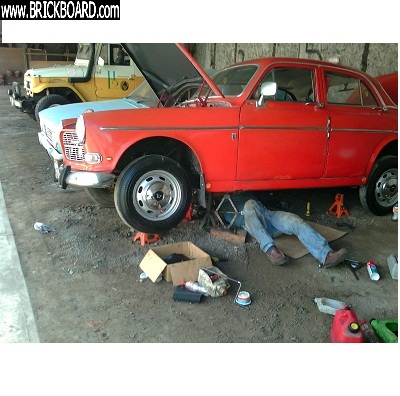
Also, you can uncap the reservoir, put a transparent plastic bag (any usual transparent plastic bag - kitchen available) over the reservoir and recap (plastic made a temporary seal). That trick works for me on volvo amazons (122s) and volkswagen beetles. Remember uncap and discard bag before tests.
|
|
|
|
|
This little tip is invaluable! Wish I'd known it a few years ago... Thanks Bruce!
-Chris
|
|
|
|
|
Glad you spotted it Chris. I try to pop it in brake posts when it looks timely. I should have added that the 1.5" is for 240, NON-ABS. (ABS 240 MCs work like 7/900 below, based on my one 240 ABS experience.)
It works on 7/9 brakes too, but the pedal has to be all the way down (drain a bleeder). This is in the 700/900 Volvo "green book".
Bruce
--
Bruce Young
'93 940-NA (current) — 240s (one V8) — 140s — 122s — since '63.
|
|
|
|
|
Yes, they fail. I had some with a bulge in it. I bought replacements. Before I started the replacement process, I pressed in on the bulge a little with my finger, and brake fluid actually came out of the hose. Before that point, the brakes had been working fine.
Bottom line, IMO, bulges = replace immediately.
Greg
--
http://home.earthlink.net/~greg.wong/
|
|
|
|
|
Yes, they fail. Sounds like you're pretty close to it. Double-walled they may be (actually I think it's one layer of teflon, then rubber, then fibre reinforcement, then more rubber) but they'll eventually die. In fairness to your source, it's rare for the hose to actually burst. Usually they'll blow apart at the fitting. Definitely time to change them!!!
--
Chris, Dartmouth NS Canada 70 M-B 280SE, 83 245DL, 84 244 turbo, 90 780 turbo, 92 VW Golf
|
|
|
|
|


