|
I did mine earlier today, after 'only' 105K mi. (And after 'only' 2 years
of it misbehaving.)
'Real' Volvo 'stats' have a little 'burp' hole in the diaphragm, so air
will not remain forever trapped in the system. One long-time Volvo
mechanic is superstitious about the angle of the car (level, uphill or
downhill) when he refills the coolant; he says it's tough to burp the air
out of some 850s. So I decided to be supersitious about the orientation of
the burp hole (upward, towards front of car) in mine when I replaced it.
The 2 screws had a kind of white powdery corrosion(?) in the threads that
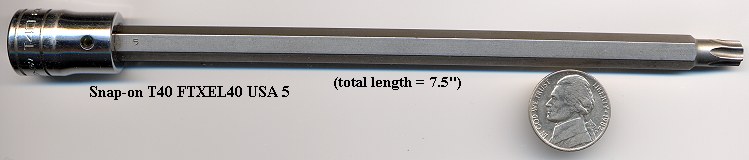
made them so difficult to break loose. Plenty of torque even for a 3/8"
ratchet with the heavy-duty torx bit! I liberally coated the threads with
anti-seize compound before reinstalling mine. The rear torx screw I'd
partialy stripped before I engaged it with the proper 'pro' tool is now in
the front position; it works OK from a small enough angle, and will be
replaced (easily, I hope, but I'll be better able to get at it "the hard
way" from there if necessary) next week.
Removing the plastic undershield is easy enough (a 10 mm bolt at each end),
then it unhooks in rear, then unclips from the front. Reinstallation is
simple if you paid attention to how/where it came apart.
The drain cock is on the l.h. (driver's side in U.S.) bottom of the
radiator. Draining 1/2 gallon is more than enough to make the job a dry
one, especially if the pail you use to catch it is clean and has a good
spout for careful pouring. The reservoir easily detaches from the fender
if you want to lower it a bit to watch the level fall to where the t-stat
is while you're draining coolant.
The upper radiator hose should be removed from the t-stat housing, but you
can (and probably should!) leave the little one alone, especially if you've
gained a bit of extra length by having unhooked (it'll slide up) the
reservoir from the fender.
As for the higher, disconcerting reading, now you know how I've felt for
most of the past 105K mi, since new. I kinda liked having a temp gauge
that told me if the engine was hot/warm/cool, instead of one that quickly
went past halfway and always stayed there. Which is how mine is again,
just like new. I wish mine worked like yours did (and always have); as it
is I'd prefer an idiot light (to a "gotcha gauge")!.
I think the engine is a bit happier now; initial throttle tip-in after not
having made the engine work hard for a long time is crisper, as if it no
longer needs to build a bit more heat before it's really ready to sparkle.
This might improve fuel mileage a smidge around town.
OTOH, the exhaust system definitly crackles along more of its length
towards the rear of the car upon shut-down; clearly it stays hotter. But
that may help the catalyst do its job more fully, too, as well as make it
harder for moisture to build up in the exhaust system.
As to why your gauge is now higher than it used to be, our cars came with
87 dC 'stats, and the [Volvo] replacements are [now all] 90 dC 'stats.
For a 5.5 yr old car, the coolant (repl once) and hoses were still in great
shape. We'll see how much they like hotter-than-new temps...
- Dave; '95 854T, 105K mi

|


 Thermostat replacement [850][95]