|
|
|
Took in car to be repaired and was told that plunger in air mass part is stuck and that it would cost between 500 to 600 to repair. Any suggestions on what to do? Can I simply spray carb cleaner to free it up, car starts up fine and by manually pushing on the gas petal it revs up fine, but driving it and going through the gears I can't bring it up to speed, 55mph tops any feed back would be appreciated. Was thinking of a conversion to a weber carb?
Thanks Gary FIRST POSTING Love this site!
|
|
|
|
|
Thanks for all the feed back, I spent all day searching the web and this is what I found, throttle body flap is what the mechanic was referring to. I found RPR Company Inc.discount volvo parts in Albany Ca. They have tech tips and it was under throttle body service that I found the most help and at IPD they have a throttle body kit. But what helped the most was finding Dave Shannon's volvo page on getting volvo issues answered, I really enjoyed his fixes and his plain English, I e-mailed him but it didn't go through if anybody has his new contact I'd appreciate it.
Thanks again, Gary P.S. Weber with some air horns loved to hear that coming down the street!
|
|
|
|
Hi Gary,
With all due respect, I think your "throttle body flap" is a mistaken conclusion. I base that on these words in your first post: "...plunger in air mass part is stuck...". There is no "plunger" in or near the throttle body, but there is one in the Fuel distributor & Airflow Meter, as I described below.
While throttle body service is probably worthwhile, I'm fairly sure it has no relationship to the problem you reported.
The early part of the K-Jet description below describes the "plunger" that I believe is stuck (as I have experienced).
================(canned post)=============>
K-jet Cliff Notes
Just rambling here, hoping to pass on some info and maybe learn something if anyone spots a mistake. This is as brief as I can be, trying to outline the basics of, and interaction between, these K-jet elements:
• Fuel Distributor
• Air Flow Meter
• Control Plunger
• Air Flow Plate
• Control Pressure
• Control Pressure Regulator
• ECU
• Frequency Valve
• Oxygen Sensor
The Fuel Distributor (FD) is the heart of the K-jet system — the black lump with all the hoses, sitting on top of the Air Flow Meter (AFM). Inside the center of the FD is a Control Plunger that moves up and down. The higher the plunger moves, the more fuel is sent to the Injectors by the hydraulic action inside the FD.
What makes the Control Plunger move up? Answer: The upward movement of the Air Flow Plate below it in the AFM. As the engine turns and sucks in air, the air flow lifts the plate. The more air flow, the higher the plate lifts the plunger, and the more fuel the FD sends to the Injectors. The amount of fuel is proportional to the engine's need, based on the air flow plate's position, temperature, and O2 sensor input. If the plate doesn't rise, no fuel leaves the FD.
But there's another force acting on the Plunger: the "Control Pressure", which is a special fuel pressure derived from the basic System pressure inside the FD, and regulated by the Control Pressure Regulator (CPR). Bosch also calls this device the Warm Up Regulator (more on that later).The control pressure acts directly on the top of the plunger, opposing the air flow plate's upward movement — but only enought to damp out pulsations and keep the air flow plate stable.
The plunger's height relative to the airflow plate is adjustable (a 3mm set screw in the plate). This provides the FIRST of three types of mixture control in the K-jet/Lambda system.
The SECOND type of mixture control is the "Control" pressure itself. The amount of control pressure is controlled by the CPR. So by varying the control pressure, the the amount of plate/plunger lift can also be varied for a given air flow. For example, by lowering the control pressure on a winter morning, the plunger and air flow plate rise higher than they would otherwise (for a given airflow rate), and more fuel is injected. The amount of air to the engine, being controlled my the throttle, does not increase significantly. The result is a richer mixture for cold starts. Of course the Cold Start injector helps too, but only while cranking.
With the engine started, and in a "cold running" state, the CPR gradually raises the control pressure on the plunger over a period of 2 or 3 minutes by means of a bi-metallic switch-controlled heater (and by heat soak from the warming engine). This slow rise in control pressure gradually increases the downward pressure on the plunger, causing the rich "cold starting" mixture to lean out toward a "warm running" mixture. That's probably why Bosch calls the CPR a "Warm Up Regulator" (WUR).
Once the engine is warm enough, the Lambda ECU "fine tunes" the fuel mixture, by means of the Frequency Valve (FV) that operates directly on the Fuel Distributor to "tweak" the mixture.
At first a default (fixed) frequency is in effect. As the engine warms up, this changes to a dynamically variable frequency in response to the signal levels from the O2 or Lambda sensor (More below).
This Frequency Valve influence is the THIRD, and most precise method of mixture control. (Recall #1, the fixed airflow plate to plunger relationship, and #2, the Control Pressure pushing down on the top of the plunger, based on the temperature at the CPR/WUR.)
The FV is basically an electrically pulsed fuel injector, in a line connecting one part of the FD to another. The more fuel the FV letsflow thru that line, the more fuel comes from the injectors (not directly from the FV), thus richening the mixture for a given airflow. Less fuel passing thru the FV means a leaner mixture. This Frequency-based mixture control is separate from the temperature-based control pressure-control plunger influence mentioned above. A 50% "duty cycle" means the FV is open half of the the time, closed the other half. The higher the frequency, more the FVos open, and the richer the mixture.
While the engine is cold, the Lambda ECU pulses the FV at a fixed 60% rate to augment the rich mixture already provided by the lowered control pressure. When the engine temp gets above 59°, the ECU reduces the FV duty cycle to a fixed 50% until an O2 sensor signal is detected.
At that point, the ECU begins to rapidly tweak the FV duty cycle back and forth a few degrees, based on the Oxygen sensor (O2) signal. This signal should vary around a mid-point of 0.5v, ideally between 0.2v and 0.7v. Signals dropping below 0.5v (lean indication) cause the ECU to increase the FV duty cycle. Higher (rich) signals cause the FV duty cycle to be reduced. A Duty Cycle (or Dwell) meter at the red wire CO test socket in th engine compartments will show the frequency bouncing above and below the nominal 50% rate, and is easier to read (narrower range) than the digital voltmeter.
Summary:
• For cold starts, the CPR lowers the control pressure on the control plunger in the FD, which provides a rich starting mixture. (The Cold Start injector also helps while the starter is engaged.)The CPR heater and increasing engine heat cause the CPR to slowly raise the control pressure, to lean out the mixture for warm running.
• For cold running, the ECU also contributes to mixture richness by pulsing the FV at a fixed 60% duty cycle until the engine temp gets above 59°F. Then the fixed FV duty cycle drops to 50% until an O2 sensor signal is detected.
• For warm running, the ECU rapidly switches the FV duty cycle a few degrees either side of 50% as it tracks the O2 sensor signal level. The FV duty cycle can be read with as "Duty Cycle" on red wire test point in the engine compartment. It can also be read as degrees on a Dwell Meter, using the 4-cylinder scale where 50% of 90° equals 45°, the ideal mid-range duration.
Extra Credit: That 60° duty cycle for cool running richness may also invoked for acceleration on some cars, by sensing a drop in manifold pressure, or by a throttle micro switch.
(Fun-seekers can also control it with a toggle switch. But with these gas prices....?)
<=============(end canned post)=====================
P.S. I haven't reviewed the above in some time, so there may be "imperfections";-)
--
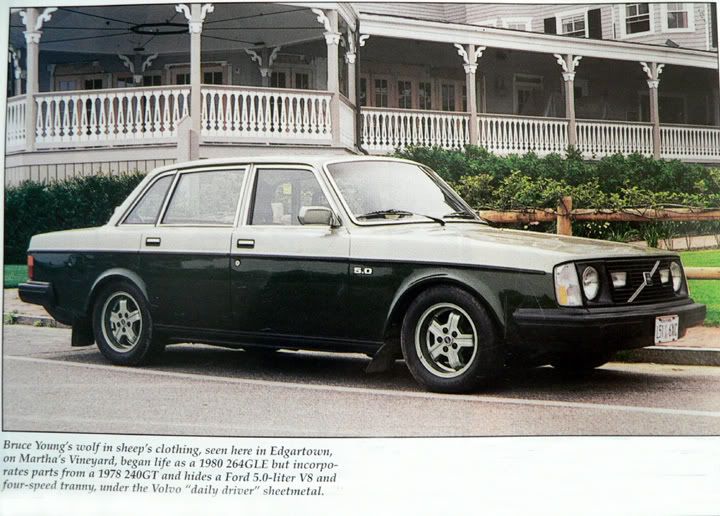
Bruce Young, '93 940-NA (current), 240s (one V8), 140s, 122s, since '63.
|
|
|
|
|
Thanks Bruce,
Boy after reading all that once, I think that's why I'd love to have carbs. This is all Greek to me, but I'll break it down and try to step by step solve this problem. Thanks to all with your input on this. What can anyone do to solve this from happening again? Is there fuel additives that can be used?
Gary
|
|
|
|
|
"Boy after reading all that once, I think that's why I'd love to have carbs."
• I'm sure a switch to (one) carb is possible, but have no advice on the details. Your problem here (assuming it's what I suggested) is extremely rare and usually brought on by long periods of not running. My only case was when resurrecting an '80 240 that hadn't run in 10 years. But it fired right up on whatever was in the tank when I replaced the snapped timing belt. I should have replaced the gas right then, but didn't. So 2 or 3 days later that Control Plunger decided to stick. Has your car been inactive for any long spells? Or is there any other reason to suspect bad gas?
"This is all Greek to me, but I'll break it down and try to step by step solve this problem. Thanks to all with your input on this. "
• Not knowing your experience level, I laid out what I know about K-Jet as simply as I could—hoping that the first 2 paragraphs would support my stuck plunger theory as something that could possibly be fixed. And maybe give you something to discuss with your mechanic (who may not know about the possible fix).
• Generally speaking, K-Jet FI is very reliable. But it does have some exceptionally close tolerances, especially in the Fuel Distributor. Just for background it was/is used on U.S. 240s from 1976 thru the 1985 Turbo and all over the world on everything from Alfa-Romeo to Rolls Royce–including Audi, BMW, Mercedes, Porsche, Saab, and VW.
"What can anyone do to solve this from happening again? Is there fuel additives that can be used?"
• Any auto/parts store should have many choices of fuel system and injector "cleaners" you could use. Chevron's "Techron" has a good reputation.
--
Bruce Young, '93 940-NA (current), 240s (one V8), 140s, 122s, since '63.
|
|
|
|
|
The Control Plunger (inside the Fuel Distributor) can become stuck due to gum and varnish from stale gas. Getting it out to clean and lubricate it means:
1) Removing the Airflow unit with FD attached.
2) Separating the FD from the Airflow unit.
3) Holding the FD in both hands and smacking it down on large socket.
The plunger's inertia when the FD's downward travel is stopped will (with luck) eject the plunger into the socket so it can be removed the rest of the way. Be careful not to scratch the plunger's surface in any way.
Maybe this operation and labor is what your mechanic plans to charge for?
K-Jet VIDEO from Art Benstein's site.
--
Bruce Young, '93 940-NA (current), 240s (one V8), 140s, 122s, since '63.
|
|
|
|
|
The air sensor plate on your K-Jet fuel injection system actually moves UP under increased airflow. At the other end of its mounting arm are the "plungers" that regulate fuel flow, in conjunction with the control pressure regulator. If you remove the bell-shaped rubber boot connecting the air-fuel control unit to the throttle body you can see the plate. It should be perfectly concentric in its opening. You can gently raise it up to see if it is binding.
If it only opens part way, it is telling the control unit that the engine is not demanding much air, so the unit will then not deliver much fuel. This is one sure recipe for low power, but there are plenty of others.
Terminology on the 'CI' abbreviation can be confusing, but Volvo seem to use CI to refer to the K-Jet system (Continuous Injection) and 'CIS' to refer to Constant Idle Speed systems. The Germans (ie: Bosch) spell continuous with a "K"...hence K-Jet.
Good K-Jet info here: http://www.k-jet.org/articles/information/k-jet-in-detail/
|
|
|
|
|
Hi. First of all, your symptoms sound like a failing main fuel pump (located under the rear seat, outside the car). It provides enough fuel for low rpm, but the combination of higher rpm and a heavy load requires too much fuel for this pump, and the engine is fuel starved.
Alternatively, have you filled your fuel tank to eliminate the possibility of a broken transfer pump (also known as in-tank pump, or pre-pump)? This pump has a small hose inside the fuel tank, and when it leaks, the engine is fuel starved when the tank is less than half full (symptoms disappear when the fuel level is higher than the hose inside the tank).
That said, and because of the strange terminology you used, is this a non-U.S. market car with a carburetor, rather than fuel injection? Your reference to switching to webers implies that, and a carburetor has the only "plunger" I can think of: the acceleration plunger on old carburetors to enrich the mixture.
There is no plunger in the Air Mass Meter (maybe the "air mass part" that you mentioned), in fact, no moving parts in the AMM: there's a wire by which air flows and it measures air flow by how much the wire is cooled (by changes in its electrical resistance).
There is a flapper in the Idle Air Control device, but that has nothing to do with engine function at speed -- it only affects idle.
The only other thing that has a moving part (other than the fuel injectors themselves, ha, ha) involved in the engine performance is the Fuel pressure regulator -- it has a diapragm (a "plunger" of sorts, maybe?) that is affected by manifold pressure -- and it might be limiting your fuel pressure to a point where your engine is fuel starved under a combination of high rpm and heavy load. The mechanic might have tried to describe a defective regulator to you?
Or else, he's giving you double-talk to fleece your wallet -- otherwise, the terms you used (from your mechanic) make little sense.
|
|
|
|
|
This car has CIS injection, Ken. It sounds like you're troubleshooting an LH system. I think he was just giving up on it prematurely and wanting to switch to a Weber.
|
|
|
|
|
I'm assuming the mechanic is talking about the air sensor plate. It could be crudded up enough to restrict movement, or it could be out of alignment. If you lift off the top of the air intake where the fuel distributor is attached, you will see the plate. I would wipe it out instead of carb cleaner, and make sure the plate is aligned by running a strip of paper around the circumference: it shouldn't bind up anywhere. Lift the plate and check for free movement. A sticking plate, albeit rare, would cause low power as it would allow less fuel to the engine. The CIS injection system is pretty sturdy. I'd be surprised if this was your problem.
Charlie
|
|
|
|
|
Thanks Charlie.
Now that the rains have stopped here in Calif I'll be looking into this, I did find this repair in question in my Chilton manual.
Thanks Gary
|
|
|
|
|


