|
There exists a bit of internet mythology about how that base idle test wire acts. As Phil mentioned, the valve has no spring, so if you pull the plug off of the valve, its flow is undefined -- could be anywhere. The test wire needs to set it at a known flow, not close it entirely, or it would not be able to reduce the idle speed from that base value when the engine condition required it. To do that, the valve is operated 100 times a second with a varying balance of on time for the "open" and "close" terminals. When you ground the blue/white wire test point, the computer sets this open/close ratio to a known, fixed value, not completely closed.
However, none of this can work if there is a second path delivering air past the throttle plate. The black knob adjusts the desired second path, and having the idle valve test wire grounded is supposed to allow that black knob to be set to the correct RPM. But that only works when the sum of the leakage is low enough to allow that knob to pass some air and not exceed the idle speed. The leakage can be checked by blocking the idle air path through the idle valve and closing down the black knob adjustment. If the car still idles with these two controls disabled, there is no way for the idle control to regulate engine speed. So you must first fix leaks (intake manifold gasket, throttle body gasket, throttle plate adjustment, throttle shaft bushings, brake booster, PCV system, cruise control, climate control, ignition load sense, etc.) before any computer system will be able to set the engine speed at idle.
Here is how I would troubleshoot.
First verify the TPS is telling the computer to control idle. Phil said the click doesn't tell all, and how right he is! Reading the signal with a voltmeter while operating the switch is the only sure way. I do that by sneaking a probe into the back of the ECU plug, inside the car, where it is clean. The pin is #3, and it has an orange wire in it, if you decide to do this verification. If it is working correctly, it will be near zero volts with the engine idling and no foot on the pedal. You touch the pedal, and the voltage should rise and then fall again when you let up. Consistently. Other folks might turn the car off, disconnect the plug from the ECU, and measure continuity to ground on pin #3. My way is better, but not easier.
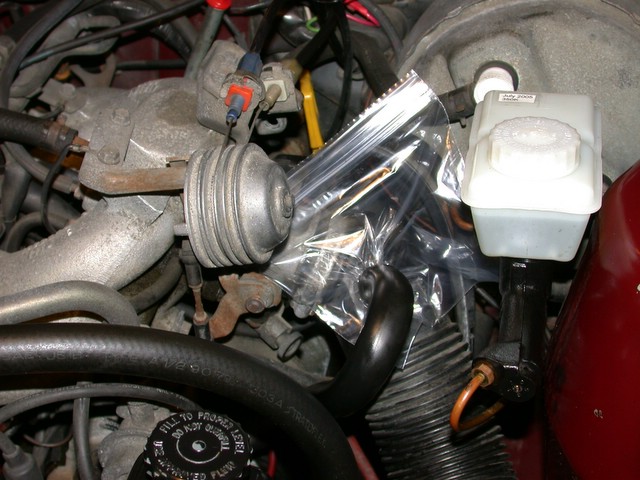
Second, I'd block the idle air valve path with some plastic film as in the photo to see if I was able to set the idle down below 5-600 RPM using the black knob. If the leaks are acceptable, I will be able to stall the motor when I close the black knob bypass valve. If not, I'd have leaks to investigate. That is what the CARB folks want you to do.
Third, and only if one and two are successful, I'd wrap my hand around the idle air valve and feel its vibration. If it isn't throbbing, it isn't working. There have been cases where someone has inadvertently swapped IAC and TPS connectors, and that results in the destruction of one of the transistors driving the idle valve, forcing it to open fully and not vibrate.
--
Art Benstein near Baltimore
My dog is worried about the economy because Alpo is up to $3.00 a can.
That's almost $21.00 in dog money.
-Joe Weinstein
|


