|
Hi Tinkerbelle,
Why would you replace the cylinder head? I'll hope you and your Volvo technician were able to exhaustively diagnose and deduce the cylinder head was at fault? Requiring you remove, rebuild, and reinstall the cylinder head? Quite an undertaking!
Is your 1992 normally-aspired (non-turbo) 740 wagon equipped with:
- Bosch LH-Jetronic fuel control / EZK ignition
- Bendix Regina fuel control / Rex ignition
Image courtesy iPd USA. The image shows the Bosch and Rex/Regina (Bendix) ignition coils.

????
Indeed, the engine, the cylinder head, actually, in your 1992 Volvo 740 wagon come fitted with two temp sensors:
- The front, dual wire temp sensor connects to the dash mounted engine coolant temperature gauge. Has no effect on engine control.
- The rear, dual wire, with the big connector, engine coolant sensor (ECT) connects, and used by the engine control (fuel and ignition).
Temperature Gauge Sensor
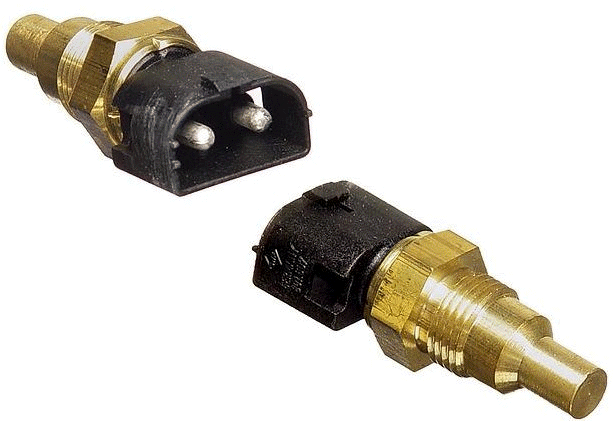
Engine Coolant Temperature Sensor (Used for engine / emissions control)

From the FAQ (Click FAQ at the top of each brickboard.com page), please read:
https://www.brickboard.com/FAQ/700-900/EngineSensors.htm#EngineTemperatureSensors
"I should maybe replace the 2nd temp sensor!If I do that ,do you think the cel will go away?"
You removed and replaced the ECT after installing the cylinder head? One would normally, I guess, remove, test, if need replace, and install cylinder head-mounted items like sensors and some other hardware before you install the (rebuilt?) cylinder head back on the engine, and install large components to the cylinder head like the air intake manifold, the exhaust manifold, the timing belt, coolant hoses and coolant.
Though some would install the cylinder head to the engine block, install fragile bits like sensors and some wire harness connections to the cylinder head, and then the bigger parts and pieces like the manifolds, coolant hoses, and such.
This brickboard contains innumerable articles that discuss how to access the ECT sensor to test it and replace it. Some may suggest intake manifold removal. Other remove all piping and the throttle body to gain access with a wrench. You cannot use a socket to remove it as the wire harness connector on the ECT sensor is to large.
" I should mention that I could only hand-tighten the sensor I put in,and I had to cut the connector off an old 940 and splice it on with electrical tape."
Which sensor? The ECT sensor, I'll imagine? You must apply a proper torque to the ECT sensor so it won't leak coolant and the ECT sensor is grounded properly to the engine. The ECT sensor is comprised of two, separate thermistors (temperature sensors). One sensor is used for the fuel injection control and the other sensor is used by the ignition control. Why I ask which engine control (Bosch or Bendix) come fitted to your 1992 Volvo 740 wagon.
ECU = Engine Control Unit. What some call the computer. Your 1992 Volvo 740 uses one ECU for fuel control and another ECU for ignition (spark). Both also control emissions.
Using electrical tape to hold together twisted copper wire connections on such a sensitive system, in the under-hood environment the electrical wire (and adhesive) from the heat, grime, and moisture, will cause problems for you and shortly. Well, you have OBD socket 2 fault code 1-2-3 - failure of the ECT to communicate with the fuel control ECU (Bosch and Bendix).
Soldering the wires together and sealing with durable heat shrink, or replacing the wires from the ECT to both ECUs would be preferable.
There does exist a small chance, inside the wire harness, between the #2 and #3 air intake manifold runners, is something like a spliced connection (or two) that interrupts the ECT to ECU (on or both) conductors. I'm unsure. It is better to repair what you know to be incorrect before adding another variable to the diagnosis and repair mix. The problem is worse in rust belt and humid locales.
"I mention this because I know the engine will make adjustments based off what the gauge sends it."
Incorrect. The engine control system (Bosch or Bendix), adjusts engine operation based on what the sensors tell it, proper wire harness condition and electrical connection, engine control system programming, and operator (driver) input. In this instance, it is the ECT that serves such a purpose.
The engine, the cylinder head, actually, in your 1992 Volvo 740 wagon come fitted with two temp sensors:
- The front, dual wire temp sensor connects to the dash mounted engine coolant temperature gauge. Has no effect on engine control.
- The rear, dual wire, with the big connector, engine coolant sensor (ECT) connects, and used by the engine control (fuel and ignition).
So you have OBD socket 2 fault code 1-2-3 - failure of the ECT to communicate with the fuel control ECU (Bosch and Bendix):
- Failure of the ECT (the fuel control side). If you have Bosch engine control, check socket six for fault codes.
- Failure of the wiring between the ECT and the ECU
Do you have any other fault codes?
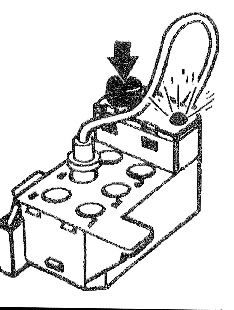
From the FAQ (Click FAQ at the top of each brickboard.com page), please read:
https://www.brickboard.com/FAQ/700-900/EngineOBDCodes.htm
This brickboard is replete with many thread on testing both coolant temp sensor (gauge and engine control ECT).
Do you have a service / repair manual for your Volvo 740?
See http://volvowiringdiagrams.com/:
Specifically - The 1991 740 Volvo wiring diagram for non-turbo can help you in this directory:
http://volvowiringdiagrams.com/?dir=volvo/740%20Wiring%20Diagrams
The PDF File:
"Volvo 740 1991 Wiring.pdf"
Specifically - The 1992 Volvo 940 wiring diagram for non-turbo can help you in this directory:
http://volvowiringdiagrams.com/?dir=volvo/940%20Wiring%20Diagrams
The PDF File:
"Volvo 940 1992.pdf"
Both 1992 740 and 940 had Turbo Bosch, and non-turbo Bosch and non-Turbo Regina / Rex (Bendix).
As the electric cooling pusher (or puller, with no water pump mounted fan)) fan in front of the A/C condenser and engine coolant radiator and the radio suppression relay ....
Unless the water pump-mounted fan was removed by you or a prior owner, and you have an electric fan option that pulls air through the AC Condenser and the Engine Coolant Radiator?
The radio suppression relay is part of the fuel injection and connects to the fuel injectors, electrically. It has no connection to the fan.
There is a single coolant fan relay. I speak of the pusher auxiliary fan in front of the AC Condenser coils and the Engine Coolant Radiator. With Bosch engine control this pusher fan turns on when you have A/C (ECC) on and can turn on as engine coolant, using the ECT sensor, rises. There is no connection between a Bendix Rex/Regina equipped 1992 Volvo 740 and the engine coolant fan. (Unless I'm wrong and may be.) The pusher fan is turned on by the ECC (A/C control system.)
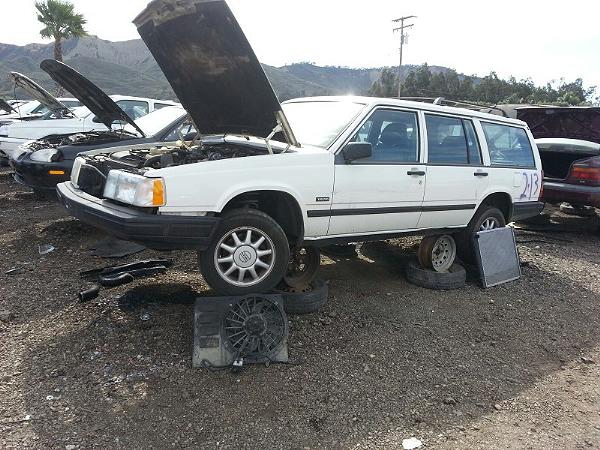
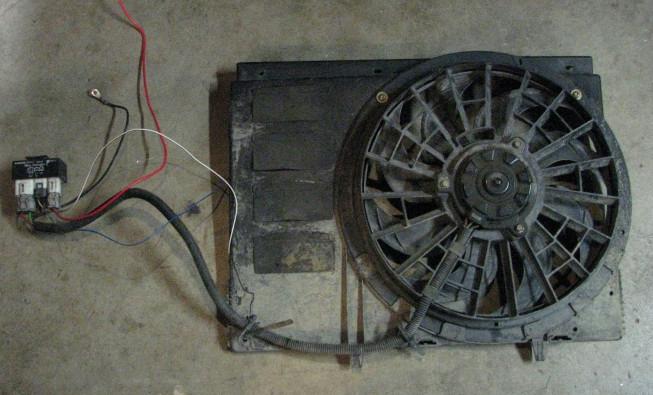
If you have a electric only fan option, like this, which 740 does not have from the factory (940 may - A swap some will to when modding a 700):
Relay for the puller fan at upper left in image -
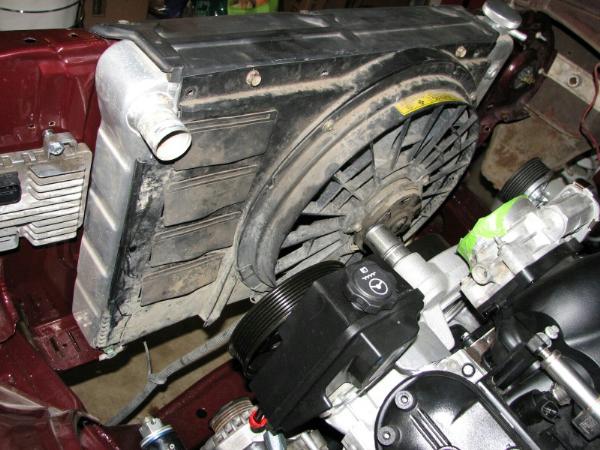
This page, from where these images come from:
http://www.therangerstation.com/tech_library/volvo_electric_fan.shtml
The fan may be seized as the factory lube can dry out. You can rebuild the fan and relube it or replace the fan with something after market or new from Volvo, maybe.
Or, see this eBay auction for the relay the pusher fan uses, I believe, yet am not sure:
http://www.ebay.com/itm/Volvo-740-240-Cooling-fan-fuel-pump-Radio-Noise-Suppression-Relay-899931-1323592-/361480321708
Using a multimeter, where you can test for volts (powered circuits), and (not powered circuits) continuity and resistance, may help you.
Hope that helps you.
Questions?
Thanks.
MacDuff.
--
Give your brickboard.com a big thumbs up! Way up! - Roger Ebert. 
|


