|
|
|
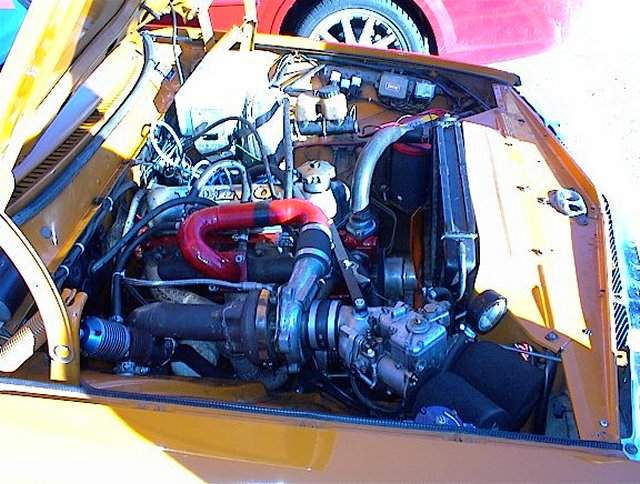
Weber 45 and turbo on a B20. Neat installation! Anyone got experience with the carb before the turbo? I wonder how cold start works.
Kåre
|
|
|
|
|
As much as I love B20's, they make a very bad choice for turbocharging. Proper turbo camshafts should have no overlap & to do so means the camshaft is so small that it restricts breathing & defeats the purpose of having a turbo. Also, you have to increase valve spring pressure to counteract boost pressure on the inlet valves & back pressure on the exhaust valves.
If you want to turbo, put in a B21 & turbo that. Better still would be a supercharged B20! :)
Cheers,
Paul.
|
|
|
|
|
Hi Paul,
Dunno that much of turbo's and chargers, but I don't see why you would need even less overlap and bigger valve springs when using a turbo versus using a charger?
BTW, when using a turbo or charger, shouldn't you fitt larger exhaust and smaller intake valves aswell?
thanks, Ben
--
Volvo P130, 1965: B18A + tilted M47. Volvo P131, 1969: B20 + AW71L: in the proces of rebuilding (www.knutselsmurf.web1000.com)
|
|
|
|
|
Turbochargers cause pressure between the turbo & the cylinder on the inlet & the exhaust. In an average setup the ratio of pressure on the exhaust side vs pressure on the inlet side can be as bad as 2:1. This means when you have 10psi of boost on the inlet you have 20psi in the exhaust manifold, any time you have overlap you have exhaust pushing up the inlet & diluting the incoming fresh charge, so any overlap is bad. With supercharging, overlap is a good thing, the right amount will blow the combustion chamber clean, too much won't hurt power but will hurt fuel economy.
Inlet valve springs need to have more seat pressure in both instances simply because the pressure is trying to hold the valve open. A 44mm inlet Valve has roughly 2.3 square inches of area, so at 10 psi you need an extra 23 pounds of spring pressure to counter it. The exhaust situation is worse with turbos because there is even more pressure, this isn't a factor with a supercharged engine. A good turbo cam for a B20 needs to be very short on duration so you could have very wide lobe centres to avoid overlap. Such a cam would have to open & close as fast as mechanically possible otherwise it would become a restriction itself. This type of cam profile then needs even more pressure. For a quality turbo install on a B20, a roller cam & roller rockers would be pretty much mandatory. With a supercharger the cam can be something which is more like a cam for an NA motor.
You are correct with valve sizes, with both force fed engines you would spend as much as possible on the exhaust side of the head but more so with turbo as it helps more in getting the pressure ratio down.
Cheers,
Paul.
|
|
|
|
|
Aha, ok. That makes things a bit clearer to me. Obvious why turbo = no overlap and with supercharging some is good.
But still a question arises to me: As I thought -and you explaned- when charging it's good to have larger exhaust then intake valves. You say "with turbo charged enines the ratio of pressure on the exhaust side vs pressure on the inlet side can be as bad as 2:1" So increasing outlet valve size would be a good thing. But why is this so? Is it only because of the somewhat smaller exhaust valve and port? I could imagine because of the turbo, the exhaust flow is restriced even more. But then again, that is not the case on supercharged engines. Thinking this over I would say that when using a belt driven charger you would indeed need somewhat bigger exhaust valves, but when using a turbo you'll need heaps bigger exhaust valves because of even more presure in the exhaust side. (or would valve size not matter because of the restriction due to the turbo then?)
Thanks again, Ben
--
Volvo P130, 1965: B18A + tilted M47. Volvo P131, 1969: B20 + AW71L: in the proces of rebuilding (www.knutselsmurf.web1000.com)
|
|
|
|
|
As far as aerodynamics through head and exhaust goes, why is supercharger any different than turbocharger? My understanding is that a supercharger is a direct drive compressor of some type, whereas the turbo is aerodynamically driven. In both cases you're forcing more air through the engine and in both cases you switch from negative to positive pressure on the intake side. Other than the much faster response of a supercharger, I didn't think there was much difference. Neither do I understand why a B21 is more amenable to turbocharging than a B20, but I have to admit I'm a rookie :(
Kåre
|
|
|
|
|
Well I figured that with a belt driver charger there is no (real) restriction after the valve and port anymore, while when using a turbo there still is a lot of restriction due to the turbo. From that I again figured that a turbo engine would need even bigger valves then a supercharged one. But I'm not sure, being a rookie aswell… :)
Dunno about B21's so can't comment on that.
Cheers Ben
--
Volvo P130, 1965: B18A + tilted M47. Volvo P131, 1969: B20 + AW71L: in the proces of rebuilding (www.knutselsmurf.web1000.com)
|
|
|
|
|
Ah yes, the restriction of the turbo turbine in the exhaust... it's pretty obvious now :) If this restriction is pretty significant, then I don't think larger exhaust valves will help a whole lot, although stiffer springs makes sense as well. I wonder if there are there any good books out there, like "turbocharging old Volvos for dummies"?
Kåre
|
|
|
|
|
"If this restriction is pretty significant, then I don't think larger exhaust valves will help a whole lot" yes, I do agree, but was/am not sure on it though.
"turbocharging old Volvos for dummies" Haha, that'll be a great book indeed. If you find it, give me a ring...
cheers Ben
--
Volvo P130, 1965: B18A + tilted M47. Volvo P131, 1969: B20 + AW71L: in the proces of rebuilding (www.knutselsmurf.web1000.com)
|
|
posted by
someone claiming to be Herman
on
Sun Feb 29 17:56 CST 2004 [ RELATED]
|
|
Doesn't Carb before Turbo = Time Bomb. In other words you are mixing gas and air and then running it through a compressor that is quite hot and yet we don't expect it just detonate every now and then? Someone please explain to this NA guy how that set up works without occasionally blowing up.
|
|
|
|
|
The Weber is also a draw-through (as opposed to blow through) on the VPD supercharger setup, and works just fine.
Doesn't look like the cold start mechanism is hooked up in that pic, but no reason it couldn't be using a single choke cable. Many people with DCOEs, including me, don't bother hooking them up. Two or three pumps on the gas pedal are generally enough to get things fired up even in cold weather.
|
|
|
|
|


