|
|
|
Hello All -
Where to start... About two months ago I started to have an intermittent bog-down. Now it has become an everyday bog-down.
Car will go 70mph on the highway, but feels like it's holding back, a faint sputter perhaps, car seems sort of shaky - had an allignment 4 months ago. Around town I can barely notice anything (30-45mph) unless I come to a hill or try to put the petal to the metal(bad pickup). Turbo gauge goes into yellow... it really doesn't feel the same as an air leak or sound the same for that matter, but the car doesn't speed up. I am not getting good gas mileage either.
No intake leaks anywhere that can be found! Replaced a few hoses, just in case.
A little related history-
Original Turbo - no oil coming out exhaust, no white, blue or black smoke, turbo gauge reads like it always has
Original Catalytic- Could be clogged... one day, several months ago I swear I heard something pass through my exhaust, kinda made "crinkle" noises... problem didn't start then...
Most of the other stuff, knock sensor, AMM, compression by pass-valve, engine temp etc original to car as far as I know. Had car maintained by the same volvo machanic for years, don't know every part he replaced.
FPR, Oil & Filter, Gas Filter, air filter, spark plugs & wires, vacume hoses- all new
No- I haven't cleaned my throttle body, my task for the weekend along with a few others
Fairly new front gas pump, exhaust & intake gaskets
On cold morning, my car does have a bit of an eratic idle. Car does not stall, cut out, or do anything else but bog-down, engine hot or cold, weather sunny or wet, doesn't make a difference.
This is the strange thing... when I changed my FPR I took my brick out for a drive on the highway. Car ran great! It hadn't run like that for weeks! I was so happy! Then my radiator broke on the way home. After I replaced the radiator the car was back to driving in bog-dowm mode.
Now, I am seeking advice (any and all) because I have put quite a bit of money into my brick these past months (glad to do it). Pretty soon there isn't going to be anything left when I reach into my pockets. I broke down yesterday and stopped by a Volvo shop in the area. They think it may be my turbo. He said this because he put my car in reverse, gave it the gas, and took his foot off, watching the turbo gauge, he said it came right back down. This is why he thinks a need a new turbo. Anyone?
I read the FAQ, I will do the test- car cold, disconnect intake hose, reach in, try to spine wheel etc. this weekend. I just don't want to go ahead an replace the turbo if that isn't what it is.
Ok, I think that is it...
Very greatful for your help!!
Best Regards,
Anastasia
86' 740turbo 367,000
|
|
|
|
|
Anastasia,
I've come across a few circumstances that might lead to the symptoms that you're experiencing, and I'll list them in the order that I think they're most likely to occur:
1. Bad AMM. Pull your 007 AMM and check the platinum wire. If it's broken, the car is running in a full-rich mixture. Even if it's not visibly broken, it would be a good idea to swap the AMM with a known good unit (I keep a backup 007 AMM in my vehicle at all times, right next to the spare Fuel Pressure Regulator, Main Relay, and Radio Supression Relay). Check your airbox thermostat while you're doing this (if you still have the preheater hose in place).
2. Mixed up spark plug wires. I saw this on an '89 740 Turbo and it was hard to diagnose. If you switch a pair of spark plugs on a pair of even-firing cylinders (like 1&4 or 2&3), the car will seem to run ok, but it will only be firing on two cylinders. (This was not easily noticable since it's an even pair and does not cause a rough idle. The 2 mixed up plugs were firing on the exhaust stroke rather than the compression stroke and thus caused no significant engine vibration.) For a picture of how the spark plug wires are supposed to go, read the following post. It would be worth your time to double check this:
http://www.brickboard.com/RWD/index.htm?id=752158
3. Bad 02 sensor. If it's dying (loosing calibration) or has broken off, the car will be running slightly rich and your gas mileage will suffer. Read the following post for cheap replacement options. (always buy Bosch, and change them every 5 years or so for the best fuel economy)
http://www.brickboard.com/RWD/index.htm?id=731387
4. Plugged/melted/obstructed cat. There's a CO2 sensor test port just before the cat that you can remove and vent some of the exhaust. You'll need an 11, 12, or 13mm socket to remove the plug (I can't remember which one), and this will provide an exhaust vent about the size of your pinky finger. While not much of an improvement it will help a bit.
-However, you should be able to unbolt the exhaust clamp just before the cat and look into the cat using a flashlight. Look for clogged passegeways in the Honeycomb element (due to black carbon buildup), parts from the O2 sensor, and fins from the Turbo exhaust turbine. If it looks like the ceramic honeycomb core has paritally melted, you'll need to replace the cat (and also check/fix a really-rich fuel mixture that caused the problem).
-Lastly, while you have the cat unbolted, here's a quick test you can perform (assuming you still have the factory exhaust system on the car). Put the exhaust clamp back together, but with the tubes offset and only use two of the bolts. Have the cat inlet tube hanging below the exhaust mainfold outlet tube (so that it looks like the cat is scooping clean air from the road surface), and arrange the triangular clamp so that you can hold it in this position using two of the bolt holes in each half of the clamp. Drive the car and see if your 'bog' symptoms are gone. Note: The exhaust will be significantly louder, but not as loud as a naturally aspirated car under similar circumstances. The turbo does a LOT to absorb the sound as it leaves the cylinders and you should be a few steps quieter than a Honda with a 2.5" exhaust and Fart-Can muffler. If you do decide to hit Wide-Open-Throttle, try to do it in an area with dense woods on both sides of the road (just to be kind to the others who don't like noisy exhausts). While driving, listen to the sound of the Turbo. The variable pitch sound of the air rushing through the rear turbine makes a very distinctive noise that is not drowned by the loud exhaust. The turbine sound changes in pitch with a slight time delay in comparison to the exhaust sound that is matched to the engine RPMs.
5. Disconnected or stuck Wastegate Arm. (unlikely to cause the symptoms you mentioned, but remotely possible) If your turbo is just barely getting into the yellow and doesn't want to boost any farther than that, check the wastegate actuator. If the little C-clip is missing, the wastegate arm and the actuating rod will seperate from each other, thus causing the wastegate to be open all the time. If everything looks normal, try removing the c-clip, smearing anti-seize on the rod/arm connection, and re-installing the c-clip. This will eliminate any binding or resistance to proper operation. The arm and rod attachment is the upper right Brass colored "S" shaped piece of metal in the following picture Click Here, and on the far right side of this picture. Pictures borrowed from Anthony Hyde's Turbo Page.
God bless,
Fitz Fitzgerald.
--
'87 Blue 245, NA 236K
|
|
|
|
|
Thank you all for your time, I will be sure to check a few things this weekend. Just to update you all I think it may be none of the above, so to speak.
I broke down and called a yet another mechanic ( third one ), he fit me in his schedule. After looking over the car and taking it for a test drive, he said "the car is severly retarded." He wasn't completely sure as to why. He suggested replacing the distributor cap and rotor, check timing etc. Pretty routine stuff. He was a really good guy. He did quite a bit of prodding around, to no avail, so we both thought. Low and behold, when I left his shop my car ran perfectly! It has been running great all night! Go figure!
The problem isn't fixed, that much I know. But what could it be? Is it possible that some wire or something of the nature is loose or shorting out and he happend to stumble upon it?
I don't think it is just per chance that it ran well after he poked around. Does anyone have any ideas?
Thanks again to you all!!!!!
Best Regards,
Anastasia
86' 740 turbo 367,000
|
|
|
|
|
Thank you for your response Fitz! I will look into ordering a new knock sensor. Either way since it is original to the car, it couldn't hurt for $30-$40!
Best Regards,
Anastasia
86' 740 Turbo 367,000
|
|
|
|
|
Had such a situation once on my '86. Slow on acceleration ... wouldn't top more than 35mph. Idled fine, though.
Didn't think much of it, as it disappeared a couple days later.
Found out after failing smog that what had happeneed was the cat broke and lodged itself in the resonator. It stayed stuck until vibrations managed to break it down a bit more.
As it is, I've still got parts of the old cat in the exhaust system.
To find out, remove the test plug just in front of the cat. If the symptoms go away, it's a clogged/broken cat.
-- Kane
--
Blossom II - '91 745Ti/M46 ... Bubbles - '74 144GL/BW35 ... Buttercup - '86 245GL/AW70 ... The Wayback Machine - '64 P220/M40
|
|
|
|
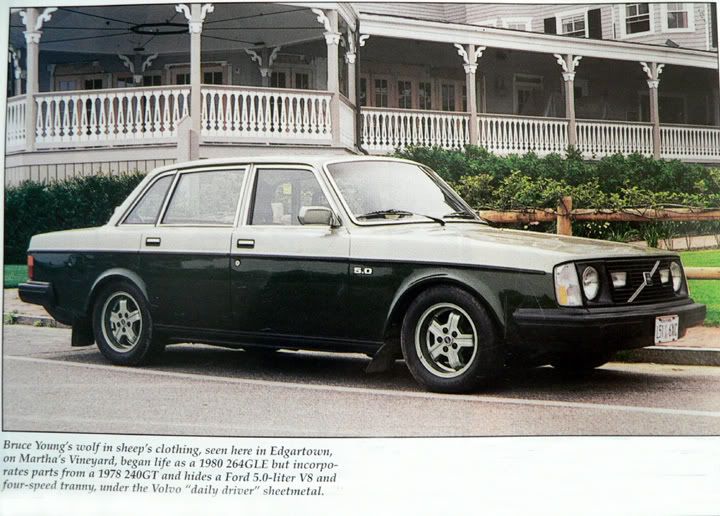
Could be a plugged cat.
I don't know how / where your cat is located (compared to B21FT), but there should be a "sampling" port with a screwplug just upsteam.
I have heard that by removing this plug and test-driving, the pressure from a plugged cat will be relieved enough to show an improvement in the "bogging down" symptoms.
--
Bruce Young
'93 940-NA (current) — 240s (one V8) — 140s — 122s — since '63.
|
|
|
|
|
I had a bog down on my '86 245 when I first got it last year...
it happened about 1 min. into driving after cold start...
that was the only time it was experienced... so my conditions aren't the same as yours, mine is not a turbo so that is different as well...
after about 6 months of troubleshooting I finally found that the O2 sensor had broken off in the exhaust stream and the sensor was failing to provide the computer adequate information....
there are several ways to check this but the easiest is to get an O2 sensor socket and remove the sensor... look at it to see if it is complete or somehow physically broken.
I replaced my sensor and the bog never came back...
this was after repairing vacuum leaks, cleaning flame trap and various clogged vacuum holes ... etc. - so it ran pretty good after that.
good luck,
jack
--
Bad Blue, '86 245, 260,000 mi., Columbus, Ohio
|
|
|
|
|


