|
|
|
I have a rather lengthy post below about selling my car. Several good folks here made me decide to keep with it>
Well I worked with it for a few hours today. I was driving around, waiting for it to do its thing, and it did. I pulled over, hooked up the timing light, and sure enough the timing was retarded about 10 degrees and would not advance with the throttle.
I was able to turn the car off and restart, and it lasted long enough to get me back home. When I got home, it happened again. I tried wiggling every connection I could think of to maybe bump it back into its normal mode to no avail. All of my grounds checked good with my meter, and battery was putting out 13.99VDC.
As I walked away to get another tool, came back, it was normal again.
So what controls the timing? Is it solely the job of the ignition control unit? Or does it also use the ECU? The ignition control box is a rebuilt Programa unit. All of the pins have the sleeves on them. I also tried pulling the vacuum hose off of the diaphragm, but no change. I'm confident the ignition harness is in good shape, and I've even taken the new knock sensor I bought to my work and put it on the O-scope...looks good! Also unplugging the knock sensor has no effect as well. I've noticed too that when it is in normal mode(at 12 BTDC), and I try knocking on the exhaust manifold with a hammer, there is no retard in the timing.
What else could it be? I could really appreciate any advice on where to go from here. I could find nothing in search about this problem. Sorry this is so long, but hopefully someone will benefit from this one day.
Thanks,
Jack
|
|
|
|
|
I just fixed the same problem on the 245. It wasn't intermittent, just zero timing adjustment under all conditions. It should advance with the vacuum signal when the throttle first opens, and with rpm's. Most cars I've owned ended up with a total advance in the mid-thirties around 3000 rpm's, and when your timing is stuck at 10 degrees, it certainly makes sense that around 25 degrees difference in ignition timing is going to make a difference. Replacing the computer fixed that instantly.
Anyways, it's unlikely that more than one part of the circuitry adjusts the timing, and when that goes, all adjustment goes with it. I'm betting that the rebuilt computers simply have the usual trouble spots fixed, and they're out the door if they pass a test. But these computers are getting old, and resistor values can drift over time, electrolytic capacitors dry out, ceramic capacitors oxidize or short, so forth. The components might still work at the shop, but they're 20 years on the way to kaput. IIRC, the delay/advance circuit should rely on at least one capacitor, probably ceramic. And that's as far as my electronics knowledge goes! It's been a really long time since electronics class. Maybe someone more skilled can track it down.
Are new computers available? If so, and assuming they're manufactured recently, that should be a good long term solution.
|
|
|
|
|
Yes, its very unfortunate that the general consensus of this board, when considering 'rebuilt' items, is less than an ideal choice. I can't believe that Volvo, with such a reputation for being a "safe" car, did not build a limp-home circuit. The times that my car has decided to act up have mostly been when pulling out into an intersection! This is shortly followed by oncoming motorists, and/or by single-finger salutes. :(
Jack
|
|
|
|
|
programma has had alot of failures expressed on the brickboard.
good luck
|
|
|
|
|
Good deal. It sounds like it might be another case of the latest version of 'Murphy's Law'. " If an unusual problem continues to plague, suspect the last new or re-built part installed".
The Bentley manual also shows an input from the TPS to the ICU. That might be something else to check.
Bentley also has the following caution on the Volvo/Chrysler ignition. I don't know if it's a bunch of BS, or if it's been covered here on the Board before. I do know I have had my connector off many times and no problems.
"CAUTION On cars with Volvo/Chrysler ignition systems, do not disconnect the harness connector from the control unit. The connector uses special one-way sleeves that are damaged when disconnected. If the harness is removed or the control unit is replaced, the complete wiring harness will need to be replaced"
--
Gary Gilliam Sumerduck VA, '94 940 na Regina 150k, '86 240 180k
|
|
|
|
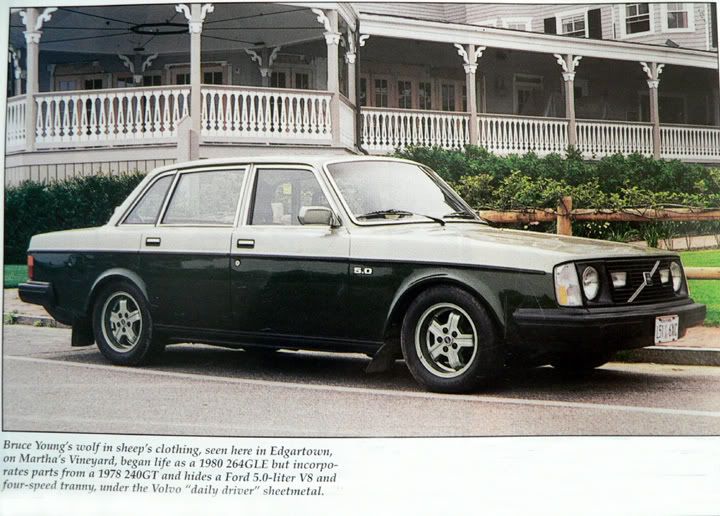
Bentley also has the following caution on the Volvo/Chrysler ignition. I don't know if it's a bunch of BS, or if it's been covered here on the Board before. I do know I have had my connector off many times and no problems.
"CAUTION On cars with Volvo/Chrysler ignition systems, do not disconnect the harness connector from the control unit. The connector uses special one-way sleeves that are damaged when disconnected. If the harness is removed or the control unit is replaced, the complete wiring harness will need to be replaced"
I posted on that a couple of days ago. Volvodad and Hardknocks both said they have had no problems unplugging and swapping V/C ICUs.
--
Bruce Young
'93 940-NA (current) — 240s (one V8) — 140s — 122s — since '63.
|
|
|
|
|
I thought that looked suspicious. I have been out of town and missed your post, but I knew that some of the smarter and more experienced members would know if it was brown and smelled.
--
Gary Gilliam Sumerduck VA, '94 940 na Regina 150k, '86 240 180k
|
|
|
|
|
several items.
ICM, knock sensor, some others.
BUT the ICM (Ignition Control Module) must have data about the manifold vacuum to do its job.
That data comes via a white (dirty white) nylon tube that looks like a fat wire. Look at a lower corner of the ICM for a vacuum thingie where the whitish nylon tube attaches.
The tube runs uner the front of the engine alongside the wiring harness, and comes up behind the distributor. Then it goes up to a right angled rubber elbow between intake rail #1 and #2. That elbow connects to a brass ferrule in the intake manifold. (The ferrule is just like the one for the small tube to the flame trap.) Check that the ferrule is not blocked.
If that nylon line is open, it makes a small vacuum leak and no spark advance. If it's blocked, no spark advance.
You might try this: Disconnect the line from the manifold. Let the engine idle, and (wipe it clean first) put your mouth on the line and suck, and listen for engine speed change. Not too scientific, but that's where I'd start. It's quick and cheap and revealing.
Taking the tube off at both ends and blowing through it runs a minor risk of messing up the point where it connects to the ICM, and also you can't tell if there is a leak en route to the ICM.
Good Luck,
Bob
:>)
|
|
|
|
|
Yes, the first thing should be to check the rubber hoses joining vacuum lines to the nipples.
On my 1988, said rubber hoses were still there and apparently holding, but quite cracked and stiff. Replacing them improved my ventilation controls and engine flexibility plus fuel consumption. Clearly, there was imperceptible, gradual vacuum loss as the rubber bits aged. Replacing them is nearly costless.
George Antony
|
|
|
|
|
I would suspect the Programa ICU. That's the only thing that can dynamically change the timing. It has just two inputs:
1) Engine load based on manifold vacuum line to ICU transducer
2) Knock Sensor (try unplugging it?)
--
Bruce Young
'93 940-NA (current) — 240s (one V8) — 140s — 122s — since '63.
|
|

|
|
Parting shot from one who owns no 85-88's: If so many of them are slipping past NOx tests with that vac line plugged, what is keeping them from bogging off the line? Centrifugal can't.
Just wondering, if in this example, the shield on the knock sensor lead is open near the controller, causing the controller to believe the sensor is hearing knocks like crazy. The input is high impedance, so integrity of the shield under the hood would be mandatory. It would have been a good indicator for the original replacement of the controller. Also an open shield (broken braid or crimp problem maybe) would be fickle.
The green book warns not to make measurements with the plug off to avoid potential damage to the sleeves. I think that warning was translated in Bentley after a few sleeves turned up missing after pulling the plug; hence "one-way", you put them on, but they won't necessarily stay put when you pull the plug again. These showed up in 83 according to Ken Cook.
--
Art Benstein near Baltimore
|
|
|
|
|
Parting shot from one who owns no 85-88's: If so many of them are slipping past NOx tests with that vac line plugged, what is keeping them from bogging off the line? Centrifugal can't.
Hi Art,
I wonder if the paragraph below, from the "plug vac line" guy, addresses your question? He's talking about when the vacuum line is plugged.
"On the dyno and on the street, unless you're really flogging it, you can tell no difference in performance. What happens is that the "limp home mode" for the Chrysler box closely matches a conventional distributor curve; i.e. advance retards 5 degrees when the throttle is opened and climbs with engine rpm to approximately 33 degrees instead of swinging immediately to 52 degrees and backing down to below ping levels."
--
Bruce Young
'93 940-NA (current) — 240s (one V8) — 140s — 122s — since '63.
|
|
|
|
|
Hi Bruce,
>>"On the dyno and on the street, unless you're really flogging it, you can tell no difference in performance. What happens is that the "limp home mode" for the Chrysler box closely matches a conventional distributor curve; i.e. advance retards 5 degrees when the throttle is opened and climbs with engine rpm to approximately 33 degrees instead of swinging immediately to 52 degrees and backing down to below ping levels."
It must work, yes, but the "no difference" part is surprising, given the V/C box has no information about load. It knows throttle open, via the TPS, and it knows RPM. But a "conventional" distributor has a vacuum motor contributing to the curve.
These cars continue to amaze me. We just took three of them on a 2000 mile round trip last week.
--
Art Benstein near Baltimore
|
|
|
|
|
I have already replaced the crimp/spade connector, and am confident in its integrity. I've wondered, if by moving the ignition wiring closer to the distributor, there could be interference to the knock sensor. When I resheathed the harnesses, I decided to route the ignition harness from under the crank pulley, to over the valve cover. I'm going to temporarily move the harness away from the distributor to see if that has any effect.
Jack
|
|
|
|
|
Hi Jack,
Well I've got no business advising on a car I don't even own, but I have some experience with the V/C ignition on the B23F cars that precede it. I think the controller is similar.
The knock sensor, being a high impedance crystal microphone, is read through a shielded wire within the harness, so it should be already shielded. If you only resheathed it, then the original coaxial wire should keep the ignition out of the knock sensor input. Sure, routing could further expose it to the ignition secondary, and depending on how close, maybe dramatically.
To test my wild theory, I would short out the knock sensor signal at the imfamous computer connector, keeping in mind some tidbit I read once where the processor is supposed to increase advance until it sees knock sensor output, then back off. Hard to say, though, when the trouble is intermittent.
The centrifugal advance on that distributor is not much under 2K and steady upward of that. But the vacuum portion combines what it sees in manifold pressure with what the controller knows about RPM to derive the much sharper advance curve. So, just thinking likelihood, I'd go with a bad controller, but if you already have a rebuilt, it makes me wonder why it was first replaced. That thing is pretty reliable and potted really well, unlike the connector and harness.
I'll check back next week for the update.
--
Art Benstein near Baltimore
|
|

|
|
Could be a bad knock sensor.
--
alex
|
|
|
|
|


