|
Well, you're certainly not going to win any races - unless you can find a Morris Minor to go up against!
For it's time, the B16 was a marginal engine. Volvo came out with the B18/B20 after just a few years of selling the PV544 with the B16.
I have my reference book here, and it says the PV444 with the 1414cc engine put out 75 H.P. and a whopping 76 ft/lbs of torque at 3,000 rpm. In a Road & Trask road test they got it up to 91.8 mph, turning over at about 6600 rpm.
That said, it got from 0 to 60 in 14.1 seconds, and all the way up to its top speed of 91 mph in 40 seconds.
Here's another test with the PV444 with a 1577cc engine (definitely the B16).
85 H.P. and 87 ft/lbs of torque. Top speed 93.8 mph, 0-60 in 14.3 seconds (a hair slower than the 1414cc engine) and top speed at 44.5 minutes.
And another test with a 1584cc engine and 4-speed transmission: 88 H.P. @ 5500 rpm, 90 ft/lbs of torque @ 3500 rpm. 0-60 time was 13 seconds, and top speed was reached in about 33 seconds.
The key to getting the maximum out of these little engines is mostly in the head, cam, and carbs. You'll need to set your engine up so it can happily spin at 6500 or 7000 rpm.
You'll want to port and polish the intake manifold so it exactly matches the openings on the head and carbs. This will give you the best air/fuel mixture flow. Somewhat like a Ricer (Tuner) putting on a better air tube/air filter.
This is relatively easy to do, and if you have an air die grinder, or even a good Dremel set, you can do this yourself without too much worry that you'll mess it up. ;-)
I believe that the stock air filters (oil-soaked paper) are nowhere near the efficiency of things you can get today. You can do a quick search here and find out how to gut your old filters and install good replaceable filter elements.
You can install stronger valve springs (try at least 77 pounders) to keep the valves from floating at high rpm. You'll probably want to at least take the head off and have the valve seats re-done to use unleaded gasoline, otherwise you can count on the valve seats receding back into the head over time, leading to a really bad-running engine.
I have a race engine shop near here do my heads (rare occasions!) and I end up spending about $500 for a pair for a V-8. Figure 1/2 of that for a 4-banger?
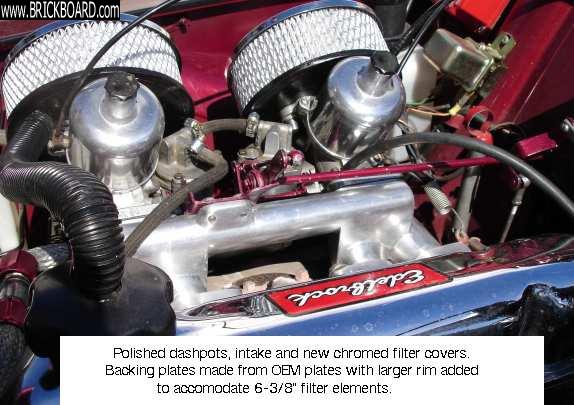
I'd stay with the Carter SU's. I think they are overall one of the best carburators you can put on these engines. I removed the fuel injection on my B20 in favor of a pair of SU H6's. Read up on the carbs and learn to tune and repair them yourself.
One carb trick you will only hear from old-time racers is to drain and clean the damper oil out of the SU dashpots (the big domed things on top) and replace it with 30-wt engine oil.
Up to a certain point, heavier oil in the dashpots will enrich your fuel/air ratio and give you much better accelleration.
Change over to decent spark plug wires; the old style aren't as good as modern ones. I bought a 'generic' set of silicon wires for a V-8 for under $20. Now I have new ones on the car and an extra set when I need them.
Better spark plugs also help things out. I found a set of Denso Iridiums on eBay for $10. You can't get better than that!
I also upgraded my ingition to an MSD-6a box, which replaces the points and condensor in the distributor and fires the plugs a few thousand times each revolution, instead of once.
Something to watch out for is the coolant pipe that runs along the rigfht bottom side of the engine. For some reason, this one part gets tinkered with and many of them I have examined have been blocked off buy crud or sealant. When the water can't get through this pipe, the rearmost cylinder cooks.
That all being said, only the most die-hard Volvo nut would be able to tell the difference by looking at your engine, whether it's a B16, a B18, or even a B20.
The B16 uses a different valve cover, but externally, that's pretty much all you can see at a glance to tell you which engine it might be.
I have a B20 from a 1975 140-series sedan, mated to an automatic transmission. Under the hood, you have to search for the trans dipstick to tell it's not the stock transmission. I also went with a B&M shifter in the cockpit, but that could easily be mated to a manual trans, so that's no sure way to tell what trans is in it. I have a chromed 'wobble stick' I could use, and it would then look totally stock again.
Take a look at some of these pictures and see what I'm talking about. Don't bother too much with the text; I'm in the middle of a website overhaul.
My Volvo Page
Steve
Southern California High Desert.
|