The message to which you are about to reply is shown first. GO TO REPLY FORM
|
|
|
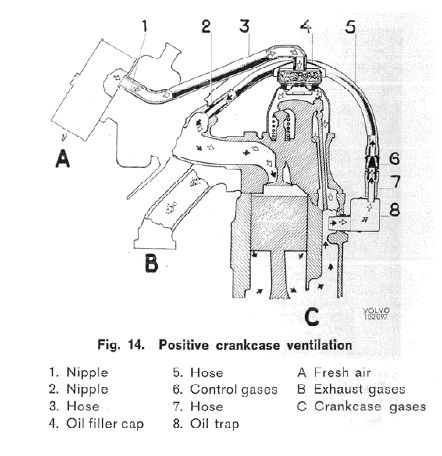
POSITIVE CRANKCASE VENTILATION
The B18A engine is provided with positive crankcase ventilation, see Fig. 14.
This arrangement prevents crankcase gases from being released into the atmosphere. They are instead sucked into the engine through the intake manifold and take part in the combustion process. The residue is blown out through the exhaust pipe together with the other combustion residues.
Between the engine crankcase and intake manifold there is a connection which consists of an oil trap (8) attached to the valve inspection cover on the right-hand side of the engine (viewed from the front), and two rubber hoses (5 and 7) between which there is a control valve (6). The rubber hose (5) is connected to a nipple (2) screwed centrally in the equalizing pipe of the intake manifold.
The partial vacuum which occurs when the engine is running causes the crankcase gases combined with the fresh air to flow from the crankcase to the intake manifold. The amount of flow is regulated by the control valve. Fresh air is supplied to the crankcase through the carburettor air filter via a nipple (1), rubber hose (3) and oil filler cap (4) to the rocker arm casing, which is connected to the crankcase through the push rod holes. The oil filler cap, which is sealed, has a built-in flame trap. This flame trap, in the same way as the control valve, which also functions as a check valve, prevents flame from any backfiring in the carburettor or intake manifold from reaching the crankcase.
As the fresh air supply passes through the carburettor air cleaners, impurities are prevented from getting into the engine. Where there is a medium or high degree of partial vacuum in the crankcase (intake manifold), which happens during idling and when operating under a light load, the system functions as described above. When the partial vacuum in the crankcase is less than that in the air cleaner, which occurs at full load and/or with large flow quantities, no fresh air is supplied. Instead, the flow in the connection between the rocker arm casing and the air cleaner reverses and the crankcase gases go both ways, partly through the control valve and partly through the air cleaner and carburettor to the intake manifold. In this way, the crankcase ventilation system can deal with relatively large quantities of crankcase gases without any escaping into the atmosphere.
Volvo Green Book 02a Engine B18A, pg. 2-15
--
Mr. Shannon DeWolfe -- I've taken to using mister because my name misleads folks on the WWW. I am a 53 year old fat man. ;-)
|
|
* = Field is optional.
+ = Enter space delimited labels for this post. An example entry: 240 muffler
©Jarrod Stenberg 1997-2022. All material except where indicated.
Brickboard.com is not affiliated with nor sponsored by AB Volvo, Volvo Car Corporation, Volvo Cars of North America, Inc. or Ford Motor Company. Brickboard.com is a Volvo owner/enthusiast site, similar to a club, and does not intend to pose as an official Volvo site. The official Volvo site can be found here.

