|
I had an 84 which, when I got it in 2000, would be difficult to start on cold mornings, mimicking my experience with the carbureted cars when the thermostatic choke mechanism would get rusty.
Because it didn't have a carb, I set out to learn how the EFI worked from one end to the other, in depth. First thing I learned is the 84 LH2.0 does cold start enrichment from the service injectors -- no fifth injector. The equivalent of the choke thermostat is a negative temperature coefficient thermistor located in the head's coolant passage. The EFI controller uses this to determine how much extra to squirt on starting.
Also, I learned the air mass meter, after making careful measurements on several spares, aged in the lean direction, but not before suspecting the fuel rail pressure could be wrong and becoming confident the computer could depend on it, by building an adapter to measure it.
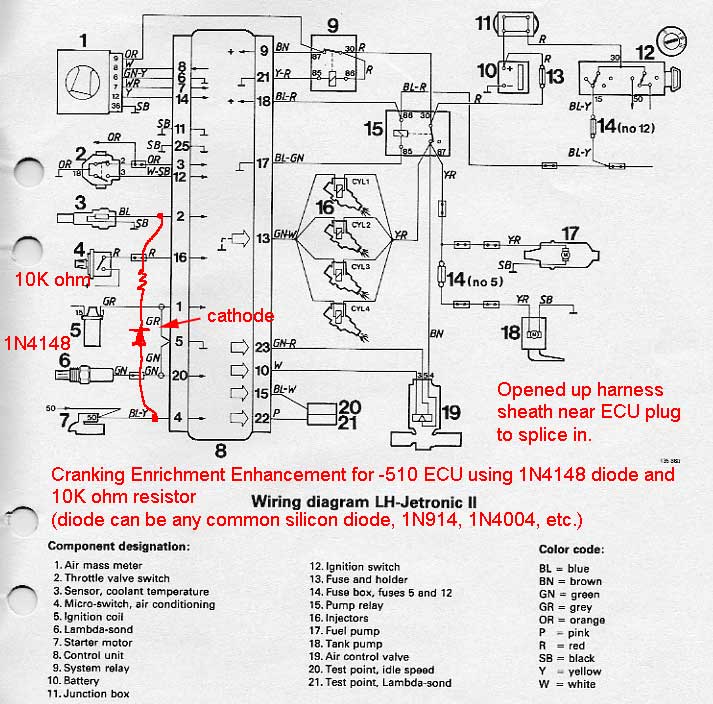
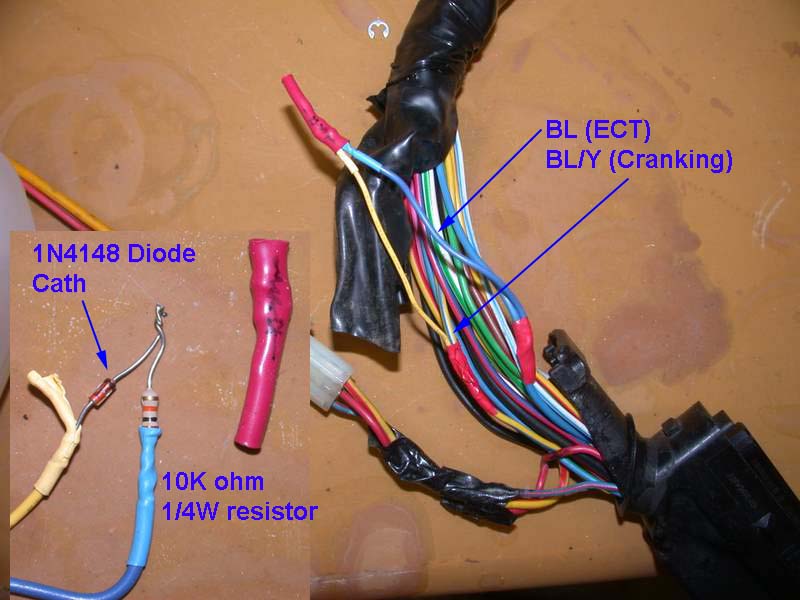
My difficulty with cold starts was not making me late for work, or keeping me from using the car, it would just be annoying to crank it several times before getting fire. I decided to fool the ECT input on the computer into thinking it was colder than it actually was, to see if it would start on first crank. It did. So I wired it that way, using the starter signal to augment the voltage at the ECU.
Now, after almost 20 years, I've looked at the AMM's stability as the singular weak spot in LH2.0, as I think Bosch did too, building two later versions, and designing the LH2.4 to compensate over time for aging.
You can imagine how delighted I was to find out later that my hack was the equivalent of a TSB released by Volvo to do the same thing. Here is my hack:
--
Art Benstein near Baltimore
Why is lemon juice made with artificial flavouring, and dishwashing liquid made with real lemons?
|


