|
Thank you for that post, Peter. Perhaps I'm a youngster, relatively, but I've never seen a car engine starter using the rotation of the starter itself to engage the gears, so I've assumed the overrunning clutch and solenoid was how Bendix did it, and referred to the clutch and return spring as "the Bendix."
Now that I've just said that, I realize that very method was used on a lawn mower I worked on a few years back. It chewed the teeth.
Up until now I've held my tongue on this starter thread, thinking about the old saw that says acquiring a hammer makes everything look like a nail. My go-to hammer is not a dial caliper, but a multimeter.
Whenever I've encountered the click-but-no-crank symptom, I've wanted to know, in reference to the battery negative post itself, what voltage is seen on the #30 stud on the solenoid, then the braided wire going into the motor, and subsequently, the rivet on the #50 tab on the solenoid, and finally, on the steel housing of the starter itself while cranking is attempted.
Fully aware what it is like to snake a sharp probe to these points for voltage drop measurements, arm extended past AMM hose, in sub-zero weather, I figured I'd keep my mouth shut for a change, since I have no you-tube to demonstrate it.
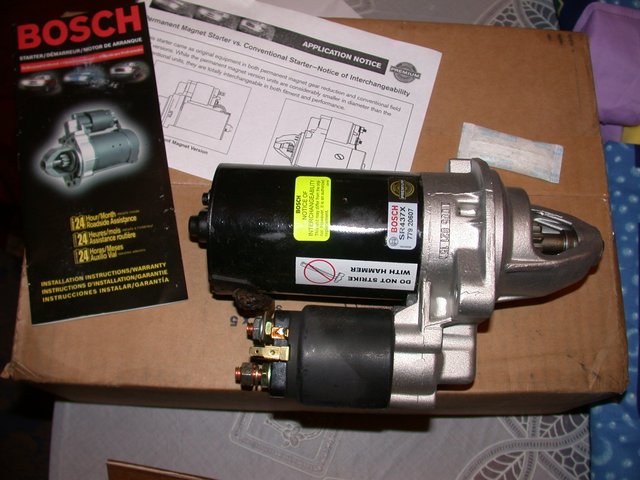
At seven-below (much less -35) I'd just try the broom handle approach, which reminds me, don't hit the permanent magnet starter (skinny one) with a hammer.
The distance the core of the solenoid traverses against its spring is dependent on the voltage applied to its two windings, and the wear on the main motor brush switch contacts (affecting the pressure of closure) will be greater when the actuating voltage is poor. We, who grab a wrench first, tend to overlook the wear of simple electrical wiring over 30 years of exposure to the elements, mostly in corrosion at connections, but also broken strands inside insulation which has petrified over time.
--
Art Benstein near Baltimore
Theories need to be built on a foundation made of Observations, Hypotheses, Predictions, and Tested Hypotheses.
|


