|
When you're done fiddling around and come back to the SU's, remember there are several tricks you can try to help maximize the efficiency of these classic carburetors.
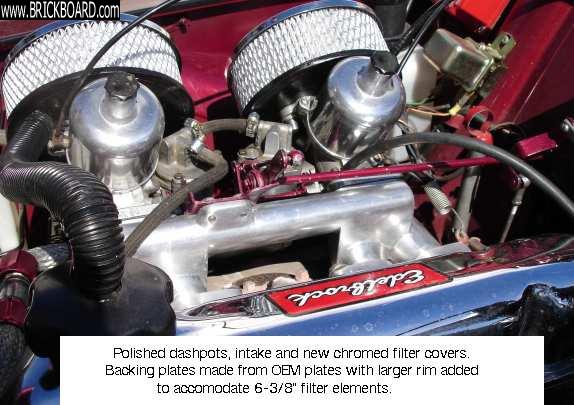
The first thing you'll want to try is changing the damping oil in the dashpots to straight 30wt engine oil. The heavier the damping oil, the better the accelleration, but you don't gain anything above the density of 30wt.
Also, I'm assuming you have properly balanced the dual carb setup. I gave up on trying to use a single meter and swapping it from one carb to the other, and ended up using a mechanic's stethoscope with the bottom end removed. This gives me an assembly of two ear tubes (one for each ear) with metal ends that can clip to the carbs so you can hear the air movement into both carbs at the same time. You will easily hear any imbalance in your carbs, and you can make the appropriate adjustments.
The single air flow meter threw off the readings depending on which carb you had it on.
You can also gain a lot of performance with both the old SU's and the new Weber by porting and polishing the intake manifolds. Use the gaskets on each end to determine the area(s) of metal to be cut away. You can cut into the head, too, but if it's already in place and torqued down, I'd match the gasket to the head, the cut the intake to match the gasket so you have one smooth run without any lips or blockages to screw up the mixture flow.
If you have an air supply, a small die grinder is perfect for this job, otherwise use a Dremel type tool. My internal runs are already done, but I need to pull the intake manifold and grind/polish the outside to a mirror finish.
We (Dad and I) did great with Weber carbs in our Volvo race cars back in the mid-1970's, but for economy AND good performance, the SU is still king in our book.
|