|
|
|
THIS WAS SUCH A GREAT CAR ,WHY DO YOU THINK VOLVO MADE THE DECISON TO STOP MAKEING THE 240?.WAS IT BECAUSE IT RAN FOREVER.HOW CAN WE EVER REPLACE OUR 240s,IF THEY EVER DIE GOD FORBID! THESE HAVE TO BE THE BEST CARsEVER BUILT,WHAT DO YOU THINK?
--
put your bones on the line, stand for something or fall! GOD bless the U.S.A.
|
|
|
|
|
This is HOW they stopped:
They launched the 240 in 1974, design and concept similar to the 140 due to their designer Jan Vilsgard who designed from 1950-1991. The normal run of a car being 6-8 years, they introduced the 240's successor, the 760, in 1982, meaning to stop the 240 a year later. The 760 did well, but the 240's popularity would not die. Volvo did not know what to make of this. They introduced other models, the aerodynamic 440, the sporty coupe 480, something for everyone. The announcement that the 240 would be discontinued resulted in such a large number of pre-orders that they had to keep producing them way past the announced deadline, adding some improvements along the way. This is how the 240 ended up surviving its successor the 740/60. It took the introduction of the revolutionary 850 in 1991...safer, front-wheel drive, updated, etc...to finally shrink the number of 240 pre-orders so that production could come to a halt in 1993.
Oh, WHY did they stop? My guess is no more room for improvements with what it was without completely redesigning it. It probably was not feasible to redesign the 240 in such a way that it could offer everything the 850 and other later models offer. Sometimes you have to let go of the past to embrace the future.
Still such a shame.
|
|
|
|
|
I would love to see a modern interpretation of the 240 core characteristics:
0) Offer a real station wagon! No dumb SUV wannabe.
1) Rear wheel drive
2) Exterior and interior design with function as the top priority and "style" as only secondary.
3) Robust understressed engine design which can readily go 500k+ miles without major repairs.
4) Heavy gauge sheet metal such that one cannot put a dent in the car with moderate palm pressure. The 240 seems to be the last such car sold in North America.
5) Outstanding visibility with features like an ample greenhouse and see-through headrests.
6) Standard sized radio opening so that aftermarket units can be easiliy installed.
7) Top shelf safety engineering.
8) Careful assembly.
9) Safe predictable handling.
10) Tight turning radius.
Things which could be done better than on the 240:
1) Design the major HVAC parts for repairability. Don't make the heater blower motor impossible to get to and don't make changing the evaporator a nightmare like it is on an 850.
2) Include a filter in the HVAC air intake with an easy to change element.
3) Avoid black plastic "trim" which will inevitably fail on exposure to sunlight. The blackout treatment at the bottom of the windows on later model 240s should never have been done.
4) Use modern blade type fuses.
5) Incorporate modern NVH (noise, vibration and harshness) reduction techniques in order to ensure safe and comfortable long distance travel.
6) If the dash pad is destined to crack, at least make it easy and cheap to change the thing.
Now if someone did these things and produced the car with high quality in a low cost manufacturing country then they could have a real winner! Basically I want a car which is the best vehicle it can be and which doesn't spend any effort attempting to be a fashion statement.
John
|
|
|
|
|
One of the best posts on the subject that I have seen.
"...not feasible to redesign the 240 in such a way that it could offer everything the 850 and other later models offer"
That's the bottom line as I see it. The car is pretty much the ultimate refinement of a 40+ year old design. But, times change...sadly.
--
Sean - now frolicking in the Land of a Thousand 240's (aka, Fredericksburg) thrice a week.
|
|
|
|
|
I remember calling and asking Volvo of North America in 1992 when they announced that they were not making them after 1993. They stated that the cost of redesigning the dash for the Federal requirement of passenger airbags was too high in light of the car's outdated performance. They also mentioned something about the wheelbase was either not long enough or wide enough to compare to newer designs. I can't recall the wheelbase issue in detail.
In essence, they did not want to redisign the car into something that it was not, They simply went with the other models.
--
1990 240- 270K- Original Owner-M-47, VX cam, bilstiens, spt exh, euro lamps-turbo whls,- still slow but handles well- Near Houston- also 2004 XC90 T5 AWD
|
|
|
|
|
Even though this thread is already saturated, I'll throw in my two cents worth.
Just about everything I was going to mention has already been said, but I'll wrap it together. Yes, the 240 would be fighting an uphill battle with CAFE emissions standards with the new fleet mileage requirements. They could have made some improvements like putting a Lockup-Torque Converter in the tranny (which the 740s started receiving back in '87), and done some body restyling to reduce the aerodynamic drag (which is pretty bad on a 240). However, both of these improvements would make a moderatly expensive car even more expensive.
Financially speaking, the 240 was a low-styled, mid-priced car. It cost double the typical American made vehicle of same size and options, and boosting the price wouldn't be helping. However, the 850 represented a new market that was growing rapidly. Building a front wheel drive car is much cheaper than building a rear wheel drive car (even though the RWDs are safer), and there was increasing demand for the 850s (which also looked like a 90s styled car with '90s comforts and could sell themselves on the dealer lots). The 240s still looked like a '70s body with late '80s upgrades, and the advantages to buying a 240 aren't readily aparent to someone walking through a dealer lot and looking at the window stickers.
In the end, the 240 factory was shut down and converted to 850s, and Volvo kept the high end 960 vehicles as their flagship cars. The 940 did manage to hang on for a couple more years past the 240, but ultimately closed in 1995 and this brough an end to the red-block engine line and Volvo could now focus all it's production resources on the white-blocks (the reason the 960 lasted so long was that it came with an in-line 6 cylinder white block, a close cousin to the 850's 5-cylinder white block engine).
I agree that the 240 is much easier to repair and maintain than the 850 and letter cars, but those DIY qualities are often lost in the effort to keep the bottom line down and stay price competative. I wish those great 240 brake calipers were available on the 700/900 series cars... If I had to get into a high speed accident today, I'd still want to be driving a 240 and no other car on the planet. They're still the safest car that I've ever seen.
God bless and drive safe,
Fitz Fitzgerald.
--
'87 Blue 240 Wagon, 279k miles.
|
|
|
|
|
We North Americans need to remember that we're not the only market:
The 940 continued to be built and sold for the European market, with 4-cyl, Turbo, and 6-cyl diesel powerplants, until 1998. The end of the 960/V90 line for us coincided with the REAL end of the red-block production for the rest of the world.
I have no idea why Volvo dropped the 940 for us with the 1995 model year. My guess is that was part of a major marketing/image-reshaping effort in the works since the 960 was introduced. When the 960 was restyled in the 95 model year, the 940 went away, and the company could concentrate on the 850 as the bread-n-butter car.
I think that people would have still bought 940s, and almost all those sales would have taken away from 850s rather than bringing in buyers from other makes. That simplifying of the production lines may have made the best economic sense at the time. After all, they could get almost 30 grand for an 850 wagon, and justify more than that for the 965/V90, but the 940 couldn't be sold for that much- and then buyers would realize that the cheaper car held more stuff than the much-touted 850 line... and cut into the sales of the new car.
If you look at advertising of the time, Volvo spent a LOT promoting the 850, in print and TV commercials, probably more than they ever spent combined on the other cars.
--
Rob Bareiss, New London CT ::: 92 244-M47-208K ::: 90 745GL-M47-271K ::: 88 245DL-AW70-182K ::: 84 242 project ::: 70 VW Bus ::: 70 Bus SInglecab Pickup ::: 71 VW Type III Notchback
|
|

|
|
OBD2 would have meant all sorts of US-only certification and such. No way it was worth it for the red block motors.
Hell, one of the guys on the Swedishbricks list was whining about how he'd consider paying $30,000 for a new 240. Yeah, fucking right. The new S40 costs $30,000, and is SIGNIFICANTLY cheaper to build than a 240 ever would be (or a 700/900 series Volvo). The market for people willing to pay $50,000 - $60,000 for a new 240 is tiny, if there even is a market at all. Most people wouldn't even consider paying $2,000 for a 240.
http://findarticles.com/p/articles/mi_m3012/is_12_180/ai_68535984
--
alex
|
|
|
|
|
The 940 and 850 served pretty much the same new car market segment and there was little reason for Volvo to continue both.
IMO the problem really is that Volvo abandoned RWD. Now instead of comparing Volvos to Mercedes and BMW one must compare Volvos to Audis, Saabs, and Volkswagen Passats.
I like the idea of some low cost country somewhere focusing on building robust rear wheel drive vehicles which are sturdy, durable, save and cheap to maintain. Someone should do this and offer an analog to the Volvo 240, the VW Bus and a really basic pickup truck. India, China and other countries are all well suited for building such vehicles and pricing them right. The could call the brand GBC for Good Basic Cars!
John
|
|
|
|
|
Hopelessly obsolete in a fashion-besotted world; relatively poor fuel economy; low power engine; aging safety features; cult classic in a business that demands volume sellers.
Volvo should have sold the tooling to somebody like the Rumanians to build and badge it as one of several Cult Cars: low volume, no investment in a modern plant; no development; merely stamp, screw, paint and ship.
--
See the 700/900 FAQ under 'Select Link' button on the top right.
|
|
|
|
|
Very interesting thought. I used to have the Yugo which was a poorly made Yugoslavian copy/remake of a Fiat. Oh by the way don't laugh too much as Yugo's are now worth a lot of money if you can find one. I had 3 of them : one in use and the other two for parts. I paid $100 For the running one , $25 for one of the 2x spares, and one of the 2x spares was given to me. $125 was not bad at the time for a poor but handy college student. Back to subject(sorry for digression there) : It really is too bad Volvo did not sell off the rights to keep making the 240 series to some other country. I think Volkswagen did this with the VW bugs and As mentioned Yugo did it. Perhaps Volvo was too vain to do this.
--
' 86 manual sedan nearly 200,000 and ' 87 auto sedan about 120,000
|
|
|
|
|
I am not in position to confirm this, but "people in the know" claim that the Russians tried to buy the production equipment back in '93. Volvo considered the offer seriously, but turned it down fearing that a possible drop in quality would stain Volvo's reputation.
Erling.
--
My 240 Page
|
|
|
|
|
I heard this story also about five years ago - I think somebody posted it at swedishbricks...
their version had it that a russian company bought and shipped all the volvo factory 240 body-making equipment. no idea if there's anything to it.
|
|
|
|
|
My answer to the question - and I don't think it's been mentioned yet - is that the market was already saturated - and in part, still is - with 240's. They made something like 3 million 240's, and THEY KEEP ON RUNNING. If you make a car that can run for 20+ years, and you make a lot of them, then eventually everyone that the car ever appealed to is going to HAVE one and there will be no more demand for the car.
The 240 with it's ancient styling and engineering, spartan design, lack of modern amenities, etc. is only going to appeal to a particular crowd - and all those people (us) have one. In some cases two, or six or ten. And STILL 240's are coming up for sale every day across the country, making it quite easy and cheap to find one in good shape.
I wish they'd moved 240 production to Mexico like VW did with the Bug just so we could have brand new body panels, seats, etc. But the fact is, average American car buyers with their H2's and their Mazdas are NOT going to pay for a 240 new. It would be like paying for a classic muscle car brand new in todays world - "No power steering, no A/C, no power anything, no air bags, gets 12mpg and you want HOW much???"
--
Sean - now frolicking in the Land of a Thousand 240's (aka, Fredericksburg) thrice a week.
|
|
|
|
|
In addition to the points made in the other answers...
The un-aerodynamic inefficient boxy shape was an obstacle to the mid-nineties Federal CAFE requirements, and the expense of redesigning the car to meet those fuel efficiency standards was too high, in light of the lower costs of building a FWD car.
Corporate Average Fuel Efficiency places an incentive on a company to have at least one line of light-weight gas-sipping low priced (read mass-market) vehicle to balance out any high-end gas guzzlers. (Maybe the current S40 is this.)
So even though the "240 Community" rasied enough hell, beginning around 1991 when the rumors of ending came out, to get Volvo to extend the run through 1993, the economics still wouldn't displace the 850.
I just hope that my stash of 240 parts in BGVPD will enable me to keep mine running another decade or more.
Regards,
Bob
:>)
|
|
|
|
|
Aerodynamics? Unlikely. If a full-sized V8 powered SUV can get 22+mpg on the highway, getting reasonable mileage out of a 240 with modern fuel injection (i.e. not LH-Jetronic) isn't that difficult. Keep in mind that a 240 wouldn't meet today's safety standards (nor would it meet the 1997 side-impact standards).
Sure, you could put in a modern engine with a modern management system, and get reasonable economy (the 240 is a pretty light car). But, in the end, you have a car that is still very, very expensive to make.
--
alex
|
|

|
|
OK, I absolutely don't know what the 1997 side impact standards are.
But I'd guess that with the basic sound design of the 240, if it didn't already meet the standards, the addition of side impact airbags or maybe a second reinforcing bar inside the doors would do it. I just can't easily believe the 240 could not be made to meet that standard when other cars now on the market are not nearly as protective of their contents.
--
DAMHIK: Don't Ask Me How I Know - - - Sven: '89 245. 951 ECU, open-front airbox, E-fan, 205/65-15's, IPD sways, E-Codes, amber front corner reflectors. 500 mi/week commute. '89 245 #2 (wifemobile). '90 244 (spare, runs).
|
|
|
|
|
Maybe volvo figured if they continued to build these bricks, people wouldn't really need to buy a new volvo for a very long time. Maintenance with the 240's are reasonable, as well as parts, considering there's a few million tanking along. So to try and boost new car sales they made crappy front wheel drive cars that seem to break down and give you more trouble than the old simple reliable bricks. Makes the volvo shops happy too. Just a thought... also i've been thinking cars are designed to break, its a conspiracy! Look at the repair/parts/new car markets: Huge!, if cars didn't last then all those shops would be outta business. But i'm driving like a jackass in my 240 fighting the system.
Yeah okay, so maybe there is no conspiracy.
--
'89 240 All original, custom exhaust, KnN, custom guages, 260,000kms
|
|
|
|
|
It's tough to face this.
We love these cars (most of us here) but they're not being made. And the updated revisions (900 series) aren't being made any more either.
I love having the opportunity to buy these things for a few hundred dollars or a thousand or two. But I definitely wouldn't sign up for a loan to buy one for twenty-some or thirty-some thousand.
We are benefiting from the yuppie craze of the mid and late 1980's. Many upwardly mobile folks at the time wanted luxury and many of them bought RWD Volvos. Now we have them, on the cheap. Lucky us, as long as we can keep them going.
Until roughly a year ago, U.S. new car buyers were buying every variety of gas-guzzling macho machine. Now they're buying whatever currently appeals to people who plunk down significant money and are willing to make loan payments and the other costs associated with new car ownership.
So good or bad, the cars now being bought new are the cars that will be available on the used car market in the next 5-10 years or so. For our future daily drivers, I'm thinking Toyota, Honda, and maybe Subaru (at least SOME of the power goes to the rear wheels). That would be maybe 5+ years in the future, based on my view of rust-rate and junkyard parts availability (I predict a lack of junkyard parts as a near-future major frustration for us).
Note, I wrote "cars now being bought new". The numbers actually being bought now will determine the number on the road in the future. They can try to market stuff that doesn't sell but if not bought in quantity, it won't be available in quantity.
--
DAMHIK: Don't Ask Me How I Know - - - Sven: '89 245. 951 ECU, open-front airbox, E-fan, IPD sways, E-Codes, amber front corner reflectors. 500 mi/week commute. '89 245 #2 (wifemobile). '90 244 (spare, runs).
|
|
|
|
|
What to buy when the yuppy's bricks are all gone? At the risk of going off-topic:
BMW sold a LOT of e36 body style sedans in the 1990s. They are all basically the same car. They just upgraded the self-diagnostics to OBDII in 1997.
They are harder to work on than bricks, but not as hard as an S70.
Dealer prices for parts are better than Volvo. On-line parts are comperable.
They are VERY reliable. I have one with 200k mi and one with 140k mi, and they have both had fewer repairs than my bricks at that mileage. The in-line six is a wonderful engine. The 4 cyl in the 318 model is only fair.
They suffer from plastic/aluminum radiators like the later bricks.
They have problems with cold/cracking solder joints, but the problems are in the radio and climate control, rather than the fuel relay and temperature guage. Same soldering iron fixes all problems.
They far more fun to drive than a brick, though those hard seats are tough on my middle-aged posterior on long trips.
|
|

|
|
It was the first slightly rounder 3 series, the 3rd generation design. They were produced for the bulk of the 90's.

The preceding squarer 3 series were called the E30's, and were produced through the bulk of the 80's:

BMW's are great cars. I owned an 83 318is coupe (E30) from 86 to 90, and ran it up from 70K miles to about 170K, and it still felt and looked and drove like a brand new car when I traded it in on a Miata in Feb '90. ran like a top throughout, needed practically nothing in terms of non routine maintenance. Very fun to drive too, even though mine was the dinkiest model they sold here in the US. They routinely go 250K miles without breaking a sweat. E36's are a touch fancier, a touch bigger, a touch more refined. The problem with those is that they aren't an under appreciated gem like the 240, the used car market is well aware of their value, and they are not cheap.
--
'63 PV544 rat rod, '93 Classic 245 + turbo
|
|
|
|
|
Sven is right on target about the yuppie craze of mid to late 80's. I live in Monmouth County NJ which is very affluent. All of the used 240 Volvo's I have bought here came from previous owners who were yuppie types. Some were even dealer maintained 5 to 10x years after initial purchase. Some come the 90's were embarrassed to have such a square car and replaced it with sporty suv's or nowadays hummers.
--
' 86 manual sedan nearly 200,000 and ' 87 auto sedan about 120,000
|
|
|
|
|
"We are benefiting from the yuppie craze of the mid and late 1980's. Many upwardly mobile folks at the time wanted luxury and many of them bought RWD Volvos. Now we have them, on the cheap. Lucky us, as long as we can keep them going."
Yep. I'm one of those benefactors. My mom bought a 1984 244 because it was fashionable. (This was confirmed with a trip to Los Angeles, where it seemed like every third car on the road was a 240.) In 1991, she gave me the 240 with less than 40,000 miles on it and bought herself a BMW 325. To this day, she says that the 240 has more personality than her Beemer.
My plans for my 240 is to keep it running as long as practical. Like I told my neighbor this past weekend when I was doing bodywork on it, the core elements of the car - engine, tranny and rest of the drivetrain - are very durable and will last a long time. But many 240s die a premature rusty death. So I'll do as much bodywork and preventive maintenance on it to keep it alive. If and when it goes (assuming that the car may outlive me), I'll try to get another RWD Volvo.
--
Mike F - 1984 244 DL - 261,000 miles
Original engine, transmission, drive train, alternator, starter
Undergoing reconstructive surgery with POR-15
|
|
|
|
|
Have to agree. The 240 is an exceptional car, but if it were being sold new, it would cost at least $30K. And that would dampen the appeal incredibly, compared to the cheaper, more powerful, safer, more reliable and (truth be told) even more durable competition in the form of more modern car designs.
Sometimes cars are jsut a heck of a lot better as used cars than they are as new cars. Look at the prices a few 'time warp' 240's have fetched on eBay over the last year or so. Pracitcally brand new cars, < 20K miles, absolutely flawless, as they were from the factory originally. Do they sell in the price range of what they'd compete against in the modern marketplace? Not even close, 1/2 the value, or less. And that's with the considerable 'rarity' factor added in on top of the intrinsic value of a 'new' 240. Even among the small cult of 240 owners, Volvo couldn't sell a new 240 at a profit.
--
I'm JohnMc, and I approved this message.
|
|

|
|
EEEKKKK !!! You mean we're all going to be stuck with SUVs ???
Brett
--
Brett Sutherland & the 1.5 million mile 122 CANADIAN --- WINDSOR, Nova Scotia the birthplace of HOCKEY www.ecvintagevolvo.com
|
|
|
|
|
Yeah, but we'll remove all their temp compensator boards.
--
DAMHIK: Don't Ask Me How I Know - - - Sven: '89 245. 951 ECU, open-front airbox, E-fan, 205/65-15's, IPD sways, E-Codes, amber front corner reflectors. 500 mi/week commute. '89 245 #2 (wifemobile). '90 244 (spare, runs).
|
|
|
|
|
I believe they blew it bigtime when they quit making the 240. They should have moved production to somewhere in Eastern Europe (with labor costs approximately 1/10 of those in Sweden) decontented it wherever possible---no overpriced factory radios, alloy wheels, leather, sunroof etc, four paint colors, none of them metallic, one color of interior, and offered it as basic transportation with an unmatched safety and durability record. Price it to compete with Hyundai, which was still poor to mediocre in quality at the time, and to top it off, have a factory rally team to highlight the ruggedness of the cars--not WRC, which was being taken over by AWD even then, but things like the Safari Rally and other such long distance events. The main reason this didn't happen was that Volvo was trying to move upmarket at the time, especially in the USA, and a low-priced car would have hurt their image.
I have to disagree with Rhys---the 740 is every bit as good of a car as the 240, but easier to work on and less prone to rust. Yes, the falling down headliners are annoying, but other than that they are no more troublesome. The V6s are the ones to avoid, but that is just as true with 200 series cars. Same with deteriorating wiring---all models 80-87 are likely to have it. The 940 is merely a revised 740, with some notable improvements to the engine. The 7/9 series was certainly a commercial success, and in no way came close to destroying the company. They were the last real Volvos, by my estimation.
I would have liked the 850 a lot better if it had been equipped with a 4 cylinder red block instead of the aluminum 5 cylinder interference engine it ended up with.
Judging by the number of PVs and 122s still around (though few of them in everyday use anymore) it should be possible to keep a good 240 or 740 going for quite a few more years, perhaps even until the world's supply of oil runs out.
|
|

|
|
Ditto on the 740. Perhaps mid-80's versions had issues, but the '90 and '91 745's I've had have been trouble free for years and years. More modern and solid with better side impact protection. All the good of the 240 with almost none of the bad... just not as "purty" as the 240.
I still love my 240 (I sold me 740 to get it!), and I've learned a LOT about maintenance owning it.
-Ryan
--
--------------------------
Athens, Ohio
1990 245 DL 130k M47, E-codes
1991 745 GL 280k (Girlfriend-mobile)
Buckeye Volvo Club
|
|
|
|
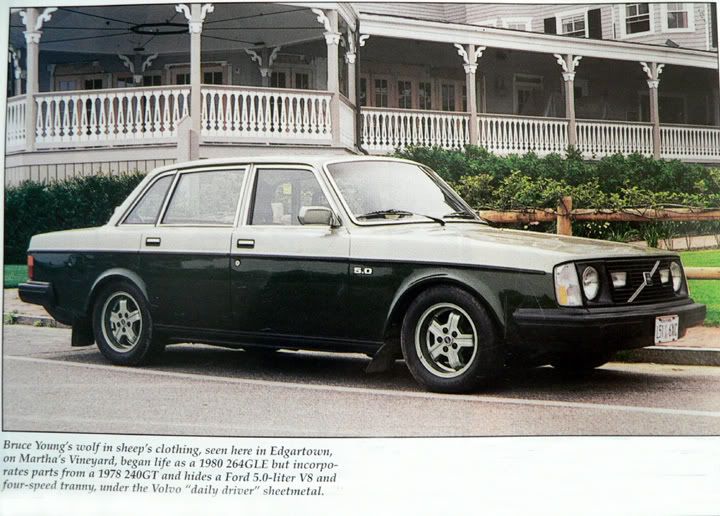
"All the good of the 240 with almost none of the bad... just not as "purty" as the 240.
But in my mind, not true "Bricks", as (I believe) that was first applied to the 200 series.
Even though I now drive a 940, the 700/900 brick wannabe's have always looked more like Buicks to me.
--
Bruce Young
'93 940-NA (current), 240s (one V8), 140s, 122s, since '63.
|
|
|
|
|
"Even though I now drive a 940, the 700/900 brick wannabe's have always looked more like Buicks to me."
Totally agree. I've mistaken 700/900 Volvos for your average mid to late 80's boxy POS so many times I can't even count. I think they have no style. Great cars? Sure. But they'll never be a classic, and I think the 240 will once they become more rare. You might even be able to call it a classic now.
--
Sean - now frolicking in the Land of a Thousand 240's (aka, Fredericksburg) thrice a week.
|
|
|
|
|
John,
is that fancy digital temp gauge stock on 240 classics?
Jimmy likey.
--
'66 220, '67 122, 2x '71 1800e, '82 242 glt, '89 244
|
|
|
|
|
I have no clue. I bought this car on eBay from a used car dealer who knew nothing of it's past, but it was obviously owned by a Volvo lover. Adding a digital gauge would have been a very minor upgrade compared to some of the other things done to it (brand new leather f&r, turbo engine swap, IPD sways, etc).
I'd almost rather have the analog outside temp gauge, just so it would fit in with the analog motif of the gauges. Since I've gotten the car I've replaced the factory color coded (?) boost gauge with a calibrated, and the voltage gauge with an oil pressure gauge.
--
'63 PV544 rat rod, '93 Classic 245 + turbo
|
|
|
|
|
Yes, the Swedish Buick.
Especially the interior.
I never owned one, but have driven one.
--
DAMHIK: Don't Ask Me How I Know - - - Sven: '89 245. 951 ECU, open-front airbox, E-fan, 205/65-15's, IPD sways, E-Codes, amber front corner reflectors. 500 mi/week commute. '89 245 #2 (wifemobile). '90 244 (spare, runs).
|
|
|
|
|
I wish I could find a car on the market which would be a modern 240 or 740 clone. I don't know of a wagon the size of the 200/700 with manual trans. and a 4cylinder available. The Japanese don't seem to make wagons and the Europeans (including Volvo) don't import them.
I believe there is a V70 Turbo Diesel, maybe with a 6speed manual in Europe. That would be something I could go for.........
--
744 & 745 16v 4+OD, 245 SE auto, 242Ti 4+OD, 745 8v auto
|
|
|
|
|
Well, there IS the Volvo 145/145E (the Yellow Peril?)
--
George Downs Bartlesville, Heart of the USA!
|
|
|
|
|
Too expensive to build. Its all about competition and profits, not building a car that lasts 20 years. My S70 is sweet, but I can dent the skin with a finger. Can't do that with a 240. Also, as nice as it rides, powerful and smooth and fast, it ain't a 240 by a long shot. Nothing is a 240 by a long shot.
|
|
|
|
|
Come 2007 the "newest" Volvo 240 series one can buy will be 14x years old. While it is a shame that Volvo did not continue this series it also is true that they did produce the 240 series for nearly 2x decades which is a pretty long time span. I really really wish I had bought a 240 Volvo new but I at time could not afford to. In the early 1990's which is when the 240 was discontinued it had a lot of competition particularly from the japanese. If I were to buy a new car today with gas prices being what they are I would give serious thought about the new Honda Fit. 40mpg hiway, both auto and manual shift, large cargo area for a compact, well built as its a Honda. Hopefully my two Volvo's will last another few years(thanks mainly to help from this most excellent site).
--
' 86 manual sedan nearly 200,000 and ' 87 auto sedan about 120,000
|
|
|
|
|
I hope I am not breaking this to you for the first time, but I think you might take a drive in a Honda or a Toyota, like an Accord or a Camry, and see what they are like. I have seen many of them exceed 400k kilometers without having the head off, and run like champs. They may chew exhaust systems, but then 240s do as well. What they don't do is eat fuel pumps, water pumps, heater fans, and especially wiring harnesses. Nobody does electrical like the Japanese, nobody. Perfect stuff.
I like 240's as much as the next Volvo lover - I have owned, and still own them, but lets be realistic. Volvo nearly destroyed the company with the 700 series, and stumbled on the 940 when the 850 was annointed the sucessor. I won't drive front drive and if I did it would be a Japanese model. So the newest Volvo in my fleet is a 1980 242DL single carb.
So the poor old 242 is a thrash about car, and I beat the hell out of it. Course I built a special engine for it, and its great fun to do that. But its not my daily driver, and I don't put the family in it. The family gets front and side airbags in more modern cars, because what Volvo puts airbags in I won't drive, and other brands have become at least as safe as what Volvos are now.
I have owned twenty six Volvos now, and the 242 will be the last. I enjoyed every one of them except the single 740. And now they make cars that don't appeal.
Life is short, don't look back.
|
|
|
|
|
Rhys said:
Volvo nearly destroyed the company with the 700 series....
Can you explain further? I can guess the sheer cost of making the 700 series.
BTW, all of these Buick comments are painful guys! ;-) We wanted a wagon but just didn't like the look of the 240 so went with a 745T.
--
Norm Cook; Vancouver BC; 1989 745T 220,000KM
|
|
|
|
|
Volvo Cars profitability plunged in the late eighties, due entirely to the lack of a new car that met customer demand, and the age of the 240, which as we know aft of the firewall was the 140 from 1966. In automotive terms that is glacially slow product revision and development. Ford bought Volvo to allow them to make "new" cars, departures from the past, and that was the 850. Without Ford, Volvo would be marine, aviation, and truck groups only. No cars.
The 740 missed the mark from a styling standpoint, but technically was a good car. The execution was lacking, especially compared with the Japanese, who one has to admit, were beginning to shake up even the Germans with their expertise.
The 740 interiors and switchgear are terrible. The wiring ground paths are terrible. The front brakes were a retrograde step from the 240 until the 92 940 brakes. FOUR variations, and three of them horrible. Inexcusable brakes for a company that was founded on safety. The 122 had great brakes - still does. The 240 has great brakes, especially the vented Girlings. The 740 brakes were mostly junk, in particular the outer surface vented Girling two piston. I made a living fixing them for customers. Front suspension bushings, although cheap, fail constantly. Ball joints too. The trans bushings, and the driveshafts ( quite different from the proven 240 types).
To top it off, many 740 were turbo engines, and the early B230's are laughable. Many excuse Volvo for these terrible engines, and slag Japanese engines. I don't. I will never own a B230 again. If I wanted an engine that sounds like a VW diesel, I would have bought a VW diesel. But the B230 does it routinely, and people tolerate that kind of symptom. I have rebuilt enough B230's for others too.
Sure they don't rust much. But they don't age well. Climate controls that will snap fingernails off. Plastics that age to completely different colours than when new. Door panels that rip off. Headliners. Water leaks from windshields and sunroofs and god knows where else. Taillights that fill with water. Exhaust systems that rot out. Convertors that rattle.
If I had a nickel for every time I drilled out a taillight or a floorboard, to simply let water out that got in I'd retire early. No one wanted to pay for a windshield repair in my experience. Center consoles that explode into brittle fragments.
The used car market is proof. A good 88 240 is more expensive than a good 88 740 all day long where I live. People vote with their pocketbooks on these cars. I can sell my 1980 242 for more money than most will get for a mid eighties 740.
The 92 and on 940's were nice cars - many of the 740 troubles were corrected -brakes and computers in particlular. But you can buy a nice used 93 Lexus LS400 for that kind of money. Drive both and compare. It is not a difficult choice.
I suppose it is pride that finally did me in personally. My own cars I figure should never end up on a tow hook. And for years none ever did - until the 740. Once a Scantech belt tensioner failed - not Volvos fault. But twice for fuel pumps, twice for distributor primary wiring, three times for computer fuel pump ground path failure, for a total of seven times that 740 was on a hook. If I had had a match.....
|
|
|
|
|
First off, Ford had nothing whatsoever to do with the 850. Volvo was still an independent company at the time, though there was that pesky partnership with the French. If I recall correctly, there was talk of a merger with Saab at some point when GM was divesting itself of some European holdings (Lotus) Later came talks with Fiat, which in my opinion would have been a far better way to go, but Ford got them in the end, in, I believe, 1998. The first generation S40 was a Mitsubishi, spawned from a joint venture with the Dutch branch of the company (formerly known as DAF) The current one (and V50) is a Mazda 3, more or less. The ugly bulbous new type V70 and XC70 must have had some Ford input on the styling. Technical expertise went in the other direction---the Ford 500 is based on the V70. The original S80 was well along in the design stage before the Ford takeover, so is mostly Volvo. (By the way, it was not the first-ever transverse FWD straight six, as Volvo advertised. That dubious honor belongs to a Wolseley badged variant of the BMC Maxi, circa 1972) The only Volvo with heavy Ford influence is the XC90---why else would such a monstrosity have been created. Ford did not buy Volvo to "allow" them to make "new" cars, they did so because they hoped to make money off the deal, to gain technology more advanced than anything they had developed themselves (particularly in the area of safety equipment) and perhaps to improve their corporate image.
Remember that the 760 came out in 1982. At the time, it was far more advanced, particularly in safety and crashworthiness, than anything the Japanese had to offer. If imitation is the sincerest form of flattery, consider the Cressida that was introduced in 83 or 84---the one that looked very much like a 760. Yes, the Toyota had a much better engine (a close copy, with two additional cylinders, of the magnificent Fiat 124 DOHC unit) but the structure was thin tin, no different from a Corolla of the time. It wouldn't be for another 8 or 10 years that the Japanese would begin to produce cars that were truly impressive, and even then they lagged behind the best of the Europeans in terms of crashworthiness and structural strength.
Early 700 series cars did suffer from quality control problems. The inferior wiring insulation was common to all Volvos from 80 to 87. The brittle interior plastic was probably related to this in some way. The headliner was a bad design from day one. The yellow/tan interior plastic did fade to an unattractive purplish color, and red faded to several different colors depending on the type of material. Blue was more stable, and, oddly, black seems to be the most durable of all. In this period, no manufacturer was immune to uneven fading of interiors--Japanese cars were just as bad. The early type door panels were prone to warping, and peeling vinyl at the top edge. The revised type, introduced in 89, is much better. All exhaust systems (except stainless) rot out quickly if the car is used mostly for short trips. Volvo is no worse that anyone else. Same with rattling catalytic converters. Heat shields rattle. Period. Whoever made them. Taillights become brittle and opaque. That can be blamed on inferior French plastic. The Hella lights on older Volvos don't have this problem. Of the five 740s I've owned, all of them were completely dry inside. One of the most watertight cars I've ever had anything to do with. (no I don't live in a desert) Never seen a center console exploded into brittle shards either, though I've come across a few with the lid broken off by being bent over backwards. As for bad grounds, VW is, and always has been, the king of that particular malady. The only ones I've run into have been minor, causing the bulb warning light to come on at inappropriate times. The main reliability issue I've run into has been the Radio Interference Suppression Relay. Carry a spare. A spare fuel pump relay is not a bad idea either.
The B230F is a fine engine. The early ones (to mid 88) had a smaller diameter crankshaft and are only good for 250K miles or so before bearings are needed. Later ones will go on indefinitely. I know of an 89 745 that has 350K miles on it and the engine has never been apart. Still has the original valve cover gasket. Yes, it clatters a bit, but the noise is harmless, unlike many Toyota engines---when they start making top end noise (usually at 150-180K) they need a cam and rocker arms, and often a full valve job as well. 22Rs are notorious for this. V6s are almost as bad. They usually also require a timing chain and gear set when this happens. I'll take an easy-to-change belt that does no harm when it breaks any day. The same 89 is still on its original alternator, starter, air flow meter and fuel pump.
I will agree with you completely on the subject of brakes. The 740 brakes were a big step backwards. What were they thinking? Probably trying to save on production costs. (this is why most Japanese cars have sliding calipers) The Girlings are especially lame. They use a tiny inadequate spring to tension the pads. This spring rusts or breaks off very quickly, and they rattle like crazy. It makes you think the whole front end is about to fall off. The Bendixes aren't as bad, but the pedal feels mushy in comparison to the 4 piston fixed calipers on a 140 or 240.
240s and 740s go for about the same around here, with the exception that really nice 240s will bring a premium price. If 740s go for less, its probably due to the headliner, which makes the whole car look ratty if it is drooping. (or missing entirely)
I've seen old Corollas and first and second generation Camrys with huge miles on them (400K+) but they looked and felt it---rusty, nasty, loose and rattly. And would you really want to have a major high speed crash in one, even if it had no rust whatsoever??
As for the LS400 as an alternative, it falls short on many counts. No stick shifts. More importantly, no wagons. Styling is just as blah as the Volvo, though perhaps a bit less dated. Far from simple and straightforward to work on. Parts are probably expensive, and may be difficult to get. For some reason, the Japanese makers love to change components frequently, sometimes two or three times within a model year. Thirsty---I can't imagine they get more than about 16-18 MPG in regular mixed driving. My 745 does 29-32. Yes, I've checked the odometer for accuracy, and it has been quite consistent for several thousand miles. I have an M46 transmission and 3.31 rear axle, and drive it fairly gently. I know that this is unusually good, but most people get about 25-26 with automatics. Turbos don't do as well. Finally, price. LS 400s are still $3-5K around here, even for 93s, even with huge miles. You can easily find a super nice 940 with 150K or less for half that.
I don't know that I agree with the idea that production costs doomed the 240. All of the tooling would have been paid off many years before the end came. Materials costs don't vary much, and as it is quite a simple car, labor costs shouldn't have been that high, especially compared to other European cars. (Asian labor costs are significantly less, due to other economic factors) It would not have been particularly difficult to have added OBD II either. Over its life span, the 240 had many different types of fuel system. Developing yet another would have hardly been a bank-breaking exercise. As for CAFE requirements, after they were gutted by the Reagan administration, the 240 was always well above them, particularly the later stick shift cars with 3.31 rear axles. It seems more likely to me that the tooling was starting to wear out, and replacing it would not have been cost effective, as there weren't/aren't enough people out there willing to pay the price for a brand new 25 year old car.
That said, the 240 series can probably be considered the definitive Volvo (though I'm sure plenty of 122 and PV owners will disagree) and it would have been great to have seen it go on forever. It had quite a run---19 years, or 27 years if you consider it to be an evolution of the 140. If you take the latter view, few other cars have lasted longer---only the VW Beetle, the Mini, the 2CV and the Porsche 911. The Saab 93/96, the Morris Minor and the Citroen Traction Avant all were produced for over 20 years, and so beat the 240 considered alone. The Model T equals it, with a 19 year run. I am not including cars made in developing countries under license, such as the Hindustan Oxford (1956 Morris Oxford) still in production in India, or the Lada (1966 Fiat 124) made in Russia until the late 90s.
|
|
|
|
|
A couple corrections:
The current V70 and XC70 were designed before Ford had any influence on Volvo, and the XC90 was mostly complete as well. I was working on the Ford 500/Freestyle in 2000 and saw prints of the XC90, you can't "blame" Ford for that one if you don't like it - it was, and is, a big success for Volvo and without it Volvo would be even less independent than it is today. The current US-market S80 (to be replaced in February) is not "mostly" Volvo, it's 100% Volvo.
The 2nd generation Toyota Cressida was introduced in the US in 1981 if I remember correctly - it hit the market here well before the 760. You could buy a 1982 model year Cressida - identical sheetmetal as the 1983-1984 Cressida, just the grille and tail lights changed in 1983 - before the 1983 model year 760 was introduced to the US market.
Zack
1980 245DL M46 282k
1988 745T+ M46 214k
|
|
|
|
|
Hey that S80 isn't "100%" Volvo... that big-ass GM 4T60E makes it at least 5% Buick. I find it amusing that Ford acquired a company building cars with the competition's transmission designed in.
Thankfully at least Ford didn't require Volvo to use a Ford transmission. I'll put up with timing belt replacements at 50K increments... but transmission replacements are a whole 'nother story.
--
Rob Bareiss, New London CT ::: 92 244-M47-208K ::: 90 745GL-M47-271K ::: 88 245DL-AW70-182K ::: 84 242 project ::: 70 VW Bus ::: 70 Bus SInglecab Pickup ::: 71 VW Type III Notchback
|
|
|
|
|
Unfortunately the 240 was no longer a competitive product in a world gone mad for fashion and style. However, it is such a simple beast that you will likely be able to keep 'em running for a long time!
John
|
|
|
|
|
Back in late 92 / early 93, we drove to the dealer in our 89 244 and were considering buying a 240 Classic. We asked the dealership owner why Volvo was discontinuing the 240. His explanation was simple: "First, Volvo can't make money selling cars for less that $20K a pop. Second, you tell me, are you willing to buy a 93 240 Classic for $24K? (this was $8K more than we paid for our new 89!). Third, Volvo knows they must advance the styling if they wish to stay competitive".
Needless to say, we didn't buy the Classic. I regret that decision now, but there was no way at the time I could pony up to the additional $8K and the depreciation on our 89.
jorrell
--
89 244 171K miles, 92 245 236K miles, 06 XC70, 00 Eclipse custom Turbo setup
|
|
|
|
|
Sales were dropping off quickly because American consumers were price-shopping it against the Ford Taurus and other front-wheel-drive cars that could be built for $2000 per unit less and still have the latest gee-whiz gagets on them. Bricks were perceived as being out-of-date, and it was too expensive to update the styling. Volvo just couldn't make any money selling 240s.
Since Volvo doesn't make RWD, I am switching to BMW, but if Volvo ever goes back to building a RWD, I will take a look, in spite of the fact that Volvo cars are now owned by Ford.
I have two bricks and two BMWs, but one of the bricks is for sale so I can buy the wife a new(er) BMW, The other brick is my trusty '91 wagon that I bought new. I'll drive that until the wheels fall off.
|
|
|
|
|
COULD IT BE THAT PEOPLE DIDN
--
put your bones on the line, stand for something or fall! GOD bless the U.S.A.
|
|
|
|
|
They are great cars.. but when i purchased my used 87 240.. the cars history showed that it was worth $30,000 canadian.. and that was 1987.
They arent cheap cars .. and they are ... ugly.. only volvo lovers would keep em..hehehe
I always try convincing first time drivers to get a volvo 240 because of its safety... but too often they would pick something which suits their style... honda civics no matter how old they are.
They were also outdated in their looks and their handling...even though they are built like tanks and with safety in mind!
|
|

|
|
One of my friends got to drive my 87 240 to drop it off to me (after fixing the bumper we "accidently" ripped off) and he loved it! He said he would ilke to get a 240 wagon now! I love my tank, its so simple and I can brag to my friends that i own a Volvo. Plus I love to say "I Roll".
--
1987 240DL...new Flame trap, Sport Air Filter, soon to be sport exhuast(non turbo)...
|
|
|
|
|


