|
|
|
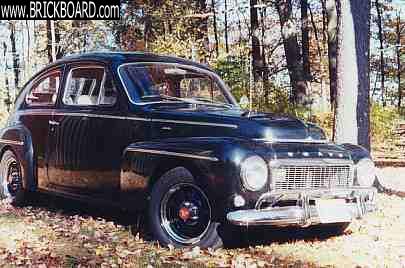
Now temperatures have reached 80ºF over here in the Netherlands, my PV444/B20F demonstrates an annoying vapour lock problem. When I park the car for a few minutes with the hot engine switched off, it will take at least 15-20 minutes before I can drive away again. Cold water on the float chambers does help of course, but I prefer preventing the problem.
I have isolated the fuel hose with a ½” waterhose but that doesn’t help. Between the 2 HIF6 SU’s and the manifold there are phenolic blocks and a heat shield as well (from a 144), but that doesn’t help either. The heat shield is a bit small though. A 82ºC thermostat is mounted and the original fan plus an electric fan is mounted with a 85/75º fan switch in the lower radiator tank, which seems to be adequate for sufficient cooling (the engine does not overheat).
I have run out of ideas how to cure this (except converting to LPG). Who can help?
|
|

|
|
I've had the same problem many, many times in my 1800, and never really found a cure. But things that seemed to help a bit were wrapping some aluminum foil around the floats (and jet tubes...mine are HS6).
What seemed to help the most though was just unlatching the hood when driving to allow a bit more air circulation and hot air to escape. Higher octane fuel seemed to help also..
I was ready to install a small electric fan next to the carbs, but the car quit being problematic.
Good luck with it!
-Matt
--
-Matt '70 145s, '65 1800s, '66 122s wagon, others inc. '53 XK120 FHC
|
|
|
|
|
If the air temperature you are experiencing is unusual for your region, the fuel you get may be formulated for colder conditions and be too volatile-- it boils too easily now in your 80 deg.F.
The 444 and 544 models seem to be built in a way that traps hot air high in the engine bay like in a hot-air balloon. There is lots of hot cast iron manifold below the carburetors. You might try opening the hood (bonnet) part way when stopped, to let the hot air escape upward and let the carburetors cool off.
If too much fuel in the manifold is typical of vapor lock after a "hot soak" happened, then it may be due to thermal expansion of fuel trapped between fuel pump check valves and carb float valves, and leaking past the float valves into the carbs, filling them too full. If there were a small passage to drain off this expansion pressure to the tank side of the fuel pump, forced fuel drainage into the carbs might be prevented. The least fuel volume in this part of the plumbing, the better: no filter and small pipes.
Fuel boiling in the float bowls will push liquid fuel into the carbs and manifold if the vent provision does not let the pressure escape.
|
|
|
|
|
You've got some good advice already. 80°F is not a hot temp for a Volvo.
We routinely experience temps in the range of 90-105°F here in Oklahoma
(not much this summer so far) and normally don't have that kind of problems.
In fact I have not had vapor lock even though the coolant was boiling.
I think you probably should do several things.
1. Make sure that your heat shield is big enough or maybe even get one
custom made to be sure that it is protecting your carbs from the radiant
heat of the exhaust.
2. Check your ignition timing to be sure it is not retarded - this will
make your exhaust MUCH hotter, to the point of glowing, cracked manifolds
and pipes burnt off at the manifold joint. Err on the side of too advanced -
if you get pinking you can always retard it back a bit.
3. Check your float level. Too high will aggravate hot flooding. Also be
sure your float valves are closing properly so you don't flood.
4. Make sure your fuel lines are routed away from hot spots.
5. Make sure your line from tank to pump does not have any leaks that
make it suck air instead of fuel. These will be worse in warm weather.
BTW I HAVE had problems with hot flooding, but not with vapor lock, not
even in the Arizona desert at 125°F.
--
George Downs, Bartlesville, Oklahoma, Central US
|
|
|
|
I think Phil is on the right track. I have no problem starting on 80 and over degree days, but the engine races for a few seconds after having been parked for more than 10 minutes. I imagine that, with a richer setting, flooding could well happen. How this would square with Mario's situation is beyond me -- I know, BIG HELP!
Bob S.
|
|
|
|
|
I've never had HiFs, but with HS6s, a hot start problem is usually over-rich mixture. Same thing with Weber side-drafts.
Are you sure it's lack of fuel due to vapor lock, and not too much fuel flooding the plugs?
|
|
posted by
someone claiming to be cdu
on
Sun Aug 1 07:22 CST 2004 [ RELATED]
|
|
I've had lots of problems with old volvos (122, 144, 164) and hot
starting. I live in a desert where the temperatures regularly get
above 120(f) on roads and in parking lots. The engines clearly get
lots hotter than that. The problems have always been easy to solve.
On one, it was the carbs being wildly out of sync. I synced the
idle and mixture and butterflys and the car would start easily from
then on. On another, the points were not opening, or were barely
opening. On the last, the car was actually getting bloody hot --
the temp gauge would jump into the red when the motor was turned off
and at idle the temp gauge would be at 3/5ths. That car had a warped
intake/exhaust manifold which I had skimmed smooth and I also
removed the secondary butterfly valves. In each case, even on
really hot days the cars would run okay after I fixed the problems.
chris
|
|
posted by
someone claiming to be mario
on
Sun Aug 1 07:00 CST 2004 [ RELATED]
|
|
On a hot day when I want to restart my B20 after parking for 15 or so minutes, I have to push the choke in, press the gas pedal down, crank the engine, after it catches and the revs come up I must immediately pull out the choke to the fast idle position so it won't die when I release the gas pedal. It seems many people have this issue and this seems to be the standard method for starting a warm car on a hot day. I know it is not a fix, but it usually works sometimes with a little sputtering.
|
|
|
|
|
Thanks for your comments.
Ignition and carb settings have been checked and rechecked and are all found to be OK. Besides that, all wearing parts of the SU carbs have been renewed not long ago. Air leaks could not be established. Under the hood almost everything is either new or reconditioned.
To solve the vapour lock problem, I will first have a heatshield made as large as possible from stainless steel, or actually one in two parts, of which the second part should be easily unbolted to restore access to the oil filter, the rear of the alternator, or to the exhaust flange nuts, when necessary. Also I will remove a floor pan in the engine room that sits in front of the cross member, which will allow for some more fresh air under the hood. It’s mounted with four screws only, though the IPD sway bar hides the front screws and will have to come off first. I already removed a circular piece from the RH radiator support panel, in fact the mirror of the fresh air opening in the LH support panel.
If all this will not help, then it still may be necessary to improve the fuel hose isolation. I think in that case I will have a stainless steel pipe made that fits the fuel hose like a glove.
If nothing works, then there is a final means with success guaranteed: converting to LPG, which is considerably cheaper in this country, though installation cost set you back initially but can be earned back by driving a lot. With an LPG setup BTW, an injection inlet manifold (see earlier post) would be ideal as it will give the most bhp. I’ll let you know what the solution will be.
|
|
|
|
|


