|
I'm enclosing a "canned response" I wrote up for questions like yours. It's as brief as I could make it, and still cover what I think are the key items.
Let me know if it helps or confuses (critiques from others are welcome too)...
==============
The Battery's main job is to supply power to the starter. Period.
Once the engine is running, the Alternator supplies power forEverything Else — plus a little extra to keep the Battery charged. (The Battery is just along for the ride at this point.)
In simple numbers, the Battery is capable of supplying no more than 12 Volts. The Alternator can put out about 14 Volts. (Anything over 12 Volts is what keeps the Battery charged.) A meter on the Battery terminals shows Battery voltage with engine off, and Alternator voltage when running. If it drops below 12V running, you're reading Battery again.
If the Alternator output falls below 12 Volts, the Battery starts taking up the slack (not its main job) and "running down". The fewer the electrical demands, the longer the running down will take. I once went about 40 daytime summer miles after leaving a wire off the (V8) Alternator.
Voltmeter readings can be misleading, however. For example, six flashlight batteries connected end-to-end will read 12 Volts on a meter. But they would hardly power your headlights, let alone turn the starter motor. They wouldn't have the "Capacity".
Alternators sometimes lack Capacity too. They may show 14+ Volts with the engine idling, but less and less as lights, fan, etc. are switched on. The usual suspects in this case are:
1 - The Voltage Regulator/Brush unit attached on the back of the Alternator
2 - Worn/grooved commutator (in the Alternator, where the brushes ride)
3 - Worn/Glazed/Loose/Slipping drive belts
4 - Poor connection(s), Alternator-to-Starter-to-Battery + terminal
5 - Poor "Ground" wire connection (between Alternator body and mounting bracket)
If the Alternator output never rises above the Battery's 12 volts, it could be due to:
A - More severe versions of any of the items listed above
B - Failure to "pre-exite" the Alternator's charging circuits (current flow from the Battery Light on the Instrument Panel via the thin red wire to D+ on the back of the Alternator.
C - An internal failure within the Alternator itself (least likely)
===================
Hope this helps,
Bruce
--
Bruce Young,
'93 940-NA (current)
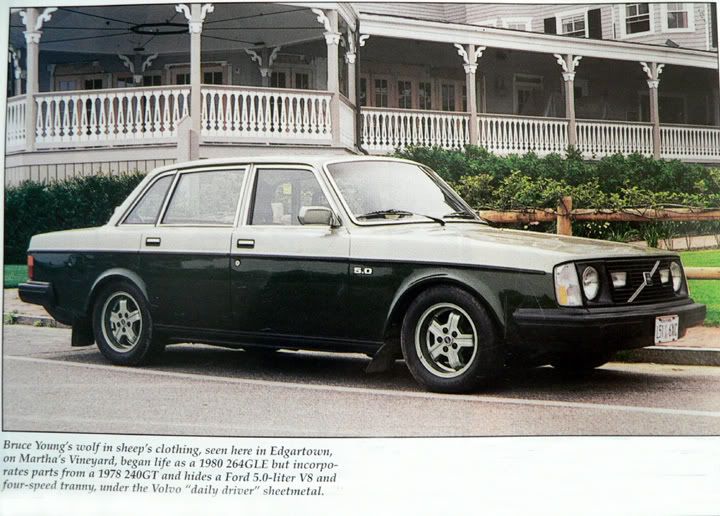
'80 GLE V8 (Sold 5/03)
'83 Turbo 245
'76 244 (lasted only 255,000 miles)
73 142 (98K)
'71 144 (track modified--crusher bound)
New 144 from '67 to '78
Used '62 122 from '63 to '67
|