posted by
someone claiming to be secretsenor
on
Tue Nov 22 16:20 CST 2005 [ RELATED]
|
|
Why do people go for Carbs over fuel injection??
Is it just for originality?
I have carbs on my b20 and am thinking about elec ignition and fuel injection for fuel effeciency.
Will elec ignition make much of a difference to a carbed engine without the fuel injection?
Is there a preferred elec ignition kit for the b20 (available in Australia)?
|
|
|
|
|
Electronic ignition is very nice addition as discussed. Either a Crane XR700 setup can be obtained for around $100US, or go with a original Bosch setup from '75 B20, a little harder to find and fetches a premium price because it's the only year B20 that came with electronic ignition (I've seen them go for $100-$150US range). I've used both, and never had an issue.
Fuel injection is very nice. In the last couple of years, I went from running a B18 twin SU carb, to a B18 downdraft Weber, to a B21F single SU carb (B21A setup), to finally to a B21F Megasquirt electronic fuel injection in my '65 122. Every step made it run a little better, but the EFI setup -> I can't believe the difference in power and acceleration.
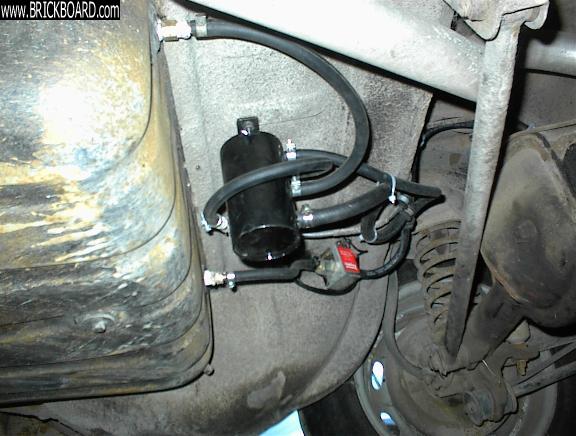
A lot of work, but it was worth it. I had to modify the gas tank, added a surge tank, a main fuel pump setup from a '85+ 240, and the hard plastic fuel line from a 240(I'll post some pictures). The engine back might give you some ideas if you go with fuel injection, and here's a link to a B20 fuel injected 122 using Megasquirt:
http://www.southroad.net/ms/
Hope it helps.
Paul
BTW- I purchased the surge tank from Tweakit in Australia.
(http://www.tweakit.net/shop/index.php?cPath=40_29)

|
|
posted by
someone claiming to be Rhys
on
Wed Nov 23 12:53 CST 2005 [ RELATED]
|
|
Very impressive work Paul! I would think that 122 goes extremely well, and drives smoothly too.
Rhys
|
|

|
|
Now all you need to do is put on a:
--
I'm JohnMc, and I approved this message.

|
|
|
|
|
The advantages and disadvantages of an electronic ignition are pretty independent of the fuel injection system. I really like them because they don't wear, I set the timing on mine (Crane XR700) and if I check it 5000 miles later it's right where I left if. Not so with points, that little rubbing block wears, the points erode, it changes from the moment you put it on. If you have modified the motor and drive it hard, you might benefit from a more powerful ignition system, as the peak pressures rise in the cylinders, the resistance across the plug gap rises, and it takes more juice to make a good spark. It's a bit more concern to forced induction motrs, but a weakened original coil will start to show problems even on a stock motor.
There's no doubt that fuel injection does a much better job at feeding the engine the fuel it needs. But there are tradeoffs. A set of SU's are dead simple to toss on, and they'll do their 'pretty good' job with no hard thought required. Develop of feel for the art (it isn't science for sure) of balancing and tuning them (seasonally) and they can be pretty decent.
D-Jet - the electronic fuel injection of the early 70's, is pretty primitive, and lacks adjustability and adaptability. It has no feedback mechanism whatsoever, so if you modify the engine (or it simply wears a bit) it can't tell the difference, it just sticks to its hardwired fuel map. In general terms on a stock motor (2 liters, D cam) it does a better job than carbs. Although typically it seems to use a bit more fuel. It gets a bad reputation because it is electrical, and when 'tinkered' with by mechanically minded mechanics it doesn't respond well. it is best approached from an electrical standpoint, the few mechanical aspects of it (like the fuel pump and pressure regulator) should not be messed with in attempts to band-aid electrical issues (like a bad wire or sensor).
To really get closer to the holy grail of clean running, max efficiency, and max power, you need a newer fuel injection system, one with feedback so it can adapt to changes in the operating conditions, fuel, and motor. Megasquirt is a neat cheap system. It's a modern fuel injection system that is completely programmable and open, unlike the sealed (literally) box that most OEM computers are, including D-jet. It's just the controller, you'd use it with fuel injection hardware of your own devising, but D-Jet hardware is a great start - you can re-use almost all of it (new throttle switch and pressure regulator (manifold pressure referenced), pitch the troublesome 'hand grenade' D-jet pressure sensor. You just install it, wire it to the car, and program it using a serial cord to a PC (laptop is very handy). The good news is that you wouldn't be a pioneer, you could probably get useable fuel maps from other people who have already done this to their Volvo B20's. Add an O2 sensor for feedback, and this can even run the ignition advance (based on MAP and RPM) if you add an extra ignition box like an MSD 6 and lock the mechanical advance on the distributor.
--
I'm JohnMc, and I approved this message.
|
|
|
|
|
I disagree with some of what you say about D-Jet. It's true that it's not able to supply enough fuel for drastic engine mods, but it works well on stock & mild engines. On a stock B20E the latest fuel injection would make no more power or fuel economy than what D-Jet in good condition can do using the same intake manifold. I don't know why you would need an O2 sensor either, other than to look after a cat-con.
|
|
|
|
|
"I don't know why you would need an O2 sensor either, other than to look after a cat-con."
In a perfect world you wouldn't, and the fuel map built into the D-Jet computer would always be valid. But in reality, things happen. The fuel pressure varies a little. A non-stock exhaust system changes the flow. The temp sensor stop working quite right. Without feedback D-Jet can only blindly inject as much fuel as it thinks there should be, and can't adapt to any changes in outcome. Without feedback, D-jet is typically tuned somewhat rich, because it doesn't really hurt much to burn extra fuel, but going lean is bad. This might give you as much power as the motor can make, but it can't pair that up with the best mileage at the same time.
--
I'm JohnMc, and I approved this message.
|
|
|
|
|
OEM injection uses O2 feedback to fine tune the mixture to be chemically correct, but a chemically correct mixture doesn't give the best MPG or BHP. For maximum fuel economy you can run leaner than a narrow band O2 meter goes & for maximum power you can go off the other end of the scale. In a performance vehicle all an O2 sensor does is provide a place to start.
|
|
|
|
|
With Megasquirt you can use a wideband sensor and give it a precise target fuel ratio for an 8X8 (or 12X12) MAP/RPM table. Anything, presumably, from 10:1 to 24:1. I agree that narrowband sensors are good only for emissions control, nothing else.
--
I'm JohnMc, and I approved this message.
|
|
|
|
|
So you can tell MegaSquirt what fuel mixture you want & it will calculate the table for you from the O2 reading? Is that a recent thing? I haven't looked at them for awhile. What I'd like is multiple maps so you could have one for hard driving & one for economy. Something else to remember about D-Jet is that's it's analogue, not digital which is a bit like having an infinite x infinite map.
A MS question for you: do you need a flyback board to run D-Jet injectors?
|
|
|
|
|
Yeah, I think the mixture targets is a more recent thing. The software changes very rapidly on those.
They have dual table versions too now.
MS doesn't just use the discrete points on the map either. It extrapolates between the points. So a person who knows what they are doing can let just two points define a wide rpm or MPA range where the VE curve is fairly steady, and cluster the points around the rpms where the curve is actually changing. So it's as good as infinite X infinite as well. Some other systems that sound better simply because they have 50 X 50 maps aren't really, because they just use only the values in the table.
Yes, I think you have to use a flyback board on D-Jet injectors, at least on the earlier MS designs - they can't handle the current drain of the low-impedance D-jet units. I think the new 3.0 MS hardware can handle them directly though, as well as do a whole lot of other new and interesting things.
--
I'm JohnMc, and I approved this message.
|
|
|
|
|
So what's your take on D-Jet injectors? Use them if you got them or spend some money for something else?
A second fuel map triggered by 4th & 5th gears would be handy. Make it extra lean below 3500 rpm in the top gears to maximize economy on the highway. Have you replaced you Webers with MS yet? I haven't really been following your progress.
I really need to buy a MS kit & try one. I've got 3 ratty 45mm DCOEs that would look & sound good as throttle bodies on a B30....
|
|
|
|
|
No, no MS on the PV yet. I tend to do all my tinkering on it during the winter, when I wouldn't be driving it anyway (salted roads around here in Missouri). And I may still decide not to do it. I keep thinking about how the same amount of money would buy be a fairly decent 240 Turbo, instead of replacing the DCOE's which work pretty well as is. (I've been reading lots of posts over on Turbobricks and have subliminally picked up the desire for a 240 Turbo)
I'd have no qualms about using D-Jet injectors, or a D-Jet manifold for that matter. They do the job as well as needs to be done. I'd be doing that and MS'ing the PV quite cheaply except:
- My R-sport head doesn't have injector ports
- A D-Jet manifold doesn't fit in a PV
I suppose I could always shorten the manifold and have the R-sport head drilled (sort of a reverso from all the B20E and F heads out there with plugged injector holes). But that would lack the cool factor of the quadruple throttle bodies of a couple of DCOE style throttle bodies (with integral injector ports). Not to mention the cool factor the DCOE's themselves have. I wonder if you could dremel out the guts in the float bowls of a DCOE, and then drill two injector ports and hide them inside the bowl shell...
--
I'm JohnMc, and I approved this message.
|
|
|
|
|
I'm not keen on using the D-Jet manifold. I think the runners are too short & their diameter is too big for a road engine & it's the manifold that makes power, not the injection. While you are making a manifold put the injectors on it. 240 Turbo = bleh, every man & his dog's got one of those. I'd like a supercharged B20 142.
|
|
|
|
|
The part I like about the 240 turbos is that you don't need to spend a bunch of money on a motor that may or may not blow up spectacularly. You can just get a long block OHC turbo motor from the junkyard for $200, and if it blows up spectacularly from an excess of boost/revs/exuberance, you just get another $200 long block.
--
I'm JohnMc, and I approved this message.
|
|
|
|
|
We never got 240 Turbos here, occasionally I see 740 Turbos. All the NA OHC motors here are high compression, so I guess I'd have to shell out for a set of B21FT pistons if I had to build something to hold boost.
|
|
posted by
someone claiming to be secretsenor
on
Sat Nov 26 10:52 CST 2005 [ RELATED]
|
|
Sounds to me like there are some pros and cons with the different set-ups of fuel injection. My simple understanding was that if the car was made more fuel effecient then all things would work more effectively. Eg. acceleration and traffic and cruising. I am not looking for a race set-up or street rod - just something that is tweaked up with a few cheap modifications to be as reliable and effecient as can be expected.
For a stock b20 with the original set-up how would you begin to make it as fuel effecient as possible. I was thinking - elec ignition and fuel injection - maybe cool air (I have asked a similar question on the 1800 list).
Is there something simple that I am missing or anything else that I should consider?
|
|
|
|
|
Have you got a B20B or E? The first thing for fuel economy is getting what you have tuned up & repaired. Electronic ignition isn't that helpful to economy when your distributor is in good nick, It's more of a convenience not having to change points. Having said that, the available electronic conversions are good at masking distributor problems, particularly if the points cam is worn funny.
Next on the list is an overdrive if you don't have one, then an improved exhaust, then a carefully ported cylinder head. Cool air isn't helpful to economy, but it is free horsepower.
|
|
posted by
someone claiming to be secretsenor
on
Mon Dec 5 15:31 CST 2005 [ RELATED]
|
|
Its a b20b.
I am probably going the way you suggest...
probably elec. ignition then 4sp+od.
I may have a little fuel leak / carb problem as well..
Lumpy and dying idle at normal running temp and intermittent fuel fumes (not exhaust) in the cabin.
We are heading toward summer here in Australia... it looks like a hot one.. was near 100F here yesterday...
|
|
|
|
|
Sounds like you are in need of needle & seat replacement. Also, does your car have plastic spacers beetween the carbie & the manifold?
|
|
posted by
someone claiming to be secretsenor
on
Tue Nov 22 16:41 CST 2005 [ RELATED]
|
|
I read also that the 1975 240 distributor is a good fit and works well.
Does anyone have any comments or experience with this set-up??
|
|
|
|
|
Yes indeed, I DO have experience with this setup and am VERY happy with it.
It fires a HOT spark on dirty plugs even with fairly low battery voltage
(after being buried in snow for a couple weeks, for example).
It is quick and easy to install - be sure to get the distributor, the module,
the connecting cable and the coil. You may be able to use the original 122
coil - I haven't done that yet but plan to try it soon.
I also have a 75 164 electronic ignition system that I plan to put on my 69
164. Same basic deal except this one also has the trigger points for the D-jet.
Another project I plan to try is to put the electronics from a B21 distributor
into a 4 cylinder D-jet distributor for the Yellow Peril.
BTW once I got the problems ironed out of my D-jet, it is GREAT, but I think
it is pretty ambitious to put one on a 122 because the plumbing and wiring
are not there to support it. The tank will have to be modified also.
--
George Downs Bartlesville, Heart of the USA!
|
|

|
|
I have used the Petronix Ignitor on my 140s and have been happy with them instead of points.
I switched from fuel injection to carbs. I prefer the carbs because they are simple, cheap and reliable. The early fuel injection systems were quite hardy, but I just prefer the simplicity of carburators. I usually get around 25 mpUSg around town.
--
'60 544, '68 220S, '70 145S, '72 144E, '86 745T
|
|
|
|
|
Electronic ignition means you don't have to check/adjust points, etc. and will compensate a little bit for a worn distributor shaft, timing wise. I have a Crane on my 122 and I'm happy with it.
I think people go for carbs because they are simpler than an FI system and it can be easier to change the jetting/settings on a carb than to reprogram in FI system.
Tom
NYC
|
|
posted by
someone claiming to be secretsenor
on
Wed Nov 23 10:47 CST 2005 [ RELATED]
|
|
Thanks for all that information.
I am cheating abit 'cause I have a 1800s - I usually look/search here because theres more b20 info discussed here than anywhere else.
I am thinking that I will go with the 75 240 ignition because it should 'plug and play' without too much trouble and be cheap and volvo designed/compatible.
The fuel injection is a bigger outlay and will occur when I have some more money... I will probably get a pro to set all this up and then search around for some fuel maps etc and adjust to suit.
thanks again for your time.
|
|
|
|
|