posted by
someone claiming to be Diyer
on
Wed Aug 3 11:32 CST 2005 [ RELATED]
|
|
... to make a long story short, I wanted to take a quick peek at the archives for any reference to replacing the Master Cylinder, when I saw your post and read about your brake ordeal, to put it mildly. THAT was a long 3 threads!
Anyway, I don't think I have concaved or convexed pads. But what I was wondering, is that since my dash light does not come on as a warning sign from my Pressure Differential Warning Switch, then perhaps I do not have a bad MC. Volvo Techs tell me the missing clue is no dash light, since a MC failing equally on both ports is a billion to one. Normally, they tell me, the seals fail unevenly, and when a MC seal starts to fails that uneven system pressure triggers the Pressure Differential Warning Switch (PDWS), i.e., the dash light comes on. Sounds logical to me.
But, at any rate, what is more important is, if I do the MC swap for a new one, did you ever figure out if:
(1) Whether bench bleeding was really required?
(2) If the caliper bleeding sequence is critical?
I ask these two questions because I have a pressure bleeder, similar to the motive but from Snap-on. Volvo techs tell me that none of that is necessary when you have a pressure bleeder.
Thanks in advance,
diyer
|
|
|
|
|
This may help
http://www.brickboard.com/RWD/volvo-914438.html
--
1980 245 Canadian B21A with SU carb and M46 trans in Brampton, Ont.
|
|
|
|
|
re: "...since my dash light does not come on as a warning sign from my Pressure Differential Warning Switch, then perhaps I do not have a bad MC...."
When I experienced the "pedal drop" symptoms of the leaking seal in the M/C, the pressure balance switch's warning light did not come on. There was not enough difference in pressure -- just enough leakage to let the pedal slowly drop. But changing the M/C was an immediate (and lasting, now about 10 years) cure.
By the way, I really endorse that new pressure bleeder (PowerBleeder) from IPD -- it's the best I've ever used -- and I flush every year!
|
|
posted by
someone claiming to be diyer
on
Thu Aug 4 10:44 CST 2005 [ RELATED]
|
|
Ken, thanks for the input. It sounded logical both ways and I wasn't sure.
diyer
|
|
|
|
|
This is not Volvo Specific, just my knowledge of having done some MC replacing.
If you bench bleed the MC, chances are very good you will not have to bleed at the Calipers.
When you disconnect the Lines from the MC, there is fluid right at the very ends of the lines.
If the MC is blead,there is Fluid right at the Connecting Threads. Basically there is no air to get into the system.
Bench Bleed on the car. Install the MC, bleed it with the small hoses and fittings that usually comes with new or rebuilt MC's. When you feel the MC is blead, hold your foot on the Brake pedal (have someone do it) so no fluid drains out while you thread the Brake lines back on.
You can loosen the MC from the Booster for this so you get a little movement i the MC to make the connection of the Brake lines easier.
--
'75 Jeep CJ5 345Hp ChevyPwrd, two motorcycles, '85 Pickup: The '89 Volvo is the newest vehicle I own. it wasn't Volvos safety , it was Longevity that sold me
|
|
posted by
someone claiming to be Diyer
on
Thu Aug 4 04:02 CST 2005 [ RELATED]
|
|
Ok, I can try that, but isn't air going to get into the lines that are removed from the MC?
... and Btw, what about that bleeding sequence if you have a pressure bleeder?
diyer
|
|
|
|
|
If you don't shake or wiggle the fluid out of the lines it will stay right at the very end of the line. IF you get the slightest bit of air way up in the braking System, it will burp it's way out the MC. I have never had spongy brakes after doing this.
Sorry but I have no experience with pressure bleeders. I would go from longest brake line to the shortest which what that sequencing is all about.
--
'75 Jeep CJ5 345Hp ChevyPwrd, two motorcycles, '85 Pickup: The '89 Volvo is the newest vehicle I own. it wasn't Volvos safety , it was Longevity that sold me
|
|
|
|
|
Your method does sound workable.
About the sequencing. I agree in part that the sequence is supposed to be based on the furthest away bleeder first. But isn't it also based on doing the highest bleeders first also? I wonder which is the more important? At any rate, the books I read have me going to the left rear first and then to the front tops second, and although the tops make sense in a home-plumbing-radiator-system kind of way, the left rear before the right rear does not make sense. Those two rear valves preceding the bleeders are located on the drivers side, as well as the MC. Go figure.
diyer
|
|

|
|
There are only two wide spots I know of where a bubble could be difficult - each side of the octopus. The high-side ports run to the rear calipers, so it makes sense to me to push that bubble through first. With pressure bleeding, I don't see how it matters which side you tackle first.
--
Art Benstein near Baltimore
|
|
posted by
someone claiming to be diyer
on
Sat Aug 6 07:07 CST 2005 [ RELATED]
|
|
89, 245, non turbo
160k
Here's how it went so far and I wonder if I have a problem?
Sucked all fluid out of old MC, took off mc and virtually no mess. Bench bled new MC best I could. Used a THEXTON MC BLEEDER, with SAE/fractional 3/8 x 24 threads. So, I used with teflon tape to take up any slack in the I assume Metric 1.00 mm pitch, ATE MC threads (didnt measure the DIA, it felt tight enough with PTFE tape). At any rate, I saw a drip at the connection as I pushed the MC rod in to bleed it. So, I tightened the connection and it stopped leaking. Proceeded to bench bleed. Not much air that I could see either way. Pushed rod in about ten times.
Mounted MC on car. Got Mom to hold brake down a little bit (instructed her NOT to allow pedal to go back - I wonder if she did, though). Removed the MC bleeder tubes and threaded in the vehicle hard metal brake lines. Pumped up pedal, felt tight. Started car to see how brakes were - OMG far worse than before, pedal drops to floor easy.
I have since been reading over the bleeding FAQ and looking at the Haynes Brake Manual. I suspect that my MC was probably not even bad to begin with and that my system was just airbound, because I never did any of the various things mentioned. Last time I bled (using a Snap-on non-diaphram type bleeder - similar to Motive but with a universal cap adapter and quick disconnect coupler), all I did was hook it up, bleed RR first, then LR, then RF, then LF. Pedal was tighter but not what I wanted it to be, and it got noticeably worse rather quickly). So, my friendly Volvo tech said it sounded like a failing MC.
Here is a list of the things I never did (some from the FAQ):
. It is also necessary to flush the lines "before" installing slave cylinders, calipers etc. Many people simply pull the old unit off and then "slap" the replacement unit on which causes any old fluid or contaminants to damage the replacement when the lines are bled. Our experience with clutch slave cylinders went from a return rate of approximately 50% to less than 5% by simply advising installers to follow these simple instructions.
. Haynes says to Pump up brake pedal to push air out of booster before bleeding.
. Remove or press back pads on one rear wheel before starting to bleed.
. If you have lots of air in the lines and master cylinder, tap them as you bleed to loosen adhered air bubbles.
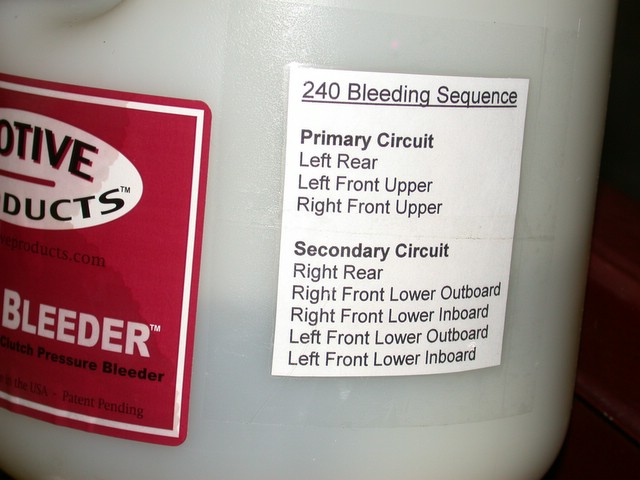
. Brake Bleeding Sequences. [These sequences apply to all cars per the Volvo manual] Bleed the brake lines in this order: Cars without ABS and 1988 or later models with ABS: LR, RR, RF, LF.
. On Volvo models with 3 bleeder screws on the front calipers, open all bleeder screws simultaneously.
. Brake Fluid Flushing Procedures. (From the Volvo Manual] The manual notes that you should de-pressurize the pressure flusher after doing each wheel, then operate the brake pedal several times, before going to the next wheel.
Well, I at least did the following one before driving the car.
. After doing all four wheels, operate the brake pedal several times.
diyer
PS. Going to try finish job today - no brakes, but I didnt bleed after MC change. Several posts are suggesting that it is very possible not to have to bleed the system after repalcing the MC. If that's true, I did something wrong.
|
|
|
|
|
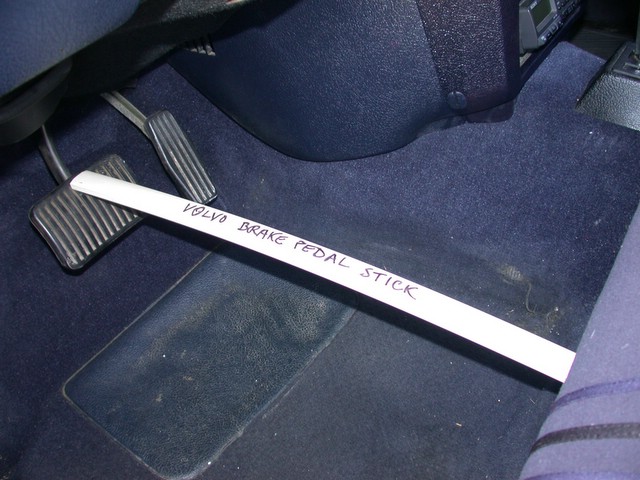
Not sure why you wanted to hold brake pedal down... you didn't have any calipers disconnected, did you?
This is how I hold the pedal down an inch to prevent the master from draining its reservoir while working on a caliper or hose. It also serves well troubleshooting brake lights.
--
Art Benstein near Baltimore
|
|
|
|
|
Well Art, the reason I held the brake pedal down is because, well ... just do a search under brake bleeding and/or master cylinder and you will read plenty of posts authoritatively saying that is part of what needs to be done. Secondly, Haynes manual says before bleeding to pump up pedal a few times and push air out of brake booster.
And now your saying I shouldn't have ...!
(Art, that last sarcastic line is meant towards those that adocated/insisted on doing that procedure, not towards you [if it is wrong, it should have been deleted from the board, not left to remain as instructive]. Who the heck can wade thru or sort out all the darn info at this site. I think a site like this is nice but who the heck do you listen to?
Anyway, read below for my other responses. Something posted there makes no sense to me.
Art, thanks for the reply. I read some of you other posts on other subjects and they were helpful.
diyer
|
|
|
|
|
Sir, I can hear your frustration. Or see it, I guess.
I try not to offer advice, just descriptions and photos of my own experience or practice. But here I will try advising:
Time to step back and remember you alone are working on your car. You shouldn't take anyone's advice without fully understanding it. Working on brakes can have serious consequences. You will come to trust those who take the time to explain the reasons for the "way things are done", but you still must make your own decisions and set your own course of action.
Sometimes people just mistake good spelling for technical authority. Don't. Read as much as you can and back it up with questions when you have the opportunity. If procedure alone was all that was necessary, anyone with a Haynes or Bentley could open up a shop.
Well, I said enough, except to say, take it slow and careful with those brake jobs.
--
Art Benstein near Baltimore
|
|
|
|
|
ART: "You will come to trust those who take the time to [explain the reasons] for the "way things are done."
MY REPLY: I hear THAT!
In the meantime while I am searching for reasons, I sure wish someone would [explain the reason] you need to de-pressurize after doing each wheel (for bleeding or flushing).
diyer
|
|
|
|
|
re: "...Got Mom to hold brake down a little bit...."
That scares me -- really! The trick to doing a perfect bleeding (and I've got a lot of practice, as I do it on all four of my Volvos every year, when I take off their snow tires in the spring) is to NOT touch the brake pedal. I use a pressure bleeder instead of pressing on the brake pedal. The risk is that if the pedal is pushed too far, you can destroy the seal (the same seal that is probably bad and the reason you changed the M/C), so maybe that's why the pedal went to the floor with your new M/C.
re: "...open all bleeder screws simultaneously.
This scares me even more than your mother. It's not the right way. You have to follow the proper sequence -- one of the other posts lists it, so I won't repeat it here. Yes, it's tedious, and has you running around the car several times, but it's for the unique dual-triangular circuits of the Volvo, and it's vital.
re: "... Brake Fluid Flushing Procedures. (From the Volvo Manual] The manual notes that you should de-pressurize the pressure flusher after doing each wheel, then operate the brake pedal several times, before going to the next wheel...."
Again, pressure bleeding, rather than using the brake pedal, is the best way.
Hope you have success. Regards....
|
|
|
|
|
KEN C: "The risk is that if the pedal is pushed too far, you can destroy the seal the same seal that is probably bad and the reason you changed the M/C), so maybe that's why the pedal went to the floor with your new M/C."
MY SECOND REPLY:
Btw, isn't that what you are doing when bench bleeding - pushing the MC rod/shaft all the way in to get all the air out? ... And why doesn't the MC get destroyed then?
and why isn't ATE or Volvo telling anyone what you are saying? They never told me this issue. They never told my local dealerships this issue. IPD had the best explanation for what that long MC stroke is all about. Re-read what I said about this.
I wish you success in furthering your brake system knowledge.
diyer
|
|
|
|
|
I personally haven't experienced this failure due to stepping too hard on the pedal during bleeding (I've always bled using power bleeding) -- although I did once experience this through normal wear (about 175,000 miles) of the seal.
However, read through the archives -- search for Master Cylinder, bleeding, or something like that -- and you'll discover that this is a widespread event, viz. that the M/C suddenly fails during the course of a routine bleeding when the pedal method is used. At least once a month, sometimes more, someone writes that they did a brake bleeding using the padal method and now their master cylinder is 'toast'; and I'm sure others here could corroborate. Then you be the judge. I only meant to help you by pointing this out, not get into an argument with you.
As for explaining this in the manuals (assuming you're using the 'real' green Volvo publications and not some junk like Haynes (although Bentley is good) -- although I've never seen those instructions in my green manuals -- is that sometimes real shop manuals assume certain prior training of the reader and leave out subtle things that an untrained amateurs may not be aware of (like never press too far on the brake pedal).
Enough said.
|
|
posted by
someone claiming to be diyer
on
Mon Aug 8 04:01 CST 2005 [ RELATED]
|
|
KEN C: " I only meant to help you by pointing this out, not get into an argument with you."
MY REPLY: " I'm not in an argument with you. Maybe you are with me, but I am not with you. I am only raising issues to flush out (nu pun intended) the truth. The physical world has many variables and even Volvo master techs make mistakes sometimes.
diyer
|
|
|
|
|
KEN C: "The trick to doing a perfect bleeding ... is to NOT touch the brake pedal. I use a pressure bleeder instead of pressing on the brake pedal."
MY REPLY: I understand the reason why, because if you press on the pedal you are shutting off the pressure of the pressure bleeder. No, that is not what I did. I only had the pedal pushed down enough to hook up the vehicle lines and to prevent any air from going into the MC (or at least as little as possible), i.e., "the inevitable step of removing the bench bleeder lines and hooking up the vehicle's metal brake lines." At some point, this has to be done regardless of ANY bench bleeding method used or not used. Btw, I have talked to Volvo dealerships that do not bench bleed at all, just install the MC and pressure bleed - they say that will do it all - and furthermore, they say no sequence is necessary, as long as it has at least some logic to it (meaning that you wouldn't just randomly jump around the system). Hey, that's what they tell me, so go figure, no wonder a person wonders what the heck to believe or not to.
KEN C: " The risk is that if the pedal is pushed too far, you can destroy the seal (the same seal that is probably bad and the reason you changed the M/C), so maybe that's why the pedal went to the floor with your new M/C.
MY REPLY: Now after I did the above, I pumped up the pedal prior to bleeding. Haynes says to do that. The pedal firmed up. Then I started the car to see if it would still be firm (because if you a good bit of the previous posts, you will see that I was being told it is possible to not have to bleed the system at all if one is successful in bench bleeding the MC. It was very mushy, so I figured the system has lots of air in it. So, I shut off the car, and pumped up the pedal to get it firm, and then started bleeding last night. LR first, then RR (got too late and dark so I stopped). (Btw, my pressure bleeder is clogged or something is wrong with it. The gauge is acting weird. But the tool can still create pressure, so I will try to finish today. As for you comment about not pushing the pedal down all the way. I had spent booko-mucho hours on the tele with IPD and a very competent IPD guy told me that what that is about is that corrosion get in the old MC and when you push down all the way all that crap destroys the seal edges a bit. The MC has a stroke that can be pushed all the way. I mean if air gets in the system, and that's what can and does happen to vehicles, then you bleed it out. You sometimes discover that by having a pedal going to the floor ...
Your not suggesting people buy a new MC everytime they get too much air in the system and the pedal drops to the floor are you? I wonder how Mechanique did not destroy his MC when the same thing happened to him and he found out that it was convexed/concaved pads.
KEN C: "...open all bleeder screws simultaneously ... This scares me even more than your mother. It's not the right way. You have to follow the proper sequence -- one of the other posts lists it, so I won't repeat it here. Yes, it's tedious, and has you running around the car several times, but it's for the unique dual-triangular circuits of the Volvo, and it's vital.
MY REPLY: Hey, don't shoot me, I'm only the messenger, RTFM - I.E., Read the FAQ at this Volvo web site - THAT is where it is written for three (3) nipple calipers. Don't believe me? Here is a verbatim copy of this sites FAQ on that subject:
" On Volvo models with 2 bleeder screws (upper and lower) on the front calipers, use upper nipple ...
On Volvo models with 3 bleeder screws on the front calipers, open all bleeder screws simultaneously."
and, I might add that there are numerous posts stating that this is all moot when using a pressure bleeder. At any rate, it is not clear at all, whether it is from this sites posts, or FAQ, or written publications, etc. So my plan is LR, RR, RF upper, LF upper, RF lower (both nipples), LF lower (both nipples). Its as logical as anything else I read.
KEN C:
"1) Brake Fluid Flushing Procedures. (From the Volvo Manual] The manual notes that you should DE-pressurize the pressure flusher after doing each wheel ...
2) Then operate the brake pedal several times, before going to the next wheel ..."
MY REPLY:
1) Ok, what is the reason to DE-pressurize after each wheel? No other vehicle manufacture or web site is advocating this nonsense except here. Hey I'll do it if you provide a reasonable explanation.
2) I thought you repeatedly said not to touch the brake pedal? Haynes does advocate doing this before bleeding to remove the pressure and air form the booster and I can understand that, but to do it between each wheel, WELL, THAT HORRIFIES ME, that after I just got the air out of a wheel, I would in essence be pumping air left in the system possibly back to the same wheel I just bled. Makes no sense and I never heard anyone advocate this before, ad I think Volvo needs a newer TSB to clarify a possible typo or explain their logic. I must have called umpteen shops and they do not do this step - they ALL think it is a total waste.
KEN C: Again, pressure bleeding, rather than using the brake pedal, is the best way. Hope you have success. Regards....
MY REPLY: Well, thanks for the vote, but your reply wasn't based on thinking I was doing the pedal/pump method was it? I mean I was fairly clear I said I was using a pressure bleeder.
Thanks for the reply, but I sure wish you would support your reply with reasons for what you are advocating.
diyer
|
|
|
|
|
re: "...Haynes says to do that...."
Ahh, that probably explains all of this.
People on this list with more colorful and/or creative writing ability have frequently described Haynes as worthy of little more than a paperweight or doorstop.
I can't comment, though, as I haven't owned one. I do have the whole set of the green Volvo manuals covering all my cars, and a Bentley for some quick reference.
Anyway, best wishes.
|
|
|
|
|
KEN C:
re: "...Haynes says to do that...." Ahh, that probably explains all of this.
MY REPLY:
Explains all of this ... Holy Bat S___ Ken C that's brilliant. Explains nothing you mean! Many topics were discussed in this thread. So, it explains what?
How old are you, 19? ... just out of automotive tech school or a college BA program? (Just messin with you Ken)
All Haynes said to do was to pump the air out of the booster before doing a brake bleed. That's what I did, and it was of zero consequence. It just is plain good advice and is supported in logic. If one were to NOT pump the air out of the booster prior to bleeding a caliper with all that system pressure, it could shoot out rather forcefully. But it just simply has nothing to do with anything else that was discussed.
I just want to know the reasons for doing and not doing something. I do not need to hear some age old mechanics wives tale of the mc push rod going to far, especially when that is exactly what you advocated doing per bench bleed to begin with ... Ahh ... Ooooops. Ok, your not perfect, your just trying to help and you believed in the old manually bleeding advice not push the pedal to the floor issue, and place a block of wood under the MC brake pedal thing to do. THAT darn old missing block of wood just keeps showing up everywhere almost as if it is a Volvo SST, it saves oil pans from crushing, etc., etc.
But we are not talking about manually bleeding a ten year old MC and have to worry about the pushrod now hitting areas of the bore where there is corrosion, and it never hit before. Just saying that Haynes explains it all says nothing and you contributed little more than your ego to this post. And btw, Haynes like many publishers of automotive technical information gets much of their info directly Volvo, just like ALLDATA, Mitchell, Bentley. I often see Pics in Haynes that I know came from Volvo. So if Volvo gave it to them then I guess the Volvo manuals are a pos as well. And there have been posts complaining about those Volvo manuals too.
But, you know, I agree about Haynes generally being a pos anyway. Say what diyer! ? I can't tell you how any times I bitched about that publishing company's typos. The again, try to find a Bentley for a 1991, 740 Regina based Volvo. Ain't no such thing. Even Volvo techs acknowledge there aint much that was ever written about those Regina cars. But who did publish some 91, et seq 740 info? Why of all publishers, Haynes did. They published a European manual. Personally I have various manuals, Volvo, Alldata, Mitchell cd's, Haynes, Bentley, Petersen, etc. But OMG does my 240 Bentley manual have the typos in it. I have a list of over ten I found so far. But I use them all anyway for cross reference. As for your confidence in the official Volvo manual - you won't get any argument from me on that point. I luv the Mfr Service manuals. Too bad they also contain typos too, and don't address many issues - Ah, the reason for original post!
Why don't you just admit it, your own logic was not well thought out before you spoke, i.e., Bench bleed the MC by driving that shaft in and out until no air, but don't push on the brake pedal even once, even if it is a smooth soft stroke for analysis sake, and you can feel there is no seal getting damaged - jeesh!
The mc pushrod, seals and bore condition are all relevant to this issue. So, I'm thinkin that you never knew this to begin with and now realize the folly of your words. At any rate, I did read and consider your first post, and thought it was one of the better ones, but since then I feel your post went downhill.
One last thing, about the many people on the board who feel Haynes is a pos and rely on the Volvo manuals, put me on that list. Keep in mind that this site tells you right from the start that this site is in no way affiliated with Volvo ... darn can't get that plug in.
Anyway, best wishes.
diyer
|
|
posted by
someone claiming to be johnwr
on
Thu Aug 4 07:12 CST 2005 [ RELATED]
|
|
the circuits are separate and independent so it makes no diff which circuit you start with using a pump as spring between primary and secondary master pistons is not a factor. you may not get all air from front of master if you bleed on car specially with front lifted - better on bench.
|
|
posted by
someone claiming to be diyer
on
Sat Aug 6 07:17 CST 2005 [ RELATED]
|
|
... "you may not get all air from front of master if you bleed on car specially with front lifted - better on bench."
That may be true, but I was told that if you pressure bleed, then you don't even have to bleed the MC. I don't know if its just the torment of this kind of work or Murphy's Law, but I know one thing for sure, no matter what far more of an expert than me tells me something, there is always far more of an expert than me telling me something contrary. And who am I to say about any of this. I'm just tying to understand it and so it as best I can. It aint ever easy. I almost sorry I ever started working on Volvos (or any vehicle), as it is always a two hour job becoming a two day + job. The ONLY redeeming thing about DIYing is that some of the techs I would be taking my vehicle to might know less than me, or worse, ignore it.
diyer
|
|
|
|
|
What John is saying is correct. (Doing brakes for my kids, I can't be anything less than perfectionist-careful.) There is a small cavity in the very end of the master beyond the outlet port that sits just a bit high, even with the car level, but moreso when you have the front jacked up to get at the bleed screws comfortably.
The leaks you had using the wrong thread on the bleeder tubes (on the bench) don't present a problem. The tubes are just to return the fluid to the reservoir, otherwise you'd push a lot of fluid getting the air out of a new master, and it would be wasted and make a mess squirting everywhere.
When you bleed using a pressure bleeder, the two circuits, primary and secondary are equally pressurized and totally separate beyond the master, so there's no reason to do one before the other, save make the process routine by following a consistent procedure.

--
Art Benstein near Baltimore
|
|
|
|
|
ART: "There is a small cavity in the very end of the master beyond the outlet port that sits just a bit high, even with the car level, but moreso when you have the front jacked up to get at the bleed screws comfortably.
MY REPLY: Art, ok, if there is any problem for me then this is what it is. Everything else was done properly. I jacked up the rear end last night and did the LR then RR both twice until no more bubbles, just clear steady fluid. It got dark and late so I decided to finish today. I did not touch the brake pedal or do anything else, except DE-pressurize the pressure bleeder and system, and remove the tool. Today I was going to jack up the front and finish with RF upper, LF upper, then RF lower (both lower nipples at same time), LF lower (both lower nipples at same time). That is what I understand to do from the collective posts and FAQ at this site.
Do I need to De-pressurize after each wheel?
However, if you are correct about that MC end spot as a place for an air bubble, what I would ask you at this point (if a bubble is in the end of the MC) since I have not yet jacked up the front, what do you suggest? Can it be removed? Will pressure bleeding not remove it? Will it pass up into the reservoir itself? etc. , etc.?
diyer
|
|
|
|
|
Okay butting in here. When I bleed the MC (see method I refered to) I raise the nose specifically to get the air in the MC to move to the outlet ports. Thus when I crack the lines and push the pedal the air will exit the system.
I wouldn't want to pressure bleed the system until the air in the MC is out because that would mean forcing that air through the whole system to the bleed screw. And since air "floats" it will be bubbling up the vertical lines (eg. MC to junction) against the flow provided by the pressure bleeder which may not be sufficient to push the bubbles down.
There is no need to de-pressurize after each caliper unless you have to top-up the reservoir which is probably a good idea before you move on to the next set of bleed screws (you don't want the reservoir to empty). So your method is fine if your pressure bleeder maintains fluid level (there are different kinds of pressure bleeders).
--
1980 245 Canadian B21A with SU carb and M46 trans in Brampton, Ont.
|
|
|
|
|
Trev,
What your saying makes a good bit of sense to me. Your logic is supported by what physicists and engineers know about how air acts in a closed system. As for the previous comments of other posts, it made little sense to me that you have to worry about the front end up in the air to get the air out of the MC. In fact, the opposite thing is what needs to be done. And I might add, that many vehicle manufacturers recommend that very procedure for cooling system bleeding, as well as, brake bleeding. Nuff said, it is a fact of physics. Parenthetically, I never understood why the MC mfrs. didn't just put a bleed screw on the MC and be done with it.
So, what to do about all this? You know its kind of uncanny that all along I was trying to picture how my pressure bleeder was going to push air down all the way from the MC to the calipers. Air is very resistant to going downward when it is mixed with liquid. I wonder if that is why many prefer the vacuum method; however, I can't see much difference in trying pull air down either.
I wonder if I can take my previous MC and install a bleeder screw (or two ?) on it? Anyone ever do this successfully?
Anyway, I bench bled the MC and the lines (2qts of DOT 4), and I now know that the MC was not bad unless I got a bad new one. So either your theory is correct and/or there is another problem. I am now hearing for the first time a knocking sound coming from the rear of the vehicle when the brake pedal is held down.
Btw, do you know what is the best or sufficient psi for pressure bleeding? Mfr. of the bleeder I have says to use 10-15 psi. I was shocked at how Mechanique said he was pressurizing to 25 psi and that his MC reservoir was bulging out. However, perhaps a higher psi is better. Is more better?
diyer
|
|
|
|
|
"I am now hearing for the first time a knocking sound coming from the rear of the vehicle when the brake pedal is held down. "
Loose caliper? Ie. missing bolt?
"Btw, do you know what is the best or sufficient psi for pressure bleeding?"
I'd say 10-15 psi is plenty. It provides a good strong stream at the bleeder. And you aren't likely to have air enter while closing the bleeder. The reservoir is the weakest point and pushing higher than 15 is risking it popping out from the MC, if it doesn't burst first.
Sometime back a bber was having problems with a spongey pedal even though he had bled many times. He finally came to the conclusion that it was the metal shims which were slightly bent and acting as springs.
However, a while later he posted that some rubber dust boots that surround the pistons had extended over the pistons and were being pinched giving that spongey feeling.
So it could be either rather than air that's causing the spongey pedal.
--
1980 245 Canadian B21A with SU carb and M46 trans in Brampton, Ont.
|
|
|
|
|
Trev, thanks for that info.
I'll probably replace the rear caliper, assuming that's what is causing the noise? I heard it by accident as I was pressing on the brake pedal - engine not running. I started hearing this deep knock sound. But it didn't happen with every push of the pedal so I'm not quite sure it is the brake system, but if it isn't it is awfully coincidental, because it did not at all when I wasn't pushing on the brake pedal. Then when I started the car and stopped at traffic lights, the sound would happen without my releasing the pedal. The sound would come on every few seconds almost like a pattern. That symptom does sound rather odd. Well, I'll find out soon enough what it is I suppose.
diyer
|
|
posted by
someone claiming to be johnwr
on
Mon Aug 8 03:32 CST 2005 [ RELATED]
|
|
it is just a small bubble at the end of the cylinder past the port not enough to screw up a brake job enough to bleed it on bench if you want it out.
|
|
|
|
|


