|
|
|
Ok, first, thanks for all those who helped in possible diagnoses of my brake problem. However, it's not all fixed yet. I replaced my master cylinder yesterday and bled the brakes once. The pedal would travel too far before braking, and felt spongy. So today, I spent 3 hours with a couple friends helping out on the pumping and bled the brakes 3 more times. Oh, as a bonus note, one of the two lower bleed screws broke on the passenger front caliper. However, I definitely got a bunch of air out of the lines, and by the last run through there was NO air coming out of any bleed screw. So now, the pedal is firmer than it was yesterday, and maybe a BIT firmer than before I replaced the master cylinder, but still a bit spongy. It is a manual (M46), and when I press the brake pedal, not much happens until just before it is even with the gas pedal (about 2-3 inches). then, it does get pretty stiff, but I can still push the brake pedal down further until it feels like the mechanics won't travel any farther, not the master cylinder stopping it with pressure. So, does this sound like the new master cylinder is bad? None of the rubber lines seem to be bulging to give a soft pedal, and I'm not sure what the proportioning block could do to make something like this happen, so I'm leading to the idea of the master cylinder being bad AGAIN. How could I have ruined a new master cylinder? thanks,
Nate Gundy
--
'86 240DL sedan, 260K miles, M46, K cam, 25/21mm sways, 260 front springs, wagon rear springs...working on my valve spring compressor website...
|
|
posted by
someone claiming to be Rhys
on
Sun Feb 1 12:33 CST 2004 [ RELATED]
|
|
Here is another idea. If the pedal was spongy before the master was replaced, and now fully bled, remains spongy, then maybe it isn't air or the master.
Many years ago a siezed rear caliper drove me crazy. Low pedal, spongy, no air, confirmed good master. Now what. I looked at the rear calipers while someone applied the brake. If one piston siezes, then the moving piston distorts the rotor and bends it towards the stuck one and takes up the clearance. As the "anvil" pad wears, the rotor gets further away from it, and the moving piston must bend the rotor further and further to make contact. Spongy pedal. If you can see movement of the pads or the rotor when the brakes are applied, that is too much. Check for a stuck piston in the rear Ate calipers. I have seen them do this many times now. Just a thought.
|
|
|
|
|
I've gone to Canadian tire, Partsource, and Home Hardware, and so far have not found anything close to a M10 X 1.0mm threaded bolt. Wait, I did find a 1.25mm threaded one, but that makes no difference. So minus that way to test the cylinder, I guess I'll try the gravity drip method. Maybe I didn't bench bleed the thing well enough, but after 4 full bleeds of the whole system, wouldn't all the air be out? I'm confused and frustrated. thanks again
Nate Gundy
--
'86 240DL sedan, 260K miles, M46, K cam, 25/21mm sways, 260 front springs, wagon rear springs...working on my valve spring compressor website...
|
|
|
|
|
hi nate. when you go to boneyard to get resivoir cap. get two flare fittings with about a foot of brakeling attached. right from the m.c. and crimp them off to make your plug. i used the one foot piece when i bench bled the m.c. i was one of the clowns that had my calipers on upside down. (wrong side) which put the bleeder on the bottom not the top. took me a week to catch that mistake. i never did tell the wife about that blunder. by the way they will not bleed upside down. good luck
|
|
|
|
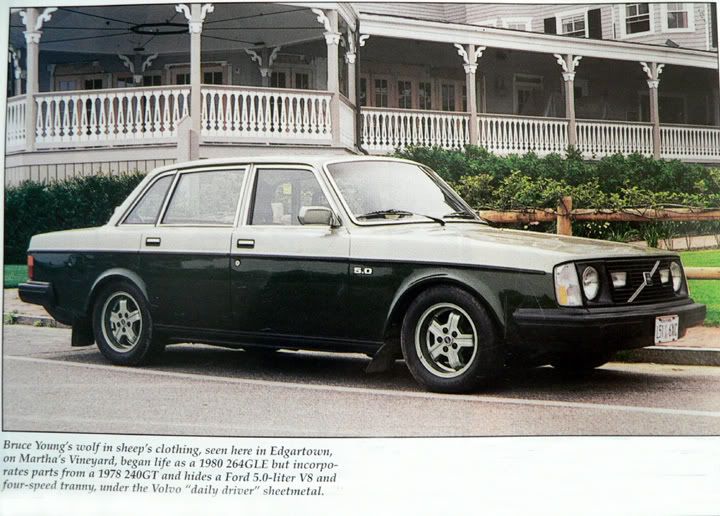
I guess they are rare, and I don't know where I got the few I have. But another way to plug the MC ports for testing is to buy a short (1') line with the correct fitting on each end, cut it in two, then fold the cut ends over and hammer them flat—thus making them into plugs.
I haven't bought any in some time, but Pep Boys had 2 types of lines with "metric" fittings—Japanese and European. I think the Japanese (also 11mm hex) have a different thread pitch, so they won't work.
I really can't believe you hurt the MC, but hope you can plug those ports and do the test. The pedal should be hard as a rock. I did it once when I thought I had MC problems, but didn't.
Did you get a chance to check for "mismatched" caliper halves? We had a case of that on the BB recently. I once got a nice new-looking caliper at the boneyard that turn out to be mismatched. I never heard of it till then, but others have posted about it since I did.
--
Bruce Young,
'93 940-NA (current), '80 GLE V8 (Sold), '86 240dl, '85 244 ti, '83 245t
'76 244 (R.I.P at 255k), 73 142 (98K), '71 144 (ex circle track car)
Used '70 144 from '78 to '92, New 144 from '67 to '78, Used '62 122 from '63 to '67
|
|
|
|
|
I think that I might be able to plug the bench bleed kit screws into the holes and plug them to test the cylinder. Heck, I'll probably bench bleed it again, then do that test. we'll see what happens. I'm also going to build a ghetto pressure bleeder with a preston valve that I have and a reservoir cap that I'm going to buy from a wrecker tomorrow (unless someone near Waterloo, ON has one I could use). I won't get a chance to check the calipers for a few days, but I really doubt they are mismatched. As I look through my records, I realized that I got my calipers from that Volvo and Saab auto dismantlers in California, so they were probably off a wreck. They looked pretty much new when I got them....but still, a bleeder screw had to break. Anyways, in a couple days I'll go at it again and see what I can figure out. Thanks again to you and everyone else for your help...I've been on this board nearly three years, and I do know a lot now, but there's still plenty of things that I just can't figure out, and it's so nice to have a community of people to help you narrow down the possibilities. thanks again,
Nate Gundy
--
'86 240DL sedan, 260K miles, M46, K cam, 25/21mm sways, 260 front springs, wagon rear springs...working on my valve spring compressor website...
|
|
|
|
|
I think that I might be able to plug the bench bleed kit screws into the holes and plug them to test the cylinder.
I thought of that too. But have doubts that they would take the pressure, since that's not their purpose. Do they have the same "bulb-shaped" tip at the end like the lines do?. If so, they might be OK when screwed down tight. Otherwise, I wouldn't trust them. You don't want to shoot fluid on the engine.
--
Bruce Young,
'93 940-NA (current), '80 GLE V8 (Sold), '86 240dl, '85 244 ti, '83 245t
'76 244 (R.I.P at 255k), 73 142 (98K), '71 144 (ex circle track car)
Used '70 144 from '78 to '92, New 144 from '67 to '78, Used '62 122 from '63 to '67
|
|
|
|
|
Nate,
Mapleleaf's comment on reversed calipers reminded me that rebuilders some times get the Left and Right halves of a single caliper paired up INCORRECTLY.
Check the TOP of each front caliper, right near the mating joint between the two halves. The surface should be free of any punch marks.
Then look up at the BOTTOM of each one. You should see a good-sized "dimple" on each half, near the joint line (within 1/2" or so).
If you DO see a dimple on the top of either half (or don't see the "match marks" on the bottom of each half), that caliper has an unbleedable lower, outside passage, which may contain trapped air.
--
Bruce Young,
'93 940-NA (current), '80 GLE V8 (Sold), '86 240dl, '85 244 ti, '83 245t
'76 244 (R.I.P at 255k), 73 142 (98K), '71 144 (ex circle track car)
Used '70 144 from '78 to '92, New 144 from '67 to '78, Used '62 122 from '63 to '67
|
|
|
|
|
Look carefully at each caliper and be sure the bleeder screws are located at the TOP of each cylinder. I've seen L&R calipers swapped or wrong side replacements making it almost impossible to properly bleed with the caliper bolted in place. However, it can be done by unbolting and holding the caliper upside-down to bleed, and then bolt it back. Unless you're the original owner and the only servicer - you can't be sure of every past repair.
That said; using the correct sequence, the best method of bleeding is a low pressure adapter (the kind many Volvo guys use) or a gravity drip (the simple but slow one-man method I've used for years). Manual pumping of the pedal simply aerates the fluid meaning you have to get "foam" to move down the line toward the bleeder. In some vehicles, there are pockets in the system that could allow liquid to drip past the foam while the foam stayed trapped. Ask any mechanic that tried bleeding early rear disc eqipped GM cars 16 times and STILL never got the pedal back to factory height. Leave the brake pedal untouched for 1/2 hour and try one of these methods.
|
|
|
|
|
hi nate. alot of posts about m.c. quality say purchase a.t.e. brand m.c. i got one from fcp groton for 55.00$ plus shipping. if your pedal is slowly sinking and there is no leaks. the m.c. must be bad. but try the test doug suggests . good luck
|
|
|
|
|
I had this issue when I replaced the MC on my '86. Took it all back out, bench bleed, put it all back together for a full system bleed. It worked.
Absolutely new or rebuilt new? If the latter, I had a Raybestos one go bad. A Canadian rebuilt was all fine, bought at Autozone, as I needed it that very day.
-- Kane ... one of the circuits failed going downhill on a street named Turnbull Canyon Rd.
--
Blossom II - '91 745Ti/M46 ... Bubbles - '74 144GL/BW35 ... Buttercup - '86 245GL/AW70 ... The Wayback Machine - '64 P220/M40
|
|
|
|
|
If the pedal "firm point" rises and hardens with 3 or 4 pumps, there is air in the either or both systems.
You can test the MC if you have two short 10mm x 1.0mm bolts and sealing washers.
1) Block the pedal about 1.5" depressed.
2) Replace the lines with the two bolts, sealing the MC ports.
3) Remove the pedal block and press on the pedal.
If the pedal sinks, the MC seals are bad. If the pedal is hard, the MC is OK.
As for the bleeding, I don't know what sequence you used, but offer the following:
"The 240 brakes have two separate hydraulic systems. The recommended bleeding sequence does each system separately, as follows (either A or B can be done first):
System A:
1) Left rear
2) Left front - Upper piston chamber (single bleeder, top)
3) Right front - Upper piston chamber (single bleeder, top)
System B:
4) Right rear
5) Right front - Lower piston chamber ( inner and outer bleeders, either first)
6) Left front - Lower piston chamber ( inner and outer bleeders, either first)
The upper piston chambers in #2 and #3 are basically an inverted "U", with the bleeder at the highest point. The lower piston chambers (#5 and #6) are like an upright "U", with bleeders at the two high points."
--
Bruce Young,
'93 940-NA (current), '80 GLE V8 (Sold), '86 240dl, '85 244 ti, '83 245t
'76 244 (R.I.P at 255k), 73 142 (98K), '71 144 (ex circle track car)
Used '70 144 from '78 to '92, New 144 from '67 to '78, Used '62 122 from '63 to '67
|
|
|
|
|
When you pump the pedal till it gets firm and hold the pedal down, does it stay firm? If so, your MC is OK. If it gets spongy quickly after you pump the pedal firm, then your MC is probably bad, for whatever reason.
|
|
|
|
|
When I pump the pedal till it's firm, it will still sink back down to the floor eventually. Even with the car off and power assist off, The pedal will go about 3 inches after pumping it a bunch, before it gets really hard. You're thinking the MC is bad? What could I have done to ruin a new MC? thanks
Nate Gundy
--
'86 240DL sedan, 260K miles, M46, K cam, 25/21mm sways, 260 front springs, wagon rear springs...working on my valve spring compressor website...
|
|
|
|
|
When I pump the pedal till it's firm, it will still sink back down to the floor eventually. Even with the car off and power assist off, The pedal will go about 3 inches after pumping it a bunch, before it gets really hard. You're thinking the MC is bad? What could I have done to ruin a new MC?
Given your description it's possible you've got a bad MC, but I wouldn't assume it was your fault. And it still would be worthwhile to go through the whole process again - bench bleed, then bleed all 4 wheels, etc. - before you exhange the MC for another one. Depending on what you mean by "eventually," I guess it's still possible that there's some air somewhere. But it's unlikely. When you pump the system, it compresses the air to the point where the pedal is firm, and unless you take your foot off the pedal, the air should stay compressed. So if all the air is compressed in the system to the point of firmness and the pedal still sinks, the most common explanation is that fluid is getting past the seal in the MC.
I've had bad MCs from Kragen and Autozone in the past.
|
|
|
|
|
Nate,
I was too hasty in my previous post when I said (in testing the MC with ports blocked), "If the pedal sinks, the MC seals are bad....".
I should have added, "or the bench bleeding was incomplete."
--
Bruce Young,
'93 940-NA (current), '80 GLE V8 (Sold), '86 240dl, '85 244 ti, '83 245t
'76 244 (R.I.P at 255k), 73 142 (98K), '71 144 (ex circle track car)
Used '70 144 from '78 to '92, New 144 from '67 to '78, Used '62 122 from '63 to '67
|
|
|
|
|
i've had trouble in the past with cylinders not ate. so, that's all i'll do now. bench bleed the master, then bolt it to the booster. jack the rear up a little higher than the front, making the master cyl level. open both the bleeders on the rears and the very top ones on the front. let it drip-gravity and keep the master full. if 1 doesn't drip, close the rest and SLIGHTLY AND SOFTLY push the pedal with your hand. don't go more than halfway to the floor. this should start it flowing. close 'em all and softly push the pedal to build it up. if this doesn't do it and there is no air in the system, the master is defective. good luck, chuck.
|
|
|
|
|
Never forget
New does not necessarily = good.
defective in the box happens with even the most expensive of replacement parts, including engines and everything smaller.
|
|
|
|
|


